
February 2, 2026
One of the most common questions raised by safety officers, contractors, and site engineers is about the minimum height at which a fall arrest system becomes necessary. Many workplace accidents occur not from extreme heights, but from relatively low elevations where fall risks are often underestimated.
Understanding the minimum height for using a fall arrest system is essential for protecting workers, meeting safety requirements, and avoiding preventable injuries. Height alone does not define risk. The type of work, surface conditions, and exposure to edges all play a role in deciding when fall protection is required.
Is There a Fixed Minimum Height for Fall Arrest Systems
There is no single universal height that applies to all work environments. The minimum height for a fall arrest system depends on applicable safety regulations, industry standards, and site conditions.
In many industrial and construction settings, fall protection is required when a worker is exposed to a fall hazard at a height of 1.8 meters or more. In some industries, the requirement may start at 1.2 meters, especially when working near dangerous equipment, sharp edges, or hazardous surfaces.
The key factor is not just height, but the presence of a fall hazard.
Why Height Alone Is Not Enough to Decide
A fall from a lower height can still result in serious injury or fatality. The risk increases when the fall surface includes machinery, sharp edges, or uneven ground.
Factors that influence fall arrest system requirements include:
- Distance to the next lower level
- Surface condition below the work area
- Possibility of striking structures during a fall
- Worker movement and task complexity
- Frequency and duration of exposure
This is why many safety standards require fall protection whenever a worker is exposed to an unprotected edge, regardless of height.
Typical Height Guidelines Across Work Environments
While regulations may vary, the following height guidelines are commonly used as reference points.
Construction and Infrastructure Sites
Fall arrest systems are typically required when workers are exposed to falls of 1.8 meters or more, especially on scaffolding, formwork, and open edges.
Industrial Plants and Maintenance Work
Fall protection is often required at heights starting from 1.2 to 1.5 meters, particularly when working near machinery, pits, or hard surfaces.
Rooftop and Edge Work
Roof edges, skylights, and fragile surfaces require fall protection regardless of height. Even short falls from rooftops can result in severe injuries.
Ladders and Vertical Access
Ladder safety systems and vertical fall arrest systems are required when climbing fixed ladders beyond a certain height, typically above 3 meters, depending on site conditions.
At this stage, many organizations struggle to interpret height rules correctly for their specific site.
If you are unsure whether your work area requires a fall arrest system, Indian Inovatix can help assess your site conditions and recommend the right height safety solution based on actual risk, not assumptions. Contact us to discuss your application and compliance needs.
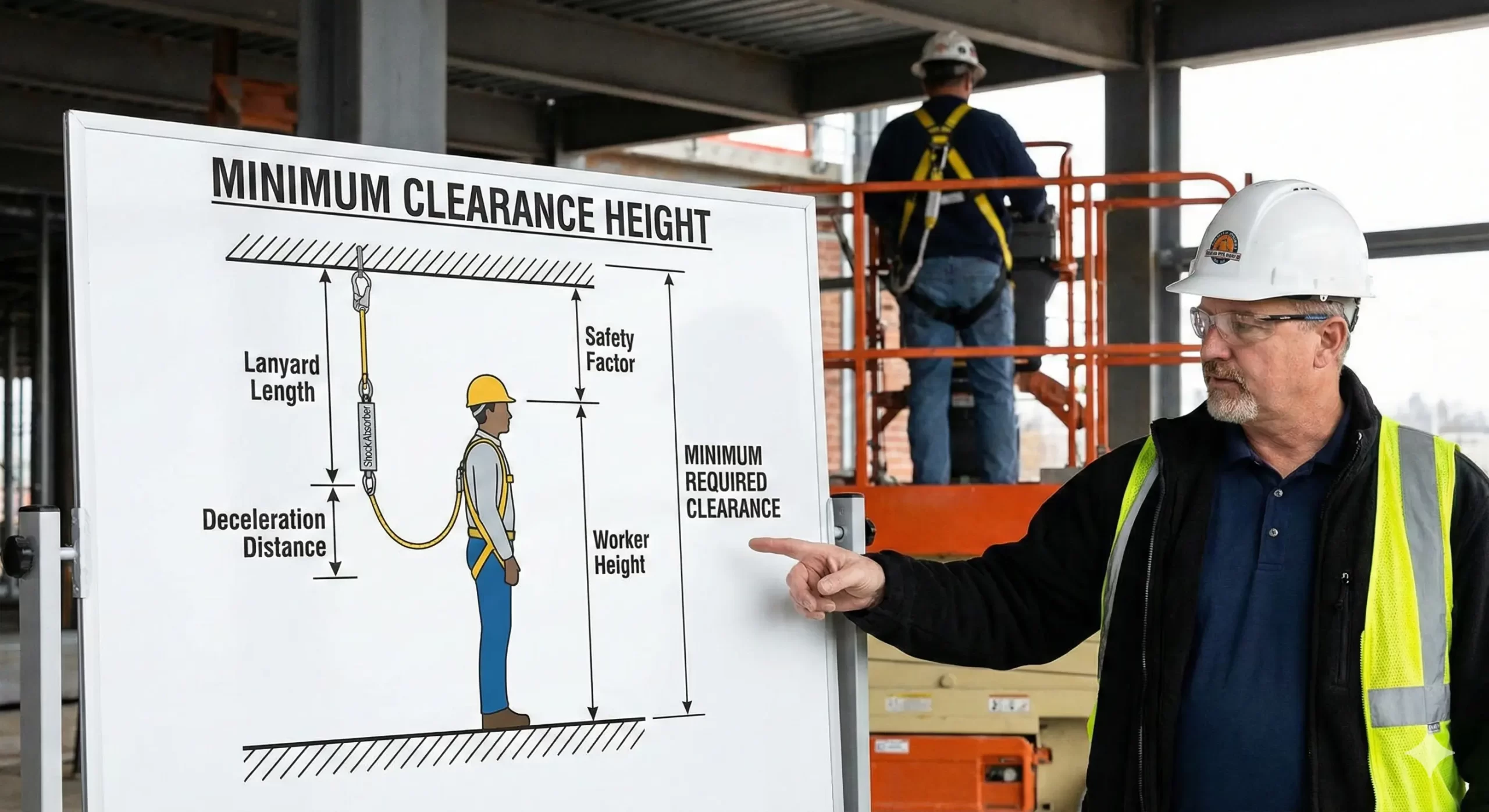
Minimum Height vs Fall Clearance
It is important to understand the difference between minimum height and fall clearance.
- Minimum height refers to when fall protection is required.
- Fall clearance refers to the vertical space needed for a fall arrest system to stop a fall safely without hitting a lower level.
Even if fall protection is required at a low height, there must be enough clearance to safely arrest a fall. This includes:
- Free fall distance
- Deceleration distance
- Harness stretch
- Worker height
- Safety margin
In low clearance environments, systems such as self retracting lifelines are often required.
When Fall Arrest Systems Are Mandatory Regardless of Height
In some situations, fall arrest systems are required even at minimal heights.
These include:
- Work near unprotected edges
- Roof openings and skylights
- Fragile or brittle surfaces
- Work above hazardous equipment
- Vertical access, such as ladders or shafts
In these cases, the risk of injury is high even from short falls.
Common Mistakes When Interpreting Height Requirements
Many workplace incidents occur due to incorrect assumptions.
Common mistakes include:
- Believing fall protection is only needed above a specific height
- Ignoring fall hazards below waist level
- Using harnesses without proper anchorage
- Selecting systems without calculating fall clearance
- Failing to plan rescue operations
Correct system selection requires a full risk assessment, not just height measurement.
Choosing the Right Fall Arrest System Based on Height
Selecting the right system depends on available clearance and movement needs.
- For low clearance areas, self retracting lifelines reduce fall distance
- For rooftops and long movement zones, horizontal lifelines provide continuous protection
- For ladders, vertical fall arrest systems ensure safe ascent and descent
System selection must always match both height and task conditions.
Role of Risk Assessment in Height Safety
A proper risk assessment helps determine:
- Where fall protection is required
- What type of system is suitable
- How workers will move safely
- What rescue method will be used
Height safety decisions should always be supported by documented assessments and trained personnel.
Why Indian Inovatix Supports Height Based Safety Planning
Indian Inovatix designs and supplies fall arrest systems for rooftops, ladders, industrial plants, and infrastructure projects. Our approach focuses on real site conditions rather than generic height rules.
Indian Inovatix supports organizations with:
- Site specific fall risk assessment guidance
- Certified fall arrest systems
- System selection based on clearance and movement
- Support for inspection, training, and rescue planning
Conclusion
There is no single minimum height that applies to every workplace. Fall arrest systems are required whenever a worker is exposed to a fall hazard that could cause injury. Height, surface conditions, movement, and clearance must all be considered together.
Understanding these factors helps organizations make informed safety decisions and avoid preventable accidents.
Every worker deserves safety. If you need help determining the correct fall arrest system based on height, clearance, and site conditions, contact or enquire now with Indian Inovatix for expert guidance and compliant height safety solutions.
Frequently Asked Questions
1. What is the minimum height for using a fall arrest system
There is no single fixed height. Fall arrest systems are required whenever a worker is exposed to a fall hazard that could cause injury. In many workplaces, this starts between 1.2 and 1.8 meters.
2. Is fall protection required below 1.8 meters
Yes. Fall protection may be required below 1.8 meters if workers are near unprotected edges, machinery, or hazardous surfaces
3. Does height requirement differ by industry
Yes. Construction, industrial maintenance, rooftop work, and ladder access may have different height thresholds based on risk and regulations.
4. What matters more than height when selecting fall protection
Exposure to fall hazards, surface conditions, worker movement, and fall clearance are often more important than height alone.
5. What is fall clearance and why is it important
Fall clearance is the vertical space required to safely stop a fall without hitting a lower level. It determines which type of fall arrest system can be used.
6. Are fall arrest systems mandatory on rooftops
Yes. Rooftops with unprotected edges, skylights, or fragile surfaces require fall protection regardless of height.
7. Can self retracting lifelines be used at low heights
Yes. Self retracting lifelines are commonly used where fall clearance is limited.
8. Who decides when a fall arrest system is required
A competent safety professional or risk assessment team determines the requirement based on site conditions and applicable standards.
9. Is rescue planning required when using fall arrest systems
Yes. A rescue plan is essential to safely retrieve a worker after fall arrest.
10. Can fall arrest systems be customized based on height
Yes. Systems can be designed to suit available clearance, movement needs, and work conditions.
Latest Post
- March 28, 2026 Why Is Fall Protection Important on Site? A Complete Guide for Industrial Safety
- March 24, 2026 Work at Height Safety: Hazards, Precautions, and What OSHA Defines
- March 18, 2026 Common Mistakes Seen During Safety Audits in Fall Protection Systems
- March 15, 2026 Safety Connector Buying Checklist for Industrial Applications

Corporate Profile
Download CatalogueTalk to Our Safety & Protection Specialists
Have questions or need guidance? Our experts can help you choose the most reliable and high-performance safety solutions tailored to your industry and site requirements.
-

- Call Us +91-8849452638
Need Help Determining the Right Fall Protection for You?
With our vast experience, our experts will assist you in selecting the most relevant system for your needs.