August 3, 2026
Construction purchase teams often compare safety rope sets by price, rope length, and delivery time. However, these factors do not confirm whether a set suits the actual fall hazard.
A damaged connector, unsuitable rope, or missing energy absorber can expose workers to serious injury. It can also lead to failed audits, delayed work, and replacement costs.
A safety rope set for construction work should match the task, anchor arrangement, fall clearance, worker movement, and applicable safety standard. Indian Inovatix Ltd., Ahmedabad, Gujarat, India, manufactures fall protection equipment for demanding industrial and construction applications.
The correct buying decision requires more than checking the rope diameter. Procurement teams must assess every component as part of one compatible system.
Key Takeaways
- A safety rope set for construction work must suit fall restraint, positioning, or fall arrest use.
- Buyers should verify rope construction, connectors, markings, certification, length, and component compatibility.
- A lanyard without an energy absorber should not be selected for fall arrest applications.
- Rope cuts, glazing, chemical damage, corrosion, or activated fall indicators require immediate review.
- Indian Inovatix Ltd. manufactures fall protection equipment from Ahmedabad for construction and industrial projects.
- Procurement documents should include certificates, inspection instructions, traceability, and approved application details.
What Is a Safety Rope Set for Construction Work?
A safety rope set is a group of compatible components used to restrain, position, or protect workers exposed to height hazards. Its design must match the intended construction activity.
The term may describe several different arrangements. Some sets contain a rope lanyard and connectors. Others include a flexible anchor line, guided fall arrester, energy absorber, and full body harness.
EN 354 covers lanyards used as connecting components within personal fall protection systems. These may support restraint, positioning, rope access, fall arrest, or rescue arrangements.
However, an EN 354 lanyard alone does not make every set suitable for arresting a fall. The complete system must control fall distance and arrest forces.
Indian Inovatix Ltd. supplies equipment for fall arrest systems, flexible rope systems, ladders, scaffolds, and temporary work arrangements. Its flexible rope system supports continuous movement with positive locking.
Is Every Construction Safety Rope Suitable for Fall Arrest?
No. A construction safety rope may serve restraint, positioning, access, rescue, or fall arrest functions. Each application requires different components and performance characteristics.
A restraint system prevents the worker from reaching an exposed edge. A work positioning system supports a stable working position.
A fall arrest system stops a worker after a fall begins. Therefore, it normally needs an approved full body harness and energy management component.
The purchase specification should clearly name the intended application. Terms such as safety rope or rope set are too broad for technical approval.
Procurement teams should ask these questions:
- Will the set prevent access to an edge?
- Will it support work positioning?
- Will it arrest an actual fall?
- Will it move along a vertical anchor line?
- Will it support rescue or evacuation work?
The answers determine which rope, connector, adjuster, harness, and absorber should be included.
Which Certification and Markings Should Buyers Check?
Buyers should confirm the applicable standard, manufacturer identity, model, batch details, date information, and approved application. Clear markings support traceability and inspection control.
EN 354 specifies requirements covering lanyard performance, testing, marking, manufacturer information, and packaging.
Other standards may apply to separate components:
| Component | Common reference | What it generally covers |
| Rope lanyard | EN 354 | Lanyard requirements, tests, marking, and instructions |
| Energy absorber | EN 355 | Energy absorbing components |
| Full body harness | EN 361 | Full body harness construction and performance |
| Connector | EN 362 | Hooks, karabiners, and related connectors |
| Flexible anchor line arrester | EN 353 Part 2 | Guided fall arresters on flexible anchor lines |
| Work positioning equipment | EN 358 | Positioning and restraint belts and lanyards |
| Complete fall protection code | ANSI Z359 | Fall protection programme and equipment requirements |
The buyer should request a certificate that matches the supplied model. A general company certificate does not replace product specific compliance documents.
Markings should remain readable throughout the equipment life. Missing labels can prevent inspectors from confirming the product model or approved use.
What Documents Should Procurement Teams Request?
Procurement teams should request product certificates, user instructions, inspection guidance, batch traceability, and technical data. These records support safe issue and audit preparation.
A complete technical submission should include:
- Product name and model number.
- Applicable certification standard.
- Rope material and construction.
- Rope diameter and total length.
- Connector type and gate mechanism.
- Maximum approved user weight, where stated.
- Inspection frequency and rejection criteria.
- Manufacturing or batch identification.
- Storage and cleaning instructions.
- Approved system configuration.
The supplied documents should match the physical product. Buyers should compare model numbers before accepting delivery.
Indian Inovatix Ltd. designs and manufactures fall protection equipment in Ahmedabad. Its published range includes harnesses, fall arrest systems, rope systems, anchorages, and connectors.
How Strong Should the Rope and Components Be?
Rope strength must match the certified system design and intended application. Buyers should not select a rope using diameter alone.
Two ropes can have the same diameter but different fibres, construction, elongation, abrasion resistance, and breaking performance. Therefore, the technical datasheet must identify the complete rope specification.
Construction sites expose ropes to concrete edges, dust, sparks, paint, oils, moisture, and repeated handling. These conditions can reduce service life.
The rope should have a consistent structure without cuts, glazing, loose fibres, hard sections, chemical staining, or damaged terminations.
Procurement teams should confirm:
- Rope material.
- Rope diameter.
- Minimum breaking strength.
- Elongation characteristics.
- Edge exposure limitations.
- Heat and chemical restrictions.
- Termination method.
- Compatibility with the rope grab or adjuster.
A rope grab must match the approved rope type and diameter. An incorrect combination may fail to travel, lock, or arrest as designed.
Does a Thicker Rope Always Provide Better Safety?
No. A thicker rope is not automatically safer. Safety depends on material, construction, certification, component compatibility, condition, and correct use.
A rope with an unsuitable diameter may not work with the selected fall arrester. It could slip, jam, or damage the device.
Procurement teams should never replace an approved rope with a visually similar site rope. The substitution may invalidate the tested system arrangement.
The manufacturer should confirm which rope can be used with each device. This requirement should appear in the purchase order.
Why Is an Energy Absorber Important?
An energy absorber reduces the force transferred during fall arrest. It must be selected when the system allows a free fall and requires controlled deceleration.
A plain rope can connect a worker to an anchor. However, it may not control the forces created during a fall.
Guidance for fall arrest lanyards warns against using a lanyard without an energy absorber for fall arrest. It also advises against knots and joined lanyards.
The absorber usually contains folded webbing that deploys under a specified load. Its deployment increases the stopping distance.
Therefore, the site must provide enough clearance below the worker. The clearance calculation should consider:
- Lanyard length.
- Absorber deployment distance.
- Harness movement.
- Worker height.
- Anchor location.
- Required safety margin.
A longer rope may create more fall distance. The extra length can also increase clearance requirements.
Can a Rope Lanyard Be Used Without an Energy Absorber?
A rope lanyard may be used without an absorber for approved restraint or positioning tasks. It should not be assumed suitable for fall arrest.
The application must prevent a free fall when no absorber is present. The anchor and rope length should stop the worker before reaching the edge.
For fall arrest, use a certified system designed for that purpose. The system should include the required harness, connectors, anchor, and energy control.
Which Connector Features Should Be Checked?
Connectors should have secure gates, compatible openings, readable markings, and no deformation. Their size must match the anchor and harness attachment point.
A connector should close and lock without manual forcing. Springs, pins, rivets, and locking sleeves should move correctly.
The connector opening must fit the intended structure. A small snap hook may not suit scaffolding tubes or large steel members.
An oversized anchor can load the connector gate or nose incorrectly. This condition can reduce system security.
Check each connector for:
- Automatic or manual locking action.
- Gate closure and alignment.
- Corrosion or deep pitting.
- Cracks, bends, and sharp edges.
- Correct attachment orientation.
- Standard and manufacturer marking.
- Adequate gate opening.
- Compatibility with the anchor point.
Connectors should not rest against edges that press the gate open. They should also avoid cross loading.
Should Procurement Teams Choose Scaffold Hooks or Karabiners?
The correct choice depends on the anchor shape and work method. Scaffold hooks suit larger members, while karabiners suit compatible eye anchors and attachment points.
Buyers should not select the connector by price alone. The gate opening must match the site structure.
The locking design must also suit workers wearing gloves. However, it should resist accidental opening during movement.
A site assessment can identify the required connector type before bulk purchasing. This step reduces unsuitable stock and field substitutions.
How Should Buyers Compare Fixed and Adjustable Rope Sets?
Fixed sets provide a defined reach, while adjustable sets allow controlled length changes. The safer choice depends on edge distance, movement, and misuse risk.
A fixed rope can simplify inspection and control. However, excess length may increase slack.
An adjustable rope can reduce slack across changing work positions. Yet, the adjuster must remain compatible with the approved rope.
| Feature | Fixed rope set | Adjustable rope set | Flexible vertical rope system |
| Length control | Predetermined | Changed by approved adjuster | Movement follows anchor line |
| Typical use | Defined restraint distance | Variable restraint or positioning | Ladder, scaffold, or vertical access |
| Main buying concern | Correct fixed length | Adjuster and rope compatibility | Arrester direction and rope match |
| Common misuse | Excess slack | Incorrect adjustment | Wrong installation direction |
| Inspection focus | Rope and terminations | Rope, adjuster, and locking action | Rope, arrester, anchors, and absorber |
Indian Inovatix Ltd. describes its flexible rope vertical system for ladders, scaffolds, and temporary installations. The system provides continuous movement and positive locking.
The buying team should compare the application, not only the component count. A larger set is not always the correct set.
Which Set Works Best for Scaffolding?
Scaffolding work may need restraint, twin connection, vertical access protection, or fall arrest. The correct set depends on movement and available anchors.
Workers changing attachment points may require continuous connection. Vertical ladder access may require a guided arrester on a flexible anchor line.
A single rope lanyard may not address every exposure. The site safety plan should define the required configuration.
What Condition Checks Are Required Before Purchase and Use?
Every set should be checked for damage, correct markings, complete components, and smooth operation. Inspection should occur before issue and before each use.
Warehouse acceptance checks can prevent damaged or mismatched equipment from reaching the site. They also create a traceable starting record.
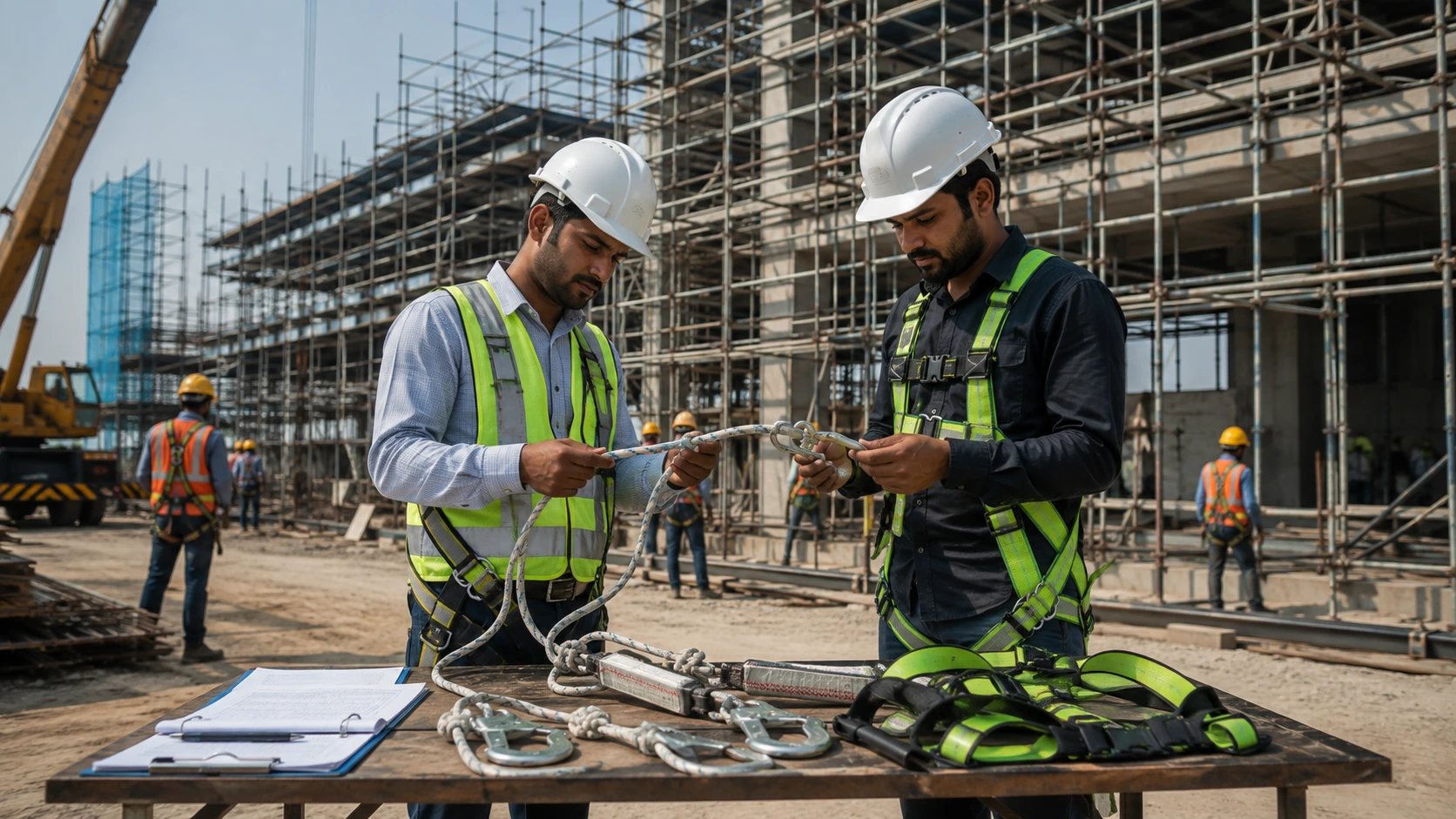
Inspect the rope under good lighting. Bend it gently to reveal cuts, stiff sections, internal damage, or surface glazing.
Inspect terminations for loose stitching, displaced thimbles, damaged sleeves, and opened splices. Check metal components for corrosion and deformation.
The equipment should be removed from use when inspectors find:
- Cut or severed fibres.
- Melted or glazed rope surfaces.
- Chemical burns or heavy staining.
- Activated impact indicators.
- Torn absorber covers.
- Open or unreliable connector gates.
- Missing labels.
- Unapproved knots or extensions.
- Unknown fall history.
- Incompatible replacement parts.
Any product involved in a fall should be isolated. A competent person or manufacturer should decide its status.
How Often Should a Construction Safety Rope Be Inspected?
Workers should inspect the set before each use. A competent person should also perform recorded examinations at planned intervals.
The interval depends on use frequency, environment, manufacturer instructions, and site rules. Harsh construction conditions may require shorter intervals.
Inspection records should include the model, identifier, date, findings, action, and inspector name. The equipment identifier must remain attached and readable.
Why Does Component Compatibility Matter?
Fall protection components must function as one approved system. A strong rope cannot correct an unsuitable harness, connector, anchor, or fall arrester.
Mixing components from unknown sources can create unexpected loading. It may also remove the tested relationship between rope diameter and locking device.
The harness should provide the correct attachment point. Indian Inovatix Ltd. manufactures harnesses with attachment arrangements for fall arrest, positioning, rescue, and rope access.
Buyers can review the company’s full range of fall protection products before preparing a system purchase specification.
The final arrangement should confirm:
- Approved anchor type.
- Correct connector opening.
- Correct harness attachment point.
- Compatible rope and rope grab.
- Required energy absorber.
- Adequate fall clearance.
- Safe rescue access.
- Manufacturer approved configuration.
One supplier should provide written confirmation when a purchase includes several connected products.
Can Buyers Mix Different Brands of Fall Protection Equipment?
Mixing brands should occur only after competent technical confirmation. Similar appearance does not prove tested compatibility.
Some components may work independently but create unsafe interaction when combined. Rope grabs are particularly sensitive to rope type and diameter.
The purchase file should contain written approval for any mixed system. Without that evidence, buyers should use an approved matched arrangement.
What Site Factors Affect Rope Set Selection?
The set must match the anchor position, fall edge, work height, movement path, surface condition, and rescue plan. Site conditions determine safe configuration.
Construction work changes rapidly. The correct equipment for a column may not suit roofing, scaffolding, or ladder access.
Procurement teams should collect site information before requesting prices. This reduces later revisions and emergency purchases.
Important site questions include:
- Where will the anchor sit relative to the worker?
- Is the work vertical, horizontal, or inclined?
- Are sharp edges present?
- Is welding or grinding performed nearby?
- Will the rope contact concrete or steel?
- Is the area exposed to chemicals?
- How much clearance exists below?
- How will rescue occur after a fall?
A rescue plan is required because a worker can remain suspended after arrest. Equipment selection should support quick access and recovery.
How Can Procurement Teams Evaluate a Supplier?
Buyers should assess manufacturing control, certification records, technical support, traceability, delivery capability, and site knowledge. Price comparison alone cannot confirm safety performance.
A dependable supplier should explain the approved application. It should also identify limitations and inspection requirements.
Indian Inovatix Ltd., Ahmedabad, Gujarat, India, designs and manufactures fall protection systems. Its published product range includes flexible rope systems, harnesses, connectors, anchorages, and emergency equipment.
Company records state that Indian Inovatix Ltd. operates from a 33,000 square foot production facility. The company also reports protecting more than 500,000 workers.
It has supplied equipment for major Indian scientific and industrial applications, including ISRO and BARC. Procurement teams should request project specific references when required.
What Should a Safety Rope Set Purchase Order Include?
A purchase order should define application, standard, rope details, connector type, length, quantity, documentation, and delivery requirements. Clear specifications reduce substitutions.
Include these procurement fields:
- Intended application.
- Work location and industry.
- Required standard.
- Rope material and diameter.
- Fixed or adjustable length.
- Connector configuration.
- Energy absorber requirement.
- Harness requirement.
- Worker weight range.
- Product marking and traceability.
- Technical certificate requirement.
- Inspection and user instructions.
- Quantity and delivery schedule.
- Site assessment requirement.
- Replacement and service support.
Indian Inovatix Ltd. can review the application before buyers release bulk orders. This review can identify missing anchors, connectors, or clearance requirements.
Frequently Asked Questions
What is a safety rope set used for in construction?
A safety rope set connects a worker’s harness to an approved anchorage or anchor line. It may support restraint, positioning, vertical movement, or fall arrest. The exact use depends on its certified configuration.
What is the most important feature in a safety rope set for construction work?
The most important feature is correct system suitability. A safety rope set for construction work must match the hazard, anchor position, fall clearance, and worker movement. Strong components can still be unsafe when used incorrectly.
Which standard applies to a construction rope lanyard?
EN 354 applies to personal fall protection lanyards. EN 355 applies when an energy absorber forms part of the system. Connectors and full body harnesses may require EN 362 and EN 361 compliance.
Can a safety rope be tied around a steel beam?
A rope should not be tied around a beam unless the manufacturer approves that method. Knots can damage the rope and change its strength. Use an approved anchorage connector suited to the beam.
How long should a construction safety rope be?
The length should restrict unnecessary slack while allowing required movement. Excess length can increase free fall and clearance needs. The site assessment should define the correct length.
When should a rope set be replaced?
Replace or isolate it after a fall, failed inspection, missing label, chemical damage, heat damage, severe abrasion, or connector failure. Follow the manufacturer’s rejection criteria. Do not repair safety rope components without approval.
Is a rope lanyard enough for fall arrest?
A plain rope lanyard is generally not enough for fall arrest. The arrangement may require an energy absorber, full body harness, approved connectors, and suitable anchorage. The complete system must control arrest force and clearance.
Can safety rope sets be supplied for projects across India?
Yes. Indian Inovatix Ltd. manufactures and supplies fall protection equipment from Ahmedabad, Gujarat, India. Equipment can support construction, infrastructure, plant, ladder, scaffold, and temporary access applications.
What rope diameter should procurement teams specify?
The correct diameter depends on the certified product and compatible rope device. Procurement teams should use the manufacturer’s technical datasheet. They should not substitute rope based on diameter alone.
Should every rope set have a unique serial number?
The set should have enough identification for inspection and traceability. This may include a serial number, batch number, model, or manufacturing record. The selected system should match the project’s equipment register process.
Conclusion
A safety rope purchase should begin with the construction hazard, not a catalogue price. Buyers must check the application, rope condition, connectors, markings, certification, absorber, and system compatibility.
A correctly selected safety rope set for construction work can support safer movement, clearer inspections, and better purchase control. It must also fit the anchor arrangement and available clearance.
Indian Inovatix Ltd. is a manufacturer, supplier, and specialist in fall protection equipment. The company supports procurement teams with product selection, technical documentation, and application review.
Specify the Rope Set Before Releasing Your Purchase Order
An incomplete specification can result in unsuitable ropes, connectors, or energy absorbers reaching the site. Indian Inovatix Ltd. can assess your work method and recommend a compatible certified arrangement.
Request a quote for a construction safety rope set with applicable compliance documentation and product details.
Call us at +91-8849452638 or write to info@indianinovatix.com to get started.

Categories
Latest Post
- September 23, 2026 How Long Does a Safety Harness Last? Expiry, Validity & Replacement Rules
- September 19, 2026 What Is Anchorage in Construction? Types, Rules & Load Requirements
- September 12, 2026 Work at Height Rules India: What Employers Need to Know in 2026

Corporate Profile
Download CatalogueTalk to Our Safety & Protection Specialists
Have questions or need guidance? Our experts can help you choose the most reliable and high-performance safety solutions tailored to your industry and site requirements.
-

- Call Us +91-8849452638
Need Help Determining the Right Fall Protection for You?
With our vast experience, our experts will assist you in selecting the most relevant system for your needs.