November 8, 2026
Climbing fixed ladders on industrial structures exposes workers to serious fall hazards. Telecommunication towers, wind turbines, chimneys and industrial plants often require repeated vertical access. Without continuous fall protection, a single climbing mistake can cause severe injuries and operational disruption.
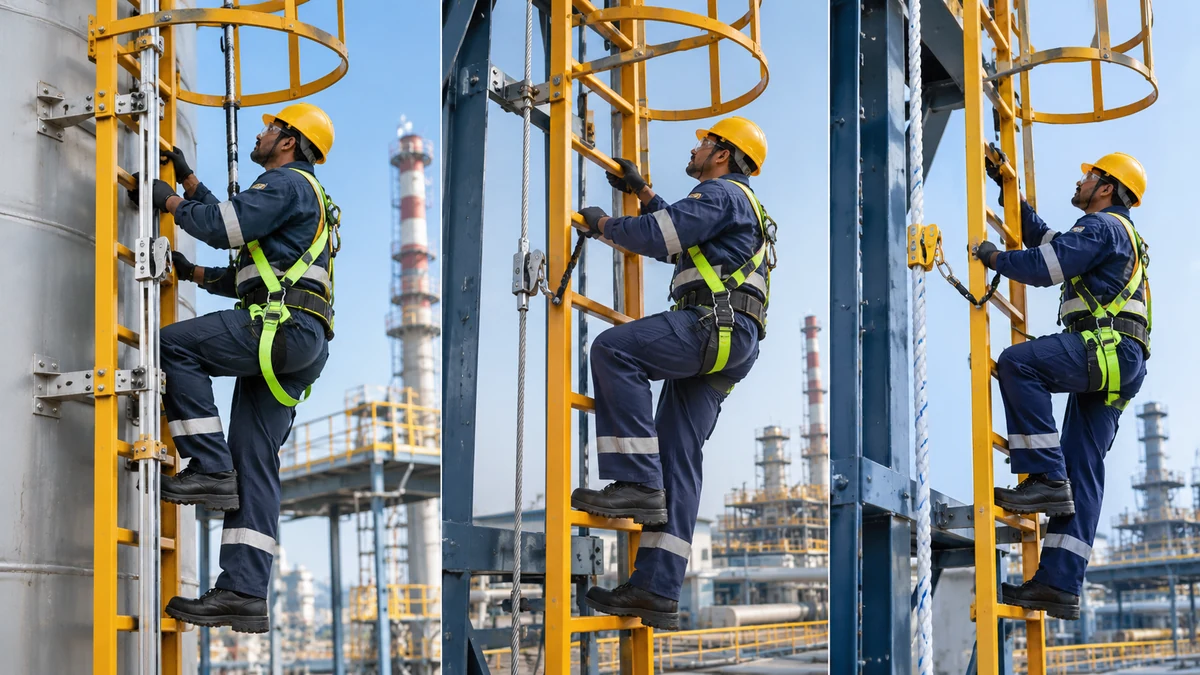
A vertical fall arrest system protects workers while ascending and descending ladders or other vertical structures. It connects the worker to a fixed vertical rail, cable or flexible rope through a compatible guided fall arrester.
However, not every vertical access application requires the same arrangement. Rigid rail, rigid cable and flexible rope systems differ in their construction, installation requirements and intended applications.
Indian Inovatix Limited., Ahmedabad, Gujarat, India, manufactures vertical fall protection equipment for industrial and infrastructure applications. The company manufactured India’s first vertical fall arrest system in 1979.
Understanding the differences between these configurations helps safety officers and EPC contractors select equipment according to ladder design, climbing frequency, environmental conditions and project requirements.
Key Takeaways
- Rigid rail, rigid cable and flexible rope systems provide vertical fall protection through different lifeline configurations.
- Guardall I and Guardall II are Indian Inovatix rigid rail systems designed for vertical climbing applications.
- Rigid cable systems are listed for ladders, scaffolds and temporary installations.
- Flexible rope systems are also listed for ladders, scaffolds and temporary installations.
- Selection depends on ladder geometry, installation conditions, climbing frequency, environmental exposure and equipment compatibility.
- IS 3521 Part 4:2021 is the relevant Indian standard reference for vertical rails and lifelines within the personal fall arrest system series.
What Is a Vertical Fall Arrest System?
A vertical fall arrest system is a guided fall protection arrangement that allows workers to climb vertical structures while remaining connected to a fixed safety line. It uses a rail, cable or rope and a compatible travelling fall arrester.
The system provides continuous attachment during ascent and descent. When the user slips, the guided fall arrester engages according to its design and arrests the fall.
Unlike conventional arrangements that require workers to reposition their connection manually, a compatible guided system moves with the climber.
A typical installation includes:
- Vertical lifeline: A rigid rail, rigid cable or flexible rope installed along the climbing route.
- Guided fall arrester: A compatible travelling device that follows the worker and engages during a fall.
- Full body safety harness: Provides the worker’s body support and designated attachment point.
- Connectors: Connect the guided arrester to the harness according to the manufacturer’s instructions.
- Mounting and anchorage components: Secure the vertical lifeline to the supporting structure.
The complete arrangement must be compatible. Workers must use the specified guided fall arrester with its corresponding rail, cable or rope system.
Where Are Vertical Fall Arrest Systems Used?
These systems support climbing activities where workers need continuous fall protection on fixed vertical access routes.
Common applications include:
- Telecommunication towers requiring regular inspection and maintenance.
- Wind turbines requiring access to elevated equipment.
- Industrial chimneys and stacks requiring inspection.
- FM and television transmission towers.
- Industrial ladders used in manufacturing facilities.
- Vertical access structures in infrastructure projects.
For example, a telecommunications maintenance team may climb a fixed tower ladder several times during routine inspection. A suitable vertical lifeline arrangement provides continuous attachment throughout the climbing route.
What Are the Three Main Types of Vertical Fall Arrest Systems?
The three main configurations are rigid rail, rigid cable and flexible rope. Each uses a different vertical lifeline arrangement and requires a compatible guided fall arrester.
Indian Inovatix manufactures four relevant product configurations: Guardall I, Guardall II, rigid cable and flexible rope.
1. Rigid Rail Fall Arrest Systems
Rigid rail fall arrest systems use a fixed structural rail installed along the climbing route. A compatible travelling sleeve moves along the rail and locks when it detects a fall.
The rail provides a defined climbing path. Its mounting arrangement must suit the ladder structure and installation conditions.
Indian Inovatix offers two rigid rail configurations.
Guardall I: Vertical Fall Arrest System on Rigid Rail
Guardall I is a rigid rail arrangement designed for continuous vertical movement and fall protection.
Its published product features include:
- 100% positive locking.
- Continuous movement with fall protection.
- Corrosion free anodized aluminium rail, GI rail or stainless steel options.
- Virtually no maintenance, as stated on the product page.
The product is listed for ladders, windmills, chimney stacks, telecommunication towers, FM towers and television transmission towers.
Explore the Guardall I rigid rail fall arrest system.
Guardall II: Vertical Fall Arrest System on Rigid Rail
Guardall II is another rigid rail configuration designed for vertical climbing applications.
Its published features include:
- 100% positive locking.
- Continuous movement with fall protection.
- Corrosion free anodized aluminium rail, GI rail or stainless steel options.
- Virtually no maintenance, as stated on the product page.
Its listed applications include ladders, windmills, chimney stacks, transmission towers, telecommunication towers, FM towers and television transmission towers.
The Guardall II product page identifies the same broad rail material options as Guardall I. The exact configuration should be confirmed against the project specification.
Explore the Guardall II rigid rail fall arrest system.
2. Rigid Cable Fall Arrest Systems
A rigid cable fall arrest system uses a fixed vertical cable arrangement with a compatible guided fall arrester. It provides a defined climbing route for workers accessing ladders and other vertical structures.
Indian Inovatix lists this configuration for:
- Ladders.
- Scaffolds.
- Temporary installations.
Its published product advantages include 100% positive locking and continuous movement with fall protection.
The system’s suitability depends on the structure, mounting arrangement, cable specifications and compatible guided arrester.
For EPC contractors, the key consideration is whether the proposed cable configuration suits the ladder geometry and intended installation.
Explore the Vertical Fall Arrest System, Rigid Cable.
3. Flexible Rope Fall Arrest Systems
A flexible rope fall arrest system uses a vertical rope lifeline and a compatible guided fall arrester. The worker remains connected while climbing or descending the designated route.
Indian Inovatix lists its flexible rope configuration for ladders, scaffolds and temporary installations.
Its published advantages include:
- 100% positive locking.
- Continuous movement with fall protection.
Flexible rope arrangements can suit applications requiring a portable or temporary vertical climbing solution, subject to the manufacturer’s specifications and approved configuration.
For example, a project team working across temporary scaffold access points may assess this arrangement when planning vertical access protection.
Explore the Vertical Fall Arrest System, Flexible Rope.
Rigid Rail vs Rigid Cable vs Flexible Rope: What Is the Difference?
Rigid rail, rigid cable and flexible rope systems differ in their vertical lifeline construction, installation requirements and intended applications. The right choice depends on the structure and climbing conditions.
| Comparison factor | Rigid rail | Rigid cable | Flexible rope |
| Lifeline construction | Fixed rigid rail | Fixed cable arrangement | Flexible rope lifeline |
| Guided device | Compatible rail travelling sleeve | Compatible cable guided arrester | Compatible rope guided arrester |
| Movement | Continuous movement along the rail | Continuous movement along the cable | Continuous movement along the rope |
| Listed applications | Ladders, windmills, chimneys and towers | Ladders, scaffolds and temporary installations | Ladders, scaffolds and temporary installations |
| Installation | Rail sections and suitable mounting arrangements | Cable arrangement and suitable mounting components | Rope arrangement and suitable anchorage |
| Main selection consideration | Rail geometry, structure and climbing frequency | Cable configuration and installation conditions | Rope configuration, portability and intended use |
| Indian Inovatix models | Guardall I and Guardall II | Rigid Cable | Flexible Rope |
The table provides a product selection overview. It does not establish that one configuration is universally safer than another.
Actual performance depends on the product specification, supporting structure, installation and compatible travelling device.
Guardall I vs Guardall II: Which Rigid Rail System Should You Choose?
Guardall I and Guardall II are two rigid rail configurations from Indian Inovatix. Both provide continuous movement and positive locking, with applications across ladders and industrial vertical structures.
The available product descriptions list similar application areas and material options. Therefore, selection should not rely on assumed performance differences.
| Selection factor | Guardall I | Guardall II |
| System type | Rigid rail | Rigid rail |
| Locking | 100% positive locking | 100% positive locking |
| Movement | Continuous movement | Continuous movement |
| Rail material options listed | Anodized aluminium, GI and SS | Anodized aluminium, GI and SS |
| Ladder applications | Yes | Yes |
| Windmill applications | Yes | Yes |
| Chimney applications | Yes | Yes |
| Tower applications | Yes | Yes |
The product pages do not provide sufficient comparative technical data to establish differences in load capacity, installation time or performance ratings.
For procurement teams, the correct approach is to request the relevant technical datasheets and confirm the required configuration.
What Should You Check Before Selecting Guardall I or Guardall II?
Before finalising either rigid rail model, assess the following:
- Ladder design: Check rung spacing, ladder width, side rail arrangement and available mounting locations.
- Supporting structure: Confirm that the structure can support the designed installation loads.
- Rail configuration: Review the required rail sections, joints and mounting brackets.
- Climbing requirements: Establish the climbing frequency and number of intended users.
- Environmental conditions: Assess exposure to corrosion, weather and industrial contaminants.
- Technical compatibility: Confirm the correct travelling sleeve, harness connection and installation components.
For example, an EPC contractor installing a ladder access system on a wind turbine should confirm the complete rail arrangement against the tower and ladder drawings.
The same assessment applies to chimney stacks, industrial towers and other permanent climbing structures.
How Do You Choose the Right Vertical Fall Arrest System?
The correct selection depends on the structure, climbing frequency, environmental conditions and intended installation. A site assessment should establish these requirements before procurement.
1. Assess the Structure
Start with the ladder or vertical access structure.
Determine whether it is attached to a steel tower, chimney, wind turbine, industrial building or scaffold.
The mounting configuration must suit the structure. Do not assume that the same arrangement fits every ladder.
2. Determine the Installation Type
Identify whether the system will serve a permanent installation or a temporary application.
Rigid rail and rigid cable arrangements may suit engineered fixed installations. Flexible rope arrangements may suit certain temporary applications.
However, the manufacturer’s approved application and installation instructions must determine the final choice.
3. Consider Climbing Frequency
Frequent climbing may influence the selection of the vertical lifeline arrangement.
For example, wind turbine technicians and telecommunication maintenance teams may repeatedly access the same ladder.
In such cases, evaluate system durability, maintenance requirements and compatibility with the planned climbing activity.
4. Evaluate Environmental Conditions
Outdoor structures may face rain, humidity, dust and corrosive conditions.
Assess the materials, protective finishes and maintenance requirements before selecting the system.
Indian Inovatix lists anodized aluminium, GI and stainless steel options for its Guardall rigid rail systems. The actual material selection should match the environmental assessment.
5. Check Compatibility of the Guided Fall Arrester
The guided fall arrester must match the specified lifeline.
A travelling device designed for one rail, cable or rope configuration must not be assumed compatible with another.
Confirm the equipment model, connector arrangement and harness attachment instructions.
6. Review Technical Documentation
Procurement teams should request the technical datasheet before approving the equipment.
Verify:
- Applicable certification and standard.
- Permitted number of users.
- Product dimensions and material specifications.
- Installation and mounting requirements.
- Compatible guided fall arrester.
- Inspection and maintenance instructions.
- Maximum permitted system length and relevant limitations.
The published product pages do not disclose all these technical values. Obtain the current manufacturer documentation before finalising specifications.
Which Industries Need Ladder Fall Arrest Systems?
A ladder fall arrest system is useful wherever workers repeatedly climb fixed vertical structures. The equipment selection depends on access height, structure design and operating conditions.
Telecommunications
Telecommunication technicians climb towers to inspect antennas, cables and associated equipment.
A suitable vertical lifeline arrangement supports continuous attachment during ascent and descent.
Wind Energy
Wind turbine maintenance requires access to elevated equipment and internal climbing routes.
Rigid rail configurations may be considered where the ladder and installation design support the selected arrangement.
Power and Transmission Infrastructure
Transmission towers require periodic inspection and maintenance. Workers need appropriate climbing protection that matches the tower’s ladder arrangement.
Industrial Chimneys and Stacks
Chimneys and stacks require vertical access for inspection and maintenance. The selected system must suit the structure’s geometry and environmental exposure.
Manufacturing Facilities
Industrial facilities may have elevated ladders for tanks, platforms, machinery and other equipment.
A suitable vertical protection arrangement can support routine access and maintenance activities.
What Safety Standards Apply to Vertical Fall Arrest Systems in India?
Vertical fall arrest systems must meet the requirements applicable to their equipment category, intended use and installation. Procurement teams should verify the current Indian standards and relevant product certifications.
One important reference is the IS 3521 series, which addresses personal fall arrest system equipment.
IS 3521 Part 4:2021 covers vertical rails and lifelines within this series. Buyers should verify the exact applicable requirements and conformity documentation for the selected product.
EN 353-1:2014+A1:2017 is another relevant standard reference for guided type fall arresters that include a rigid anchor line.
For procurement and compliance reviews, examine the following:
- Product certification and applicable standard.
- Manufacturer’s technical datasheet.
- Installation and mounting instructions.
- Compatible guided fall arrester documentation.
- Harness compatibility.
- Inspection and maintenance requirements.
- User training and rescue procedures.
Certification of an individual component does not automatically establish compliance of every installed system. The complete configuration and installation must meet the applicable requirements.
How Should Vertical Fall Arrest Systems Be Inspected and Maintained?
Regular inspection helps identify damage, installation problems and equipment defects before workers use the system. Follow the manufacturer’s inspection and maintenance instructions.
Before Each Use
Workers should check the following:
- The guided fall arrester moves correctly along its designated lifeline.
- The locking mechanism operates according to the manufacturer’s instructions.
- The rail, cable or rope shows no visible damage.
- Connectors and attachment points remain in proper condition.
- The harness and connecting components have no visible defects.
- No obstruction prevents the travelling device from moving correctly.
Periodic Inspection
A competent person should inspect the complete installation at the prescribed intervals.
The inspection should cover the lifeline, mounting components, connections and travelling device.
For outdoor installations, environmental exposure and corrosion should also form part of the assessment.
Training and Rescue Planning
Workers must receive suitable instruction before using the system.
Training should cover correct harness attachment, guided arrester operation, pre-use checks and safe climbing procedures.
A rescue plan must also be available. If a fall occurs, the organisation should have a suitable method for recovering the suspended worker.
Frequently Asked Questions
What is a vertical fall arrest system?
A vertical fall arrest system protects workers while climbing ladders and vertical structures. It uses a rigid rail, cable or flexible rope with a compatible guided fall arrester. The device follows the climber and engages when a fall occurs.
What are the three types of vertical fall arrest systems?
The three main configurations are rigid rail, rigid cable and flexible rope. Indian Inovatix offers Guardall I and Guardall II rigid rail systems, along with rigid cable and flexible rope configurations. Each requires its compatible guided fall arrester.
What is the difference between rigid rail and rigid cable fall arrest systems?
Rigid rail systems use a fixed structural rail, while rigid cable systems use a cable lifeline. Both allow a compatible guided device to travel with the worker. Selection depends on the structure, mounting arrangement and product specifications.
What is Guardall I?
Guardall I is an Indian Inovatix rigid rail fall arrest system designed for continuous vertical movement and positive locking. Its listed applications include ladders, windmills, chimney stacks and transmission towers. It is available with anodized aluminium, GI or stainless steel rail options.
What is the difference between Guardall I and Guardall II?
Both are rigid rail systems with continuous movement and positive locking. Their published product descriptions list similar applications and rail material options. Consult the manufacturer for detailed technical differences and the appropriate product configuration.
Is a flexible rope system suitable for temporary ladder installations?
Indian Inovatix lists its flexible rope system for ladders, scaffolds and temporary installations. The actual suitability depends on the structure, approved configuration and manufacturer instructions. Always verify the compatible guided fall arrester.
Which standard applies to vertical fall arrest systems in India?
IS 3521 Part 4:2021 is a relevant Indian standard reference for vertical rails and lifelines. EN 353-1:2014+A1:2017 is another relevant standard for guided fall arresters with rigid anchor lines. Confirm the exact certification and applicable requirements for the selected product.
Can one guided fall arrester work with rail, cable and rope systems?
Not necessarily. Guided fall arresters are designed for specific lifeline configurations. Use only the device approved for the corresponding rail, cable or rope system.
Where are ladder fall arrest systems commonly used in India?
They are used in telecommunication towers, wind turbines, industrial chimneys, transmission infrastructure and manufacturing facilities. Inovatix manufactures vertical climbing protection equipment in Ahmedabad, Gujarat, India, for industrial and infrastructure applications.
How often should a vertical fall arrester be inspected?
Inspect the equipment before every use and arrange periodic inspections according to the manufacturer’s instructions. A competent person should examine the complete installation at the specified intervals. Remove defective equipment from service until appropriately assessed.
Conclusion
Rigid rail, rigid cable and flexible rope systems serve different vertical access requirements. The right selection depends on the ladder design, supporting structure, climbing frequency, environmental conditions and compatibility of the guided fall arrester.
Indian Inovatix Limited., Ahmedabad, Gujarat, India, manufactures vertical fall protection equipment for industrial and infrastructure applications. Its manufacturing history includes India’s first vertical fall arrest system in 1979, followed by decades of product development and manufacturing experience.
A properly selected vertical fall arrest system must include compatible equipment, suitable installation, documented inspection and worker training. These factors help organisations establish reliable protection for routine climbing activities.
Is Your Ladder Installation Matched to the Right Fall Arrest System?
Selecting between Guardall I, Guardall II, rigid cable and flexible rope requires more than comparing product names. Your ladder geometry, climbing frequency and installation conditions determine the appropriate configuration.
Indian Inovatix manufactures these vertical fall protection solutions for industrial and infrastructure applications.
Request a technical consultation and quote for the appropriate vertical ladder fall arrest system for your project.
Call us at +91-8849452638 or write to info@indianinovatix.com to get started.


Talk to Our Safety & Protection Specialists
Have questions or need guidance? Our experts can help you choose the most reliable and high-performance safety solutions tailored to your industry and site requirements.
-

- Call Us +91-8849452638
Need Help Determining the Right Fall Protection for You?
With our vast experience, our experts will assist you in selecting the most relevant system for your needs.