September 19, 2026
Construction work at height requires more than a safety harness and lanyard. The connection between the worker’s fall protection system and the structure is equally important. Understanding what is anchorage in construction helps safety teams select suitable anchor points and design safer fall protection systems.
An anchorage provides the structural connection for a fall arrest, restraint, or positioning system. Its capacity depends on the anchor design, supporting structure, installation method, load direction, and complete system configuration.
Indian Inovatix Limited, Ahmedabad, Gujarat, India, manufactures and supplies permanent and temporary anchorage systems for construction, roofing, industrial, infrastructure, and maintenance applications. Its anchorage range includes fixed beam anchors, parapet anchors, reusable roof anchors, single point anchors, container posts, and door window anchors.
Key Takeaways
- What is anchorage in construction? It is the structural connection point used to attach a fall protection system to a building, structure, or approved support.
- Construction anchorage points must match the structure, application, load direction, and number of workers connected.
- OSHA construction requirements specify 5,000 pounds, or 22.2 kN, per attached worker unless an alternative qualified person design provides a safety factor of at least two.
- Common types include fixed beam anchors, roof anchors, parapet anchors, single point anchors, and temporary anchors.
- Anchorage selection should consider certification, structural capacity, installation method, inspection, compatibility, and rescue requirements.
What Is Anchorage in Construction?
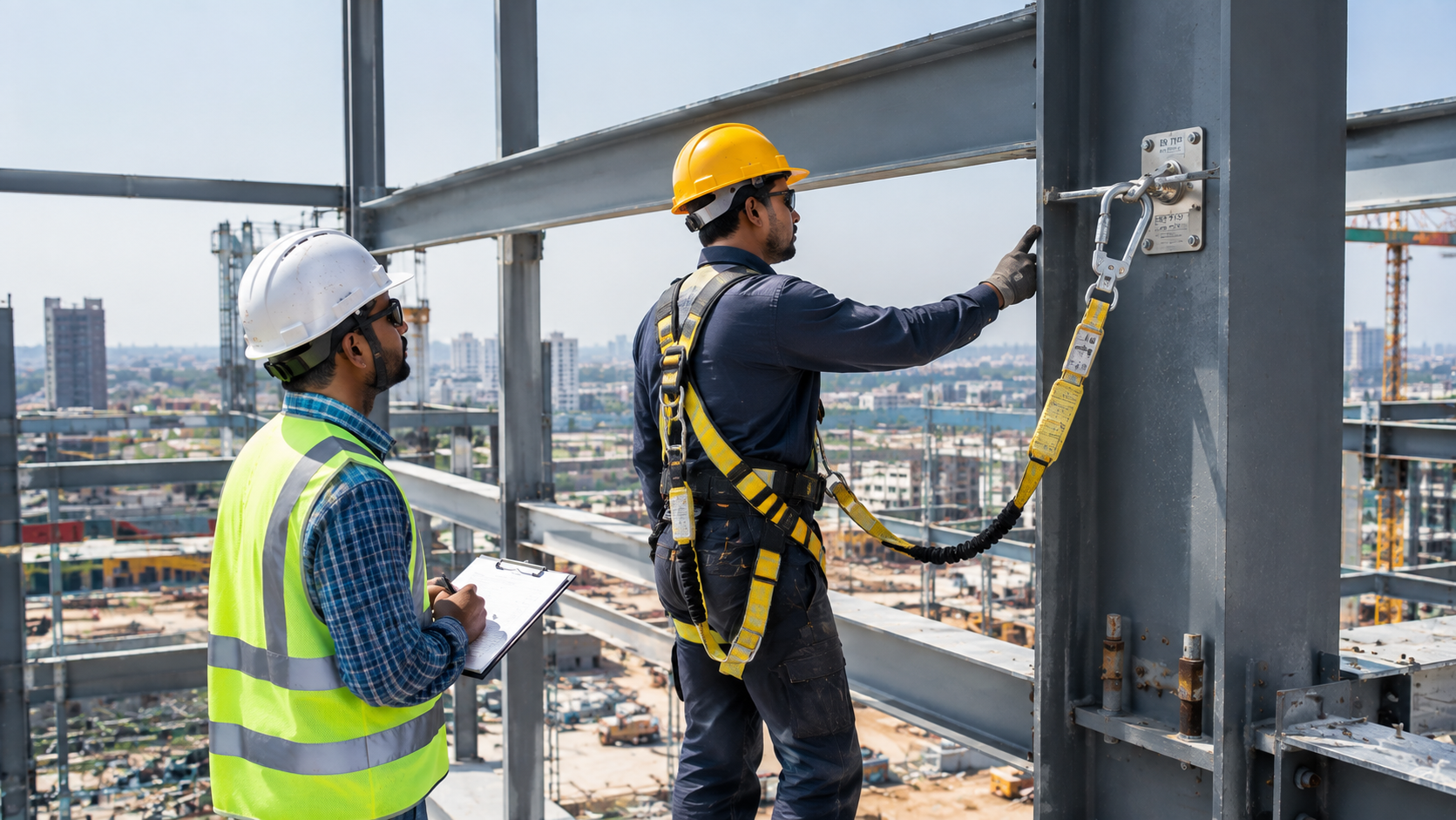
Anchorage in construction is a secure structural connection used to attach personal fall protection equipment to a building or supporting structure. It transfers forces from the fall protection system into the structure.
An anchorage can be permanent or temporary. The correct solution depends on the construction activity, structure, worker movement, and fall protection method.
For example, a steel beam may accommodate a beam anchor, while a roof may require a certified roof anchor. A parapet edge may require a suitable parapet anchor designed for that application.
The anchorage is only one part of the complete system.
A typical arrangement is:
Worker → Full body harness → Connector → Anchorage → Supporting structure
Every component must be compatible. A strong harness cannot compensate for an unsuitable anchor or weak supporting structure.
Indian Inovatix manufactures anchor systems for different structural applications and identifies construction and roofing among their applications.
Why Are Construction Anchorage Points Important?
Construction anchorage points provide a controlled connection between workers and the supporting structure during work at height. They must remain secure under the forces generated by the selected fall protection system.
An anchor should never be selected simply because a structural member looks strong. Its suitability depends on engineering assessment, connection method, load direction, edge conditions, and the complete system.
Important factors include:
- Supporting structure
- Anchor type
- Installation method
- Expected load
- Number of users
- Direction of loading
- Fall protection system
- Available clearance
OSHA construction requirements state that anchorages used for personal fall arrest equipment must be independent of platforms used to support or suspend employees. They must support at least 5,000 pounds, or 22.2 kN, per attached employee, unless designed as part of a complete system with a safety factor of at least two under qualified supervision.
This requirement illustrates why structural assessment is essential before installation.
What Are the Types of Anchorage in Fall Protection?
Types of anchorage in fall protection include fixed beam anchors, roof anchors, parapet anchors, single point anchors, and temporary anchors. Each type is designed for particular structures and applications.
Indian Inovatix’s anchorage range includes several configurations for construction and industrial environments.
| Anchorage type | Typical application | Main consideration |
| Fixed beam anchor | Steel beams and industrial structures | Beam dimensions and strength |
| Roof anchor | Rooftop work | Roof structure and installation |
| Parapet anchor | Building edges | Parapet construction |
| Single point anchor | Localised work areas | Structural fixing |
| Door window anchor | Temporary access applications | Opening and frame compatibility |
| Container post | Container and logistics areas | Structural arrangement |
The anchor type should be selected based on the actual structure. Temporary equipment should not be installed on unsuitable surfaces simply because installation appears convenient.
What Are Anchorage Load Requirements?
Anchorage load requirements define the capacity an anchor and its supporting structure must provide for the intended fall protection system. The required capacity depends on the applicable standard, system design, number of users, and engineering conditions.
For OSHA construction applications, the standard specifies 5,000 pounds, or 22.2 kN, per employee attached, with an alternative based on a qualified person’s design and a safety factor of at least two.
This number should not be treated as a universal design value for every project worldwide. Indian projects must follow applicable Indian standards, project specifications, manufacturer requirements, and structural engineering assessments.
Load assessment should consider:
- Number of connected workers.
- Fall arrest or restraint application.
- Direction of applied force.
- Strength of the supporting structure.
- Fasteners and fixing method.
- Anchor certification.
- Complete system configuration.
A certified anchor still requires a suitable supporting structure and correct installation.
How Do You Select the Right Construction Anchorage Point?
Select a construction anchorage point according to the supporting structure, fall protection application, required load, worker movement, and applicable standard. The anchor should be compatible with the harness, connector, lifeline, and structural connection.
A practical selection process is:
- Identify the work area and fall hazard.
- Identify suitable structural members.
- Determine whether the system requires arrest, restraint, or positioning.
- Establish the required number of users.
- Select the appropriate anchor type.
- Verify structural capacity.
- Confirm certification and technical documentation.
- Install according to engineering and manufacturer requirements.
- Inspect the completed installation.
- Establish an inspection and rescue procedure.
For example, Indian Inovatix’s Fixed Beam Anchor is designed for I beam flanges from 70 mm to 520 mm and can anchor in different directions. The product information lists EN 795:2012 Type B and ANSI Z359.1:2007.
This demonstrates why anchor selection should be based on actual structural dimensions rather than a generic product choice.
What Is the Difference Between Permanent and Temporary Anchors?
Permanent anchors remain installed as part of a building or facility’s long term fall protection arrangement. Temporary anchors are designed for applications where workers need a removable or portable connection point.
The choice depends on project duration, work frequency, structural configuration, and required mobility.
| Factor | Permanent anchor | Temporary anchor |
| Installation | Long term | Removable |
| Typical use | Buildings and industrial facilities | Maintenance and project work |
| Mobility | Limited | Higher |
| Planning | Engineering required | Application specific |
| Inspection | Periodic | Before and during use |
Both types require correct installation and inspection. A temporary anchor is not automatically suitable simply because it can be moved between locations.
What Standards Apply to Construction Anchorage?
Applicable anchorage standards depend on the project location, equipment type, and specified compliance requirements. In India, buyers should review relevant IS requirements and the manufacturer’s certification.
BIS lists IS 3521:2021 parts covering personal fall arrest system components, including lanyards and energy absorbers and self retracting lifelines.
For anchors, Indian Inovatix lists EN 795 and IS 3521 compliance for its anchorage range.
For projects following OSHA requirements, 29 CFR 1926.502(d)(15) provides the construction anchorage requirement of 5,000 pounds, or 22.2 kN, per attached worker, or an alternative qualified design with a safety factor of two.
Always confirm the standard specified by the project, client, consultant, or governing authority.
What Common Mistakes Should Be Avoided With Anchorage?
Common anchorage mistakes include selecting an unsuitable structural member, ignoring load direction, exceeding the approved number of users, and installing anchors without structural assessment.
Safety teams should avoid:
- Using unverified structural members.
- Connecting to non approved fixtures.
- Ignoring the supporting structure.
- Exceeding the rated user capacity.
- Mixing incompatible components.
- Installing without following manufacturer instructions.
- Failing to inspect anchor points.
- Using damaged or corroded anchors.
OSHA also requires personal fall protection systems to be inspected before initial use during each workshift for wear, damage, mildew, and other deterioration. Defective components must be removed from service.
How Does Anchorage Work With a Fall Protection System?
Anchorage provides the structural connection, while the harness, connector, and lifeline provide the worker protection components. The complete system must be selected and installed as a compatible assembly.
For example:
Full body harness + energy absorbing lanyard + certified anchor
or
Full body harness + retractable fall arrest block + certified anchor
For longer work areas, the anchor may form part of a horizontal or vertical lifeline system. Indian Inovatix supplies fall arrest systems, lifelines, anchors, harnesses, and connectors for construction and industrial applications.
The anchor location also affects fall clearance and swing fall exposure. Therefore, anchor selection should be considered during the complete system design.
Frequently Asked Questions About Construction Anchorage
What is anchorage in construction?
Anchorage is the structural connection point used to attach a fall protection system to a building or supporting structure.
What are construction anchorage points?
Construction anchorage points are approved attachment points for connecting harnesses, lanyards, lifelines, or other fall protection equipment to a structure.
What is the anchorage load requirement?
Under OSHA construction rules, an anchorage must support at least 5,000 pounds, or 22.2 kN, per attached worker, unless an approved qualified design uses a safety factor of at least two.
What are the types of anchorage in fall protection?
Common types include fixed beam anchors, roof anchors, parapet anchors, single point anchors, and temporary anchors.
Can one anchor be used by two workers?
Only when the anchor and complete system are specifically designed and rated for multiple users.
Can a roof sheet be used as an anchor?
Not automatically. The roof structure and anchor installation must be assessed and approved for the intended fall protection load.
What standard applies to fall protection anchors?
EN 795 is commonly used for anchor devices, while applicable Indian requirements should also be reviewed for projects in India. Indian Inovatix lists EN 795 and IS 3521 for its anchorage range.
How often should anchor points be inspected?
Inspect anchor points before use and periodically according to the manufacturer’s instructions and site safety procedures.
Can a beam anchor be used on any steel beam?
No. The beam size, flange dimensions, material, condition, and anchor specification must match the manufacturer’s requirements.
Who should approve an anchorage installation?
A competent or qualified person should assess the anchorage and supporting structure according to the applicable standard and system design.
Choose Anchorage Based on Structure and Fall Protection Requirements
Understanding what is anchorage in construction is essential for selecting safe attachment points for work at height. The correct anchor must match the supporting structure, load requirements, fall protection system, number of users, and applicable standards.
Indian Inovatix Limited, Ahmedabad, Gujarat, India, manufactures and supplies engineered anchorage solutions for construction, roofing, infrastructure, industrial, and maintenance applications. Its range includes fixed beam anchors, parapet anchors, reusable roof anchors, single point anchors, and other fall protection anchor systems.
Does Your Construction Anchorage Match the Structure?
The right anchor starts with the structure, not simply the equipment catalogue. Indian Inovatix can help construction and EPC teams identify suitable anchorage solutions based on the application, structure, and fall protection requirements.
Request an anchorage solution for your construction or industrial project and confirm the required anchor type and system configuration.

Categories
Latest Post
- September 19, 2026 What Is Anchorage in Construction? Types, Rules & Load Requirements
- September 12, 2026 Work at Height Rules India: What Employers Need to Know in 2026
- September 5, 2026 Coconut Tree Climber Machine Buying Guide for Indian Farmers

Corporate Profile
Download CatalogueTalk to Our Safety & Protection Specialists
Have questions or need guidance? Our experts can help you choose the most reliable and high-performance safety solutions tailored to your industry and site requirements.
-

- Call Us +91-8849452638
Need Help Determining the Right Fall Protection for You?
With our vast experience, our experts will assist you in selecting the most relevant system for your needs.