October 19, 2026
A common question from safety officers and procurement teams is, how much weight can a harness hold? The answer depends on the harness design, certification, manufacturer specification, and the total user’s weight with clothing and equipment.
The full body harness load capacity in kg should never be confused with the breaking strength of the harness webbing or D ring. A harness may have a webbing breaking strength of 15 kN or higher, while its approved user weight can be much lower.
For many industrial harnesses, the specified user weight can range from 100 kg to 140 kg or more, depending on the model. Indian Inovatix publishes harness specifications that include weight capacities up to 140 kg or more for applicable models.
Key Takeaways
- Full body harness load capacity in kg depends on the certified product specification, not simply its webbing strength.
- Indian Inovatix specifications identify harness weight capacities in the 100 kg to 140 kg range, depending on the model.
- A 15 kN webbing or hardware strength rating is not the same as a 150 kg user rating.
- The user’s body weight should be considered together with tools, clothing, and other equipment carried during work.
- Always check the manufacturer’s label, technical documentation, and applicable standard before selecting a harness.
What Is Full Body Harness Load Capacity in KG?
Full body harness load capacity is the maximum user weight specified by the manufacturer for a particular harness model and application. It includes the worker and any additional equipment that the manufacturer’s instructions require you to consider.
The capacity is determined through product design, testing, certification, and manufacturer specifications. Therefore, buyers should never assume that every harness has the same weight limit.
For example, Indian Inovatix technical information lists 100 kg to 140 kg as a typical weight capacity range for safety harnesses. Some models may have higher approved capacities, so the specific product documentation should always be checked.
What does harness weight capacity mean?
Harness weight capacity refers to the maximum permitted combined user load specified for that harness. It is different from the breaking strength of the webbing, D rings, or other components.
A simple guide is:
| User requirement | What to check |
| Up to 100 kg | Harness rated for at least the required user load |
| 100 to 120 kg | Check the model’s certified capacity |
| 120 to 140 kg | Select a model specifically rated for this range |
| Above 140 kg | Obtain manufacturer confirmation before use |
The manufacturer’s stated capacity always takes priority over a general industry range.
How Much Weight Can a Safety Harness Hold?
A safety harness can hold the user’s approved working load specified by its manufacturer. Many industrial harnesses are designed for users weighing up to 140 kg or more, but the exact capacity varies by model.
This is why the question “how much weight can a harness hold?” cannot be answered with one universal number.
Before purchasing, safety teams should check:
- Maximum approved user weight.
- Whether tools and equipment are included.
- Applicable certification.
- Harness model and configuration.
- Manufacturer instructions.
- Compatibility with the complete fall arrest system.
Indian Inovatix states that its full body harness range includes products manufactured to applicable IS 3521 and EN 361 requirements.
The correct harness must therefore be selected according to its certified specification rather than a generic weight assumption.
Is 100 KG the Standard Safety Harness Capacity?
No. 100 kg is not a universal safety harness capacity. Different harnesses can have different approved user weight limits.
A 100 kg harness may be suitable for a worker within its certified rating. However, a worker weighing 115 kg should not automatically use the same harness unless the manufacturer confirms that the model supports that load.
For procurement teams, the important question is not whether a harness is “100 kg” or “140 kg” in general. The question is whether the specific harness model is certified for the intended total user load.
Indian Inovatix’s published inspection guidance lists harness weight capacity as 100 to 140 kg, demonstrating why model specific verification matters.
Can a 140 KG Person Use a Full Body Harness?
A 140 kg person can use a full body harness only when the selected harness is specifically rated for that user load and the manufacturer’s instructions permit it.
The total working load should be considered. This can include:
- Worker body weight
- Work clothing
- Safety footwear
- Tools
- Carried equipment
- Other permitted PPE
For example, if a worker weighs 135 kg and carries 5 kg of equipment, the total load becomes 140 kg. The harness must be rated appropriately for the total load under its manufacturer’s instructions.
For heavier workers, procurement teams should obtain written confirmation from the manufacturer before selecting equipment.
Is Harness Weight Capacity the Same as Breaking Strength?
No. Harness weight capacity and breaking strength are two different specifications.
Breaking strength describes the force a component can withstand during testing. User weight capacity specifies the maximum permitted user load for the complete product.
For example:
| Specification | Meaning |
| 15 kN breaking strength | Component strength under specified testing |
| 100 kg user capacity | Maximum approved user load |
| 140 kg user capacity | Higher approved user load for the specified model |
| EN 361 | Standard for full body fall arrest harnesses |
A 15 kN breaking strength should not be converted directly into kilograms to determine how heavy a worker can be.
Fall arrest involves dynamic forces, energy absorption, anchorage, lanyards, and other system components. Therefore, simple kg to kN conversion does not provide a safe harness selection method.
What Is the Difference Between Safety Belt Load Capacity and Harness Capacity?
A safety belt and a full body harness serve different functions. A waist only safety belt should not be treated as a substitute for a full body fall arrest harness.
A full body harness distributes fall arrest forces through appropriate load bearing areas and connects to approved fall arrest equipment. EN 361 applies to full body harnesses used in fall arrest systems.
For fall arrest applications, buyers should focus on a certified full body harness rather than selecting equipment only by a stated weight capacity.
Indian Inovatix identifies full body harnesses as the appropriate equipment for fall arrest applications and distinguishes them from positioning belts.
What Standards Should You Check for Harness Weight Capacity?
EN 361 is a key standard for full body harnesses used in fall arrest systems. Indian projects may also specify IS 3521 or other standards depending on the application and client requirements.
Standards help define design and performance requirements. However, the standard itself does not mean every harness has the same user weight capacity.
Procurement teams should check:
- Product certification.
- Manufacturer’s maximum user weight.
- Product marking.
- Technical data sheet.
- Harness configuration.
- Compatibility with lanyards and lifelines.
Indian Inovatix manufactures full body harnesses aligned with EN 361 and IS 3521 requirements for construction and industrial applications.
How Do You Choose the Right Harness for a Heavy Worker?
Choose a harness for a heavier worker by checking the manufacturer’s certified user weight, complete system compatibility, fit, and intended application. Do not select equipment based only on webbing strength.
A practical selection process is:
- Record the worker’s body weight.
- Add applicable tools and equipment.
- Check the harness’s maximum approved load.
- Confirm certification.
- Check harness size and adjustment range.
- Verify compatibility with the lanyard and anchorage.
- Confirm the manufacturer’s instructions before use.
Fit becomes especially important as worker size increases. The harness must adjust correctly without compromising the intended positioning of straps and attachment points.
Indian Inovatix provides multiple full body harness configurations for construction, tower work, industrial maintenance, and other height safety applications.
What Should Procurement Teams Check Before Buying High Capacity Harnesses?
Procurement teams should verify the exact weight rating, certification, product configuration, technical documentation, and supplier support before purchasing high capacity harnesses.
A suitable procurement checklist includes:
| Check | Why it matters |
| Maximum user weight | Confirms permitted load |
| Product certification | Confirms applicable testing |
| Harness size | Ensures proper fit |
| Webbing strength | Confirms component performance |
| D ring configuration | Matches fall protection application |
| Connector compatibility | Supports complete system performance |
| Inspection requirements | Supports ongoing equipment control |
| Manufacturer documentation | Provides traceability |
A high capacity harness should not be purchased simply because it has stronger webbing. The entire certified system must match the intended application.
Indian Inovatix operates a 33,000 sq ft production facility in Ahmedabad and manufactures full body harnesses and other fall protection equipment. The company has also protected more than 500,000 workers across India through its safety solutions.
How Often Should a Harness Be Checked?
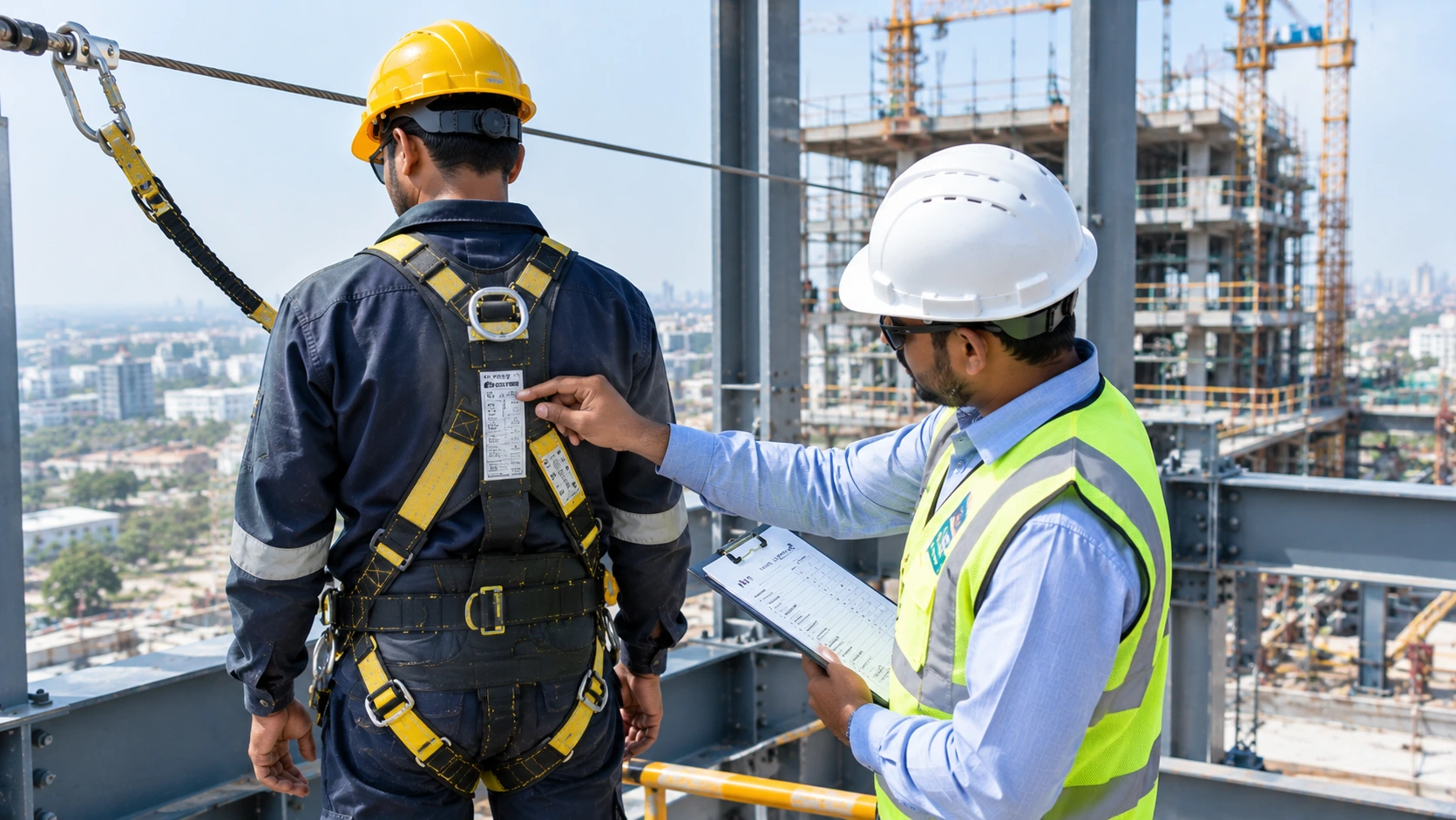
A harness should be inspected before every use and periodically according to the manufacturer’s instructions and site safety procedures. Damaged equipment should be removed from service.
Check for:
- Cuts or abrasion in webbing
- Damaged stitching
- Deformed D rings
- Damaged buckles
- Chemical or heat damage
- Missing labels
- Signs of excessive wear
Even a correctly rated harness may become unsafe if its webbing, stitching, hardware, or attachment components are damaged. Indian Inovatix recommends pre use inspection and periodic inspection based on usage conditions.
Frequently Asked Questions
What is the full body harness load capacity in kg?
It depends on the harness model. Indian Inovatix specifications identify capacities from 100 kg to 140 kg, with the exact rating determined by the product.
How much weight can a safety harness hold?
Many industrial harnesses support users up to 140 kg or more, depending on the certified model. Always check the manufacturer’s stated capacity.
Is a 100 kg harness suitable for a 110 kg worker?
No, unless the manufacturer specifically approves that model for a 110 kg user. Never exceed the marked capacity.
Can a 140 kg person wear a safety harness?
Yes, if the selected harness is specifically rated for a 140 kg total user load. Check whether tools and equipment must also be included.
Is 15 kN the weight capacity of a harness?
No. 15 kN is a force rating, not a 15 kg or 150 kg user capacity. User weight must be taken from the manufacturer’s certified specification.
What is the safety harness capacity in kg?
Common industrial ratings include 100 kg to 140 kg, but the capacity varies by model. Always follow the product label and technical documentation.
Does harness capacity include tools?
It may, depending on the manufacturer’s specification. Safety teams should confirm whether the stated capacity includes clothing, tools, and additional equipment.
What standard applies to full body harnesses?
EN 361 applies to full body harnesses used in fall arrest systems. Indian projects may also specify IS 3521 requirements.
What is the difference between harness weight capacity and breaking strength?
Weight capacity is the permitted user load. Breaking strength is the force a component can withstand during specified testing.
Can a heavy worker use any full body harness?
No. The harness must be rated for the worker’s total load and must fit correctly. Manufacturer approval should be obtained when the worker approaches or exceeds the standard rating.
Choose Harness Capacity Based on the Complete User Load
The correct full body harness load capacity in kg depends on the specific harness model, certification, user weight, equipment carried, and manufacturer’s instructions. A harness rated for 100 kg should not be used for a 110 kg worker, while a 140 kg rated model may be suitable when its certification permits the total load.
Indian Inovatix Limited, Ahmedabad, Gujarat, India, manufactures full body harnesses for construction and industrial applications. Its published specifications include harness capacities ranging from 100 kg to 140 kg, depending on the model.
For buyers evaluating full body harness systems, the correct approach is to match the product rating with the complete working load rather than relying on a generic kg figure.
Is Your Harness Rated for the Actual Worker Load?
Selecting the correct harness capacity helps safety teams avoid incorrect equipment selection and supports compliance with the specified fall protection requirements.
Request the appropriate full body harness for your worker weight, application, and fall protection system.


Talk to Our Safety & Protection Specialists
Have questions or need guidance? Our experts can help you choose the most reliable and high-performance safety solutions tailored to your industry and site requirements.
-

- Call Us +91-8849452638
Need Help Determining the Right Fall Protection for You?
With our vast experience, our experts will assist you in selecting the most relevant system for your needs.