October 9, 2026
Key Takeaways
- How to set up confined space tripod safely starts with site assessment, equipment inspection, and checking the manufacturer’s instructions.
- Tripod assembly confined space work requires stable positioning, correct leg adjustment, secure connections, and compatible retrieval equipment.
- The tripod should be part of a complete confined space entry and rescue plan, not treated as a standalone rescue solution.
- Atmospheric testing, communication, trained personnel, and an appropriate retrieval system should be addressed before entry.
- Always verify the equipment’s rated capacity, configuration, compatibility, and intended application before use.
What Is a Confined Space Tripod?
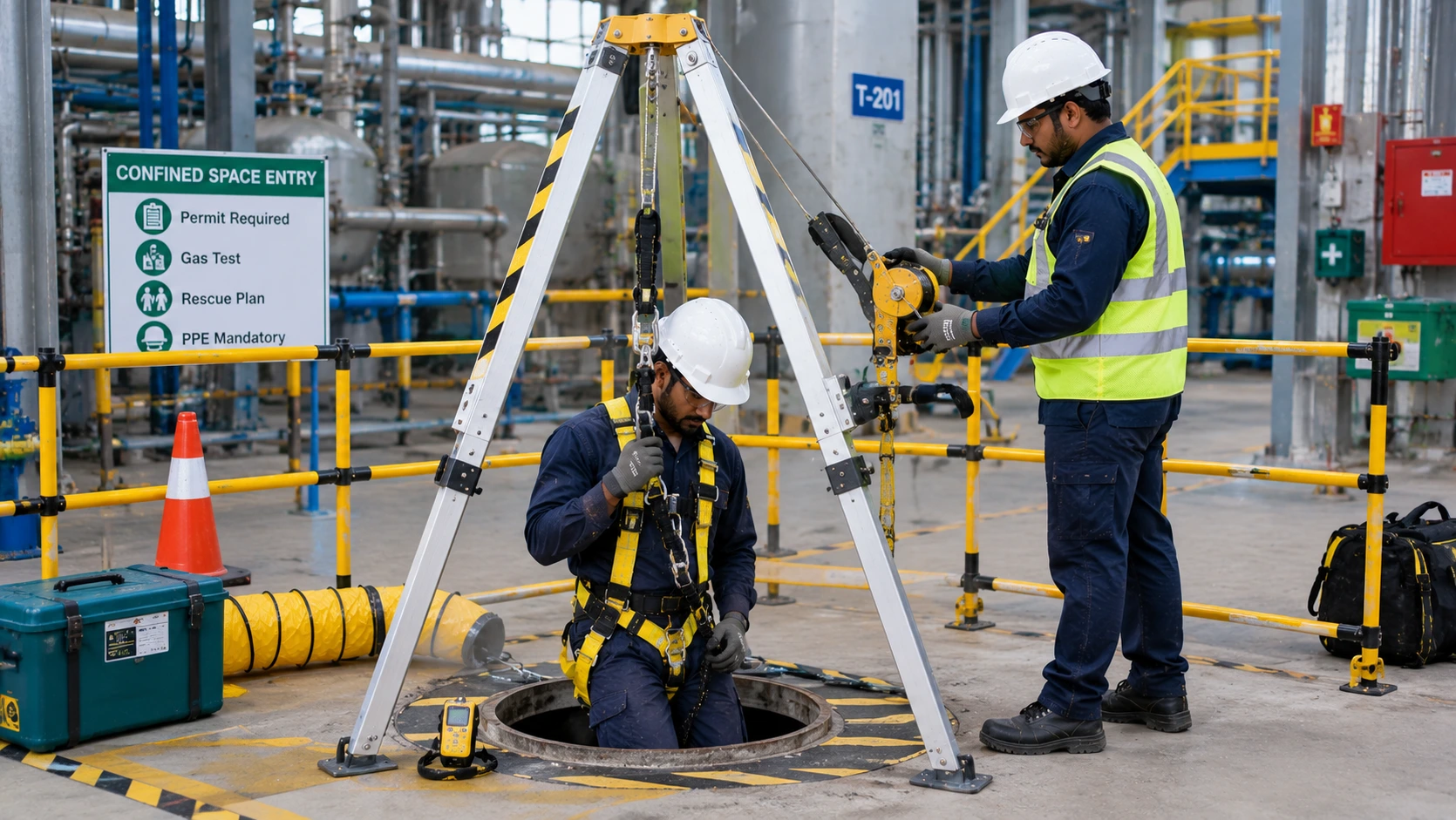
A confined space tripod is a portable support and anchorage system used around vertical access openings such as tanks, manholes, vessels, shafts, and similar confined spaces. Depending on its design and configuration, it can support entry, retrieval, fall protection, or rescue equipment.
A typical setup may include a tripod, mechanical winch or retrieval device, lifeline, full body harness, connectors, and other equipment selected for the specific application.
The tripod does not make a confined space safe by itself. It is one part of a planned entry and rescue system.
OSHA guidance identifies retrieval systems, harnesses, lifelines, and mechanical retrieval devices as components that may be used for confined space rescue, depending on the characteristics of the space and rescue plan.
How to Set Up Confined Space Tripod Safely
The basic process is to assess the opening, inspect the equipment, position and secure the tripod, install compatible retrieval equipment, verify the complete system, and confirm rescue readiness before entry.
1. Assess the Confined Space Before Tripod Assembly
Before starting tripod assembly confined space operations, understand the space and the work being performed.
Check:
- Entry opening dimensions
- Depth and internal configuration
- Surface condition around the opening
- Potential atmospheric hazards
- Internal obstructions
- Possible fall hazards
- Required entry and exit route
- Planned rescue method
- Equipment required for the task
- Weather, traffic, machinery, or other external hazards
This assessment helps determine whether a tripod is suitable and how it should be positioned.
A vertical space with internal projections or obstructions may create complications for retrieval. The rescue plan must account for these conditions before anyone enters.
What Should You Inspect Before Tripod Assembly?
Inspect the complete equipment system before assembly. OSHA training material recommends checking items such as the tripod, winch, cable, housing, labels, hardware, and braking mechanism, while following the manufacturer’s inspection requirements.
Look for:
- Bent, cracked, damaged, or deformed tripod components
- Damaged legs, pins, feet, or adjustment mechanisms
- Worn or damaged cables and lifelines
- Damaged hooks, connectors, or hardware
- Missing locking components
- Unclear or damaged labels
- Problems with the winch or retrieval device
- Signs of corrosion or excessive wear
- Evidence that equipment has been subjected to a fall or overload
Do not use equipment when its condition is questionable. Remove it from service according to the manufacturer’s procedure and have it evaluated by the appropriate competent or authorized person.
Confined Space Tripod Setup Steps
2. Position the Tripod Over the Entry Point
Place the tripod so the intended working area and entry opening are properly aligned.
The tripod should stand on a surface capable of supporting the equipment and the intended loading. Avoid positioning it where the legs can slide, sink, interfere with traffic, or become unstable.
The exact leg arrangement and positioning method depend on the tripod design. Follow the manufacturer’s instructions rather than applying a generic setup dimension.
3. Adjust and Secure the Tripod Legs
Extend the legs according to the manufacturer’s procedure.
Check that:
- All required leg sections are correctly engaged.
- Adjustment pins or locking mechanisms are properly installed.
- Feet are positioned securely.
- The tripod is stable.
- The entry opening remains accessible.
- The tripod is not being positioned outside its rated configuration.
Do not improvise with missing pins, temporary fasteners, or unapproved modifications.
4. Install the Retrieval or Winch System
Once the tripod is correctly positioned, install the compatible retrieval device according to its manufacturer’s instructions.
Depending on the system, this may include a mechanical winch, self retracting lifeline, pulley arrangement, or another approved retrieval device.
Check that the connection between the tripod and retrieval equipment is intended for that specific configuration.
The retrieval line should run through the planned path without unnecessary interference, sharp edges, or entanglement hazards.
OSHA guidance recognizes mechanical retrieval equipment as part of non entry rescue arrangements for applicable vertical permit spaces. The specific rescue arrangement must still be evaluated for the space and task.
How Do You Connect the Harness to the Tripod Rescue System?
The harness and retrieval line should be connected using the designated attachment point and compatible equipment specified by the applicable system.
For permit required confined spaces, OSHA specifies requirements for retrieval lines connected to a chest or full body harness and addresses attachment positioning intended to facilitate removal of the entrant.
Before entry, verify that:
- The harness is correctly fitted.
- The retrieval line is correctly connected.
- Connections are secured.
- The line path is clear.
- The retrieval device operates correctly.
- The complete arrangement matches the rescue plan.
Never connect equipment simply because two connectors physically fit together. Compatibility, rating, configuration, and manufacturer instructions all matter.
5. Check the Complete Confined Space Tripod Setup
Before entry, perform a complete system check.
Confirm:
- Tripod stability
- Leg and pin security
- Retrieval device attachment
- Cable or lifeline condition
- Harness connection
- Winch operation
- Communication method
- Entry opening protection
- Required PPE
- Atmospheric monitoring
- Rescue equipment availability
- Attendant availability
- Emergency response arrangements
This is an important stage in the confined space tripod setup steps because individual components may appear correct while the complete system is not suitable for the intended operation.
6. Complete Atmospheric Testing and Entry Controls
Tripod setup does not replace confined space entry controls.
Before entry, the space should be evaluated according to the applicable confined space procedure. Atmospheric testing may be required to identify oxygen deficiency or enrichment, combustible atmospheres, and toxic contaminants.
OSHA guidance emphasizes atmospheric testing, ventilation, PPE, rescue planning, and periodic retesting as part of confined or enclosed space work.
For permit required spaces, the entry permit should identify the hazards, controls, authorized personnel, and required procedures.
7. Confirm the Attendant and Rescue Plan
A confined space operation should have clearly assigned responsibilities.
The attendant remains outside the space and monitors the entry according to the applicable procedure. The entrant must understand the hazards, communication method, evacuation requirements, and use of the retrieval system.
The rescue plan should answer:
- Who will initiate the rescue?
- Who will operate the retrieval equipment?
- How will emergency services be contacted?
- Can non entry retrieval actually work in this space?
- What happens if the entrant becomes entangled?
- What additional rescue equipment is required?
- What happens if atmospheric conditions change?
OSHA requires employers using permit required confined spaces to ensure that rescue personnel are appropriately trained and that rescue arrangements are suitable for the spaces involved.
When Should You Not Use a Confined Space Tripod?
A tripod should not be used simply because it is available.
Stop and reassess when:
- The tripod is damaged.
- The ground or support surface is unstable.
- The opening does not suit the tripod configuration.
- The retrieval path contains significant obstructions.
- The equipment rating is insufficient.
- Components are incompatible.
- Required locking mechanisms are missing.
- The rescue method has not been established.
- Atmospheric conditions are unsafe.
- Workers are not trained for the planned operation.
The correct response may be to select different equipment, change the rescue method, or stop the entry operation.
Confined Space Tripod Setup Checklist
Use this checklist as a field reminder, while following the equipment manufacturer’s instructions and your site specific procedure.
| Checkpoint | Verify Before Entry |
| Site assessment | Space, opening, hazards and rescue route evaluated |
| Tripod condition | Legs, feet, pins, fittings and structure inspected |
| Positioning | Tripod correctly positioned over entry |
| Stability | Surface and tripod configuration are suitable |
| Retrieval device | Compatible and correctly installed |
| Lifeline | Correct condition, routing and connection |
| Harness | Correctly fitted and connected |
| Atmosphere | Required testing completed |
| Communication | Entrant and attendant can communicate |
| Rescue plan | Rescue personnel and equipment available |
| Training | Assigned personnel trained for their roles |
| Permit | Required entry permit completed and authorized |
Tripod Rescue Field Guide: Common Setup Mistakes
Several mistakes can undermine an otherwise well planned confined space operation.
Using the tripod without assessing the space: A tripod suitable for one vertical entry may not work for another configuration.
Ignoring manufacturer instructions: Leg adjustment, connection points, load ratings, and compatible accessories vary between systems.
Treating the tripod as the entire rescue plan: A tripod provides a support system. Rescue also requires trained people, communication, retrieval equipment, atmospheric controls, and an appropriate emergency response plan.
Skipping pre use inspection: Damaged components can compromise the complete system.
Using incompatible equipment: Harnesses, lifelines, connectors, winches, and tripods must work together as an approved configuration.
Failing to consider internal obstructions: Retrieval may not work as expected when the entrant can become caught against internal structures.
Why Choose the Right Confined Space Tripod?
For industrial applications, tripod selection should consider the entry opening, working depth, expected loading, portability requirements, retrieval arrangement, and the manufacturer’s specified operating configuration.
Indian Inovatix manufactures confined space equipment including tripods and modular davit systems for applications such as tanks, vessels, drainage, sewerage, pharmaceutical facilities, and chemical plants.
Its confined space equipment range is designed for entry, retrieval, and rescue applications, with configurations selected according to the requirements of the worksite.
For more information, see the [Confined Space Entry Equipment] internal resource and the [Tripod for Confined Space Equipment] product page.
FAQ
How do you set up a confined space tripod?
Inspect the equipment, position it over the opening, secure the legs, install compatible retrieval equipment, check the complete system, and confirm entry and rescue controls.
What is tripod assembly in confined space work?
It is the process of positioning, adjusting, securing, and equipping a tripod for a specific confined space entry or rescue application.
Can one tripod be used for every confined space?
No. Suitability depends on the space, opening, configuration, rated capacity, equipment compatibility, and manufacturer’s instructions.
Is a winch required with a confined space tripod?
Not always, but mechanical retrieval equipment may be required or appropriate for specific vertical entry and rescue arrangements.
Can a tripod be used without a full body harness?
The complete rescue and fall protection arrangement must be selected according to the application and applicable requirements. Do not improvise the connection system.
How often should a confined space tripod be inspected?
Inspect it before use and follow the manufacturer’s required periodic inspection schedule.
Can a tripod rescue an unconscious worker?
A tripod can support a retrieval system, but successful rescue depends on the space configuration, retrieval equipment, trained rescuers, and the rescue plan.
What standards apply to confined space tripod systems?
Applicable requirements depend on the jurisdiction and application. OSHA 1910.146 is a widely referenced confined space standard, while relevant EN, ANSI, and Indian requirements may apply to specific equipment and workplaces.
Conclusion
Knowing how to set up confined space tripod equipment safely is more than assembling three legs over an opening. The process requires site assessment, equipment inspection, correct positioning, compatible retrieval equipment, harness connection, atmospheric controls, communication, trained personnel, and a workable rescue plan.
A tripod should always be selected and used according to its manufacturer’s instructions, rated configuration, applicable standards, and the specific conditions of the confined space.
For industrial confined space applications, Indian Inovatix Ltd. manufactures confined space tripods and related entry and rescue equipment. Speak with the technical team about selecting a configuration for your application.
Call: +91 88494 52638 Email: info@indianinovatix.com


Talk to Our Safety & Protection Specialists
Have questions or need guidance? Our experts can help you choose the most reliable and high-performance safety solutions tailored to your industry and site requirements.
-

- Call Us +91-8849452638
Need Help Determining the Right Fall Protection for You?
With our vast experience, our experts will assist you in selecting the most relevant system for your needs.