October 22, 2026
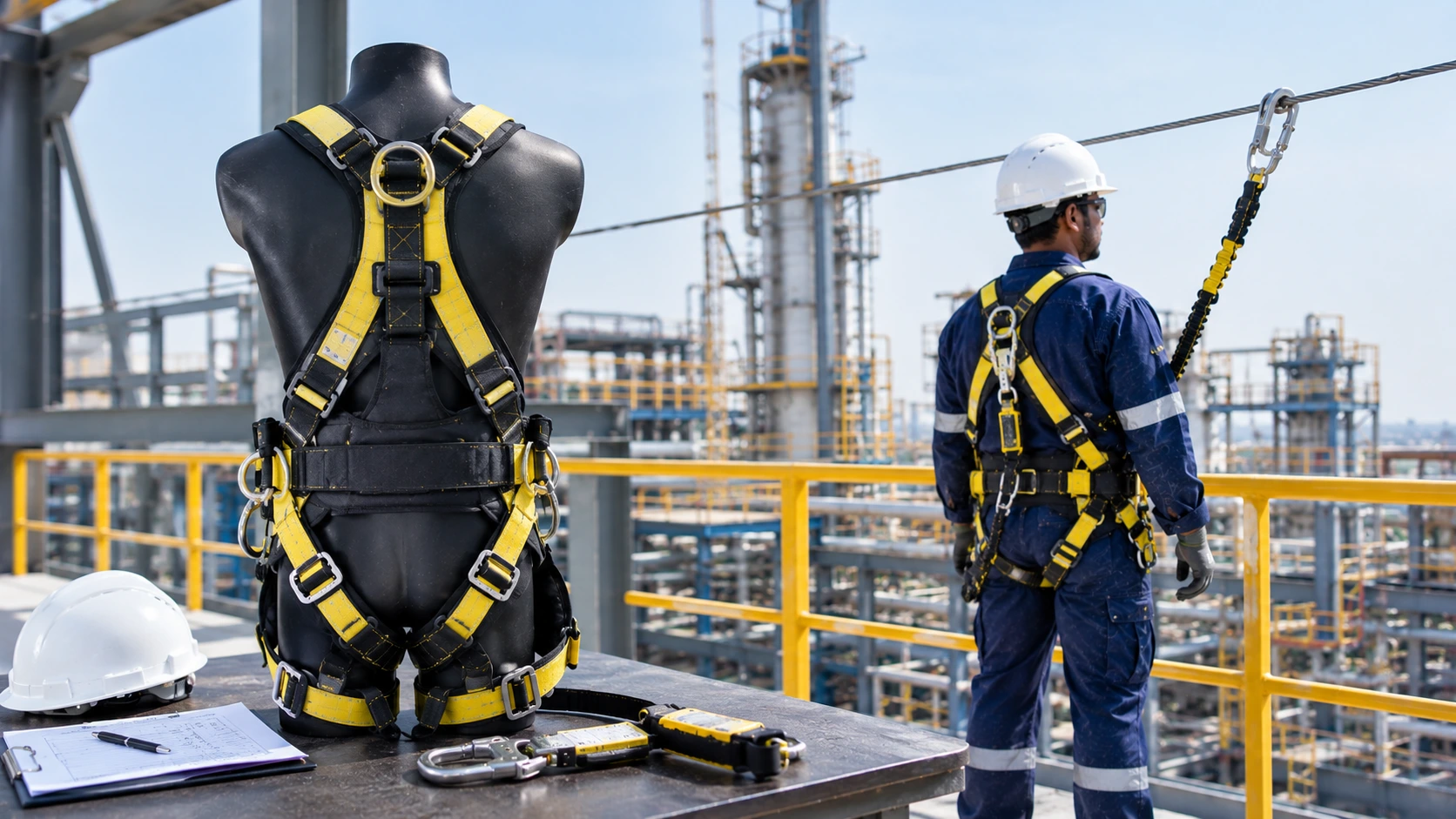
When purchasing a full body safety harness for construction, manufacturing, infrastructure, or industrial maintenance, buyers in India often ask whether the product complies with IS 3521. However, checking only the standard number is not enough. The edition, applicable part, certification status, intended use, and supporting documentation also matter.
The introduction of IS 3521 Part 1 2021 marked an important change in India’s approach to full body harness specifications. The earlier IS 3521:1999 standard covered industrial safety belts and harnesses more broadly. The 2021 revision introduced a more specific framework for personal fall arrest systems, with Part 1 dedicated to full body harnesses. The revision also updated terminology, attachment point positioning, strap definitions, and test methods.BIS documentation provides the product specification reference.
For procurement teams, safety officers, contractors, and industrial buyers, understanding these differences helps improve product evaluation and reduce the risk of selecting a harness that is unsuitable for the intended work.
This guide explains the major changes, what buyers should verify, and how to evaluate a full body harness before purchasing it.
Key Takeaways
- IS 3521 Part 1 2021 specifically addresses full body harnesses used in personal fall arrest systems.
- IS 3521:1999 was a broader standard covering industrial safety belts and harnesses.
- The 2021 revision updated terminology, harness classifications, attachment point positioning, and testing requirements.
- Buyers should verify the applicable standard edition, certification evidence, product marking, user instructions, and intended application.
- A harness is only one component of a complete fall protection system.
- Amendment 1 to IS 3521 (Part 1):2021 was published in 2025. Buyers should check the current applicable edition and amendment status. BIS implementation guidance.
What Is IS 3521 Part 1 2021?
IS 3521 (Part 1):2021 is the Indian Standard titled Personal Fall Arrest Systems: Specification, Part 1, Full Body Harness. It specifies requirements for full body harnesses, including applicable materials, construction, testing, marking, instructions for use, packaging, and maintenance.
The standard was developed by the Bureau of Indian Standards (BIS) as part of the revision of IS 3521:1999. It is intended to provide a more specific framework for full body harnesses used in personal fall arrest systems.
For buyers, the standard helps establish a technical basis for evaluating harness design and performance rather than relying only on appearance, price, or general claims about strength.
A conforming harness must still be suitable for the task, correctly fitted, used with compatible equipment, and connected to a suitable anchorage.
What Was IS 3521:1999?
IS 3521:1999 was titled Industrial Safety Belts and Harnesses: Specification. It covered safety belts and harnesses used in industrial work environments.
The 1999 revision already included important safety provisions. These included static and dynamic strength testing, harness classifications based on work positions, webbing requirements, and considerations relating to ergonomics and safe use.
Therefore, the older standard should not be described as having no meaningful safety requirements. The 2021 revision developed this foundation further and separated the requirements for full body harnesses into a dedicated part of the IS 3521 series.
For buyers comparing older and newer products, the relevant question is whether the harness meets the requirements applicable to the product being purchased and whether it remains suitable for its intended use.
IS 3521:1999 vs IS 3521 Part 1:2021: Key Differences
The most significant differences concern the scope of the standard, terminology, harness design, attachment point positioning, and testing.
| Comparison Factor | IS 3521:1999 | IS 3521 (Part 1):2021 |
| Standard title | Industrial safety belts and harnesses | Personal fall arrest systems, Part 1: Full body harness |
| Scope | Broader coverage of industrial safety belts and harnesses | Dedicated part for full body harnesses |
| Standard structure | Earlier consolidated structure | Revised into separate parts for different PFAS components |
| Terminology | Earlier terminology for belts and harnesses | Updated terminology relating to personal fall arrest systems |
| Harness attachment positioning | Requirements under earlier classification system | Revised positioning requirements, including Class A and Class P |
| Strap definitions | Earlier design framework | Primary and secondary strap concepts introduced |
| Test methods | Included static and dynamic strength tests | Additional test methods introduced, including buckle shake, corrosion, static suspension, and static suspension angle tests |
| Product documentation | Requirements under the earlier standard | Updated requirements for marking, instructions, maintenance, and use |
| Buyer verification | Check the edition and applicable product requirements | Check the applicable edition, amendments, and certification documentation |
These differences are based on the revision information in the 2021 standard and BIS product documentation.
What Changed in Harness Classification and Attachment Points?
One important change in the 2021 revision concerns how harness classes and attachment points are defined.
Attachment points are not interchangeable simply because they look similar or are made from metal. Their intended use depends on the harness design and classification.
Class A: Fall Arrest Attachment
Class A is associated with fall arrest. The 2021 revision specifies the positioning of the Class A attachment point more clearly, including its location at the back of the wearer, centrally between the shoulder blades.
This positioning is important because the harness must help support the body during fall arrest and maintain an appropriate suspension position.
Buyers should check the product’s marking and instructions to identify the intended fall arrest attachment point.
Class P: Work Positioning Attachment
Class P relates to work positioning. The 2021 revision refined requirements for work positioning attachment elements, including their positioning and use.
Work positioning attachment points should not automatically be treated as fall arrest points. Buyers and users must follow the harness manufacturer’s instructions and the applicable system requirements.
Class E: Confined Space Applications
Harnesses intended for confined space entry or retrieval may have shoulder attachment elements designed for specific lifting and lowering arrangements.
The suitability of these points depends on the harness design, compatible equipment, and the intended rescue or retrieval method. Do not assume that every harness with shoulder attachment points is suitable for every confined space operation.
Buyer takeaway: Verify the intended function of every attachment point before purchasing or issuing a harness.
Why Did the 2021 Revision Introduce Primary and Secondary Straps?
The 2021 standard introduced the concepts of primary and secondary straps and defined their widths.
This provides a more specific framework for understanding the different roles of harness straps. Primary straps form important load-bearing parts of the harness, while secondary straps have supporting functions within the design.
For buyers, the distinction reinforces why a harness should be assessed as a complete engineered assembly. Webbing quality alone does not establish performance. Stitching, buckles, attachment elements, strap routing, and the overall design all contribute to how the harness behaves under load.
When evaluating products, request the relevant conformity documentation rather than trying to judge load-bearing performance by visual appearance.
What Additional Testing Was Introduced in IS 3521 Part 1:2021?
The 2021 revision introduced additional test methods beyond those included in the earlier framework.
These include:
- Buckle shake testing: Evaluates buckle behaviour under the prescribed test conditions.
- Corrosion testing: Assesses the performance of relevant metallic components under specified conditions.
- Static suspension testing: Evaluates harness behaviour during the prescribed suspension test.
- Static suspension angle testing: Assesses suspension angle under the specified test procedure.
- Performance testing: The standard refers to IS 3521 (Part 6) for harness performance tests.
These methods help evaluate different aspects of harness performance. They do not mean that a buyer can determine compliance from a single test result or product photograph.
The complete applicable standard and test requirements should be used when assessing conformity.
Is IS 3521 Part 1:2021 Still Current?
Buyers should also be aware of the 2025 amendment to IS 3521 (Part 1):2021.
BIS published Amendment 1 in 2025 and issued implementation guidance for licensees and applicants. The guidance identifies changes involving the unit for synthetic fibre breaking strength, coating requirements for fittings, a tolerance for stainless steel lanyard diameter, and changes to sample sizes in certain testing tables. BIS stated that these changes did not constitute a technical change to the standard’s overall requirements.
This matters because procurement specifications and supplier documents may refer to different editions or amendment statuses.
Before purchasing a harness, buyers should:
- Confirm the applicable standard and amendment status.
- Request current product documentation from the manufacturer.
- Verify any applicable BIS licence or certification details.
- Ensure the product documentation matches the exact harness model being supplied.
- Check that the harness is suitable for the intended application.
Do not assume that a catalogue mentioning the 2021 edition automatically confirms compliance with every current requirement.
What Is the Safety Belt IS Code in India?
The phrase safety belt IS code is often used broadly when searching for industrial fall protection equipment. However, buyers should distinguish between a safety belt, a full body harness, and the complete personal fall arrest system.
IS 3521:1999 was the earlier standard for industrial safety belts and harnesses. IS 3521 (Part 1):2021 specifically covers full body harnesses.
For a full body harness purchase, the specification should identify the applicable part and edition instead of relying on a generic statement such as “IS 3521 compliant.”
The wider IS 3521 series also addresses other components of personal fall arrest systems in separate parts, including lanyards and energy absorbers, self-retracting lifelines, and connectors.
The appropriate part depends on the component being procured. A harness certificate should not be treated as evidence that every other component in the system also conforms.
What Should Buyers Check Before Purchasing an IS 3521 Full Body Harness?
When evaluating an IS 3521 full body harness, use a structured procurement checklist.
1. Verify the Standard and Product Documents
Ask the manufacturer for documentation identifying the applicable standard, edition, amendments, product model, and relevant conformity evidence.
Where BIS certification is claimed, verify the licence and product scope through official BIS resources.
2. Confirm the Intended Application
Identify whether the harness will be used for fall arrest, work positioning, confined space entry, ladder climbing, or another specified application.
Do not select a harness solely because it has multiple D-rings.
3. Check Product Marking
Confirm that the harness has the required product identification and marking. Check the manufacturer details, model identification, applicable standard information, and attachment point identification as required.
The markings should correspond to the supplied product and its documentation.
4. Review the User Instructions
The instructions should explain fitting, adjustment, inspection, use, maintenance, limitations, and conditions requiring removal from service.
Workers must understand how to put on the harness correctly and connect it to the intended system.
5. Check Compatibility With Other Equipment
A harness works as part of a larger fall protection arrangement. Verify compatibility with the lanyard, energy absorber, connector, lifeline, and anchorage.
The complete arrangement must suit the work height, fall clearance, movement requirements, and rescue plan.
6. Evaluate Fit and User Training
The harness must fit the intended user and be adjusted according to the manufacturer’s instructions. Workers should receive training in correct fitting, connection, inspection, and emergency procedures.
A conforming product cannot compensate for incorrect use.
Common Mistakes Buyers Should Avoid
When comparing harnesses, avoid these purchasing mistakes:
- Accepting a generic “IS 3521” claim without checking the applicable part and edition.
- Assuming that a harness complying with the older standard is automatically unsafe.
- Assuming that a product referencing the 2021 standard automatically reflects the latest amendment.
- Treating all D-rings as suitable for fall arrest.
- Comparing products only by price, webbing appearance, or the number of attachment points.
- Failing to check manufacturer documentation and applicable certification.
- Buying a harness without considering compatibility with the complete fall protection system.
- Ignoring user training, inspection, maintenance, and rescue requirements.
A sound purchasing decision considers the standard, product design, intended use, documentation, and actual working conditions together.
Explore Full Body Harness Solutions From Indian Inovatix
Indian Inovatix Ltd. manufactures fall protection solutions for industrial and work at height applications. When evaluating a full body harness, buyers should identify the intended application and confirm the applicable product specifications before finalising procurement.
Explore the Indian Inovatix Full Body Harness range to review available products.
When contacting the team, share the work application, number of users, working conditions, required attachment configuration, and any applicable procurement specification. This helps the team understand the requirements and identify relevant product options.
Frequently Asked Questions
1. What is IS 3521 Part 1:2021?
It is the Indian Standard for personal fall arrest systems, Part 1, covering full body harnesses.
2. What was IS 3521:1999?
It was the earlier Indian Standard covering industrial safety belts and harnesses.
3. What changed in IS 3521 Part 1:2021?
The revision updated the standard’s scope, terminology, attachment positioning, strap definitions, and test methods.
4. Is IS 3521:1999 automatically unsafe?
No. The year of the standard alone does not establish whether an individual harness is safe or unsafe. Assess its condition, intended use, documentation, and applicable requirements.
5. What is the safety belt IS code in India?
IS 3521:1999 was the earlier industrial safety belts and harnesses standard. IS 3521 (Part 1):2021 specifically covers full body harnesses.
6. What is the full body harness IS code?
For full body harnesses, the relevant reference is IS 3521 (Part 1):2021, subject to applicable amendments.
7. Was IS 3521 amended in 2025?
Yes. BIS published Amendment 1 to IS 3521 (Part 1):2021 in 2025.
8. Does a harness alone form a complete fall arrest system?
No. The harness must be used with compatible equipment and suitable anchorage as part of a correctly designed system.
9. How can buyers verify harness compliance?
Check the exact product model, applicable standard edition, manufacturer documents, and any relevant BIS certification or licence details.
10. Where can I find full body harnesses from Indian Inovatix?
Visit the Indian Inovatix Full Body Harness category.
Conclusion
The transition from IS 3521:1999 to IS 3521 Part 1:2021 was an important development in the specification of full body harnesses in India. The newer framework introduced a dedicated part for full body harnesses and updated terminology, attachment point requirements, strap definitions, and test methods.
For buyers, the practical lesson is to look beyond a generic standards claim. Verify the exact standard edition and applicable amendment, check product marking and conformity documentation, and make sure the harness suits the work being performed.
A full body harness is one part of a complete fall protection system. Correct selection, compatibility, fitting, inspection, training, and rescue planning remain essential.
Need Help Selecting a Full Body Harness?
Indian Inovatix Ltd. manufactures fall protection solutions for industrial and work at height applications. Contact the team to discuss your harness requirements, application, and product specifications.
Call: +91 88494 52638
Email: info@indianinovatix.com


Talk to Our Safety & Protection Specialists
Have questions or need guidance? Our experts can help you choose the most reliable and high-performance safety solutions tailored to your industry and site requirements.
-

- Call Us +91-8849452638
Need Help Determining the Right Fall Protection for You?
With our vast experience, our experts will assist you in selecting the most relevant system for your needs.