November 4, 2026
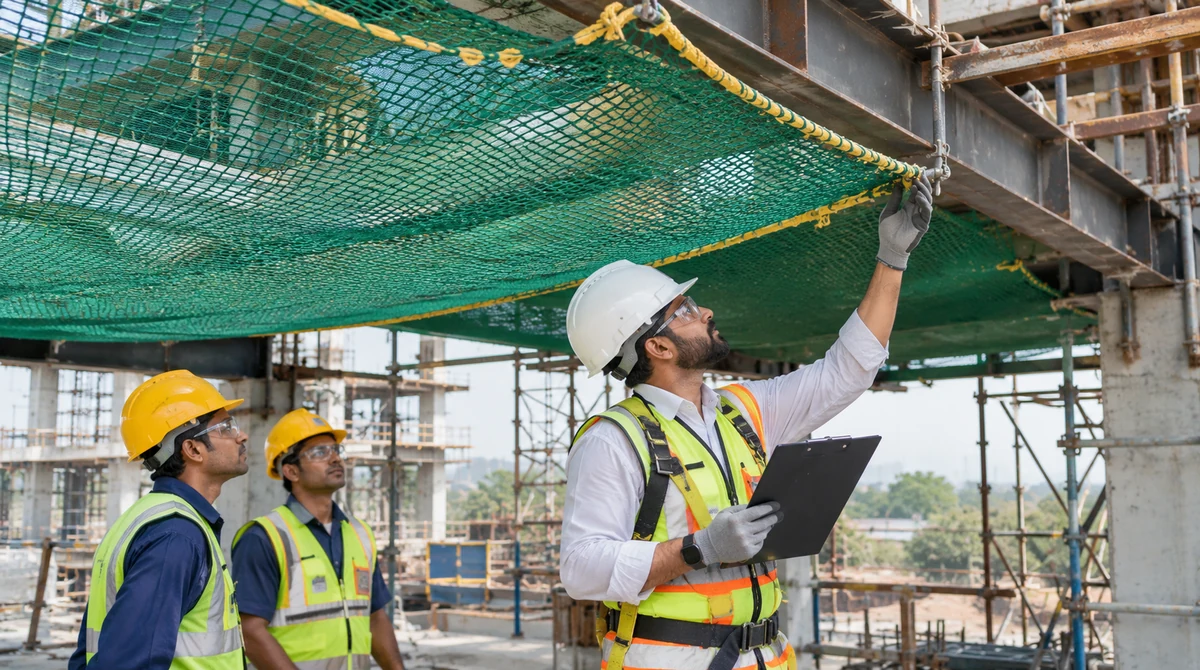
Safety nets are widely used as collective fall protection in construction, structural work, industrial projects, bridges, and other work at height applications. Their condition can change because of weather, abrasion, falling objects, chemicals, improper installation, or repeated exposure.
This raises an important question: how often should safety nets be inspected?
A proper inspection programme should not rely on one calendar interval alone. The frequency should consider applicable standards, manufacturer instructions, site conditions, installation, use, and any event that could affect the integrity of the system.
For construction safety programmes, weekly inspection is an established benchmark under OSHA requirements, with additional inspection required after an occurrence that could affect the safety net system.
For Indian projects, safety teams should also review applicable BIS requirements, project specifications, manufacturer instructions, and site safety procedures.
Key Takeaways
- How often should safety nets be inspected? Weekly inspection is a recognized construction benchmark, with additional checks after events that could affect the system.
- Inspect the netting, border ropes, connections, fixing points, supporting structure, and surrounding conditions.
- Remove defective safety nets or components from service until they are properly assessed.
- Remove tools, scrap, and other debris from the net as soon as possible.
- Maintain inspection records for better safety management and audit readiness.
- For safety net compliance India, always follow the requirements applicable to the specific product, project, and installation.
How Often Should Safety Nets Be Inspected?
Safety nets should be inspected at least weekly where the applicable construction requirement specifies weekly inspection, and immediately after an event that could affect their integrity. Additional checks may also be necessary when site conditions create a higher risk of deterioration.
OSHA 1926.502(c)(5) states that safety nets must be inspected at least once a week for wear, damage, and deterioration. It also requires inspection after any occurrence that could affect the integrity of the system. Defective nets and components must not remain in service.
A practical site programme can therefore include:
| Inspection Type | When to Inspect | Main Purpose |
| Routine visual check | Before work or according to site procedure | Identify visible damage |
| Weekly inspection | At least weekly where required | Check wear and deterioration |
| Post event inspection | After impact, severe weather, dropped objects, or other affecting events | Confirm system condition |
| Installation inspection | After initial installation or relocation | Verify installation and fixing |
| Repair inspection | After significant repair | Confirm suitability for use |
| Periodic technical assessment | As specified by manufacturer or applicable standard | Evaluate long term condition |
The exact programme should be documented by the responsible safety team.
Why Is Safety Net Inspection Frequency Important?
Safety nets are designed to provide protection when workers fall from height, but their performance depends on the condition of the complete system.
Inspection helps identify:
- Cuts and tears
- Broken or damaged mesh
- Abrasion
- Heat or burn damage
- Chemical exposure
- UV or weather deterioration
- Damaged border ropes
- Loose connections
- Damaged fixing points
- Displacement of the net
- Excessive debris
- Damage to supporting structures
A net can look acceptable from a distance while having damage at connection points, edges, ropes, or mesh intersections.
That is why inspection should cover the entire installed system, not just the visible centre section of the net.
What Should a Fall Protection Net Checklist Include?
A fall protection net checklist should provide a consistent method for checking the net and its installation.
1. Check the Netting
Look across the complete net surface for:
- Cuts
- Holes
- Broken mesh
- Frayed sections
- Abrasion
- Burn marks
- Chemical damage
- Unusual stretching or deformation
Any defect that could affect the intended performance of the net should be reported and assessed.
2. Inspect Border Ropes
The border rope connects the net to the supporting arrangement and should be checked for:
- Cuts
- Fraying
- Abrasion
- Broken fibres
- Chemical deterioration
- Damage around connection points
Do not ignore minor looking damage at the perimeter.
3. Check Connections and Fixings
Inspect every relevant connection between the net and its support.
Look for:
- Loose fixing points
- Damaged hooks or connectors
- Missing ties
- Incorrect connections
- Displaced sections
- Damaged support components
- Signs of movement
The net should remain correctly positioned according to its installation requirements.
4. Remove Debris
Construction debris should not be allowed to accumulate inside a safety net.
OSHA requires objects such as scrap, equipment, and tools that fall into a safety net to be removed as soon as possible and at least before the next work shift.
When Should a Safety Net Be Inspected Immediately?
Weekly inspection should not be treated as the only inspection opportunity.
An additional inspection should be carried out when an event could affect the integrity of the safety net.
Examples include:
- A person falls into the net.
- Heavy material falls into the net.
- Severe weather or high winds affect the installation.
- The net is relocated.
- The supporting structure is modified.
- The net suffers impact or mechanical damage.
- Chemicals, heat, sparks, or other contaminants affect the material.
- A major repair is completed.
- The net has been displaced from its intended position.
OSHA specifically requires inspection after an occurrence that could affect the integrity of the safety net system.
Should a Safety Net Be Inspected After a Fall?
Yes. A safety net that has arrested a fall should be treated as requiring assessment before continued use.
The inspection should consider the mesh, border rope, connections, support points, installation arrangement, and any deformation or damage caused by the event.
The decision to return the net to service should follow the applicable standard and manufacturer’s instructions. If there is doubt about its condition, it should remain out of service until assessed by an appropriately competent person.
What Standards Apply to Safety Net Compliance India?
For Indian projects, IS 11057:1984, Industrial Safety Nets, is an important BIS reference. BIS documentation describes industrial safety nets intended to catch personnel and/or debris during activities such as high rise construction, flyovers, roads, structural work, and industrial equipment installation.
International project specifications may also reference standards such as EN requirements for safety nets.
OSHA 1926.502(c) provides another commonly referenced international benchmark for construction safety nets. It addresses inspection, defective nets, installation, clearance, mesh, border ropes, and connections.
For safety net compliance India, companies should not assume that an international requirement automatically replaces an applicable Indian requirement. The inspection programme should be based on the standards, specifications, manufacturer instructions, and safety procedures applicable to the project.
How Should Safety Net Inspections Be Documented?
A documented inspection process makes it easier to identify defects, assign corrective actions, and demonstrate that inspections are being performed.
A basic inspection record can include:
| Record | Details |
| Net identification | ID, location, or section |
| Installation date | Date installed |
| Inspection date | Date checked |
| Inspection type | Weekly, post event, relocation, etc. |
| Condition | Acceptable or defective |
| Defects | Description of findings |
| Corrective action | Repair, replacement, adjustment, or removal |
| Inspector | Name and designation |
| Next inspection | Planned date |
For projects with multiple safety nets, identification by location or system ID can make inspection tracking easier.
How Can Companies Improve Safety Net Compliance?
A good inspection programme starts with proper selection and installation.
Follow these steps:
- Select a safety net suitable for the intended application.
- Verify applicable product standards and documentation.
- Ensure installation is performed according to the approved method.
- Inspect the installation before putting the system into service.
- Establish the required inspection frequency.
- Train relevant workers to identify visible defects.
- Conduct additional inspections after affecting events.
- Remove defective components from service.
- Record inspection findings and corrective actions.
- Review manufacturer instructions and project requirements periodically.
Companies can also review Indian Inovatix’s [fall arrest systems] and [full body harness solutions] when developing a wider work at height protection programme.
Safety Net Inspection Frequency: Quick Reference
| Situation | Inspection Action |
| Normal construction use | Follow the planned inspection schedule |
| Weekly requirement applies | Inspect at least once every week |
| Heavy object falls into net | Inspect immediately |
| Worker falls into net | Remove from service and assess |
| Severe weather | Inspect before continued use |
| Net relocated | Inspect installation before use |
| Major repair | Inspect before returning to service |
| Visible damage | Stop use and assess |
| Debris in net | Remove promptly |
| Doubt about condition | Keep out of service until assessed |
This approach is more effective than waiting for the next scheduled inspection when a potentially damaging event has already occurred.
FAQ
1. How often should safety nets be inspected?
How often should safety nets be inspected? At least weekly where the applicable requirement specifies weekly inspection, plus after events that could affect system integrity.
2. Who should inspect a safety net?
A competent person should conduct the required detailed inspection according to the applicable project procedure and standard.
3. Should safety nets be inspected after a fall?
Yes. The net should be assessed before being considered for continued use.
4. What is checked during a safety net inspection?
Check mesh, ropes, connections, fixing points, support structures, damage, deterioration, displacement, and debris.
5. What is a fall protection net checklist?
It is a documented checklist used to verify the condition and installation of a safety net.
6. Can a damaged safety net be used?
No. Defective safety nets should not remain in service until the defect has been properly assessed and addressed.
7. Does weather affect safety net inspection frequency?
Yes. Severe weather can justify an additional inspection before the system is used again.
8. Is weekly inspection required for every safety net in India?
Not necessarily. Requirements depend on the applicable standard, project specifications, manufacturer instructions, and site conditions.
9. What is IS 11057?
IS 11057 is the Indian Standard specification for industrial safety nets.
10. Should debris be removed from a safety net?
Yes. Tools, scrap, and other objects should be removed promptly to prevent additional hazards and possible damage.
Conclusion
Knowing how often should safety nets be inspected is an important part of managing fall protection at construction and industrial sites. A weekly inspection is an established construction benchmark under OSHA, but inspection should also be carried out after any event that could affect the integrity of the system.
For safety net compliance India, companies should consider applicable BIS requirements, project specifications, manufacturer instructions, installation conditions, environmental exposure, and site procedures.
Regular inspection, proper documentation, prompt removal of defective components, and competent assessment help keep safety net systems ready for their intended protective function.
Need Help With Safety Nets or Fall Protection Systems?
Indian Inovatix Ltd. manufactures and supplies fall protection solutions for construction and industrial applications. If you need assistance with safety net selection, fall protection planning, inspection requirements, or a project specific solution, contact our team.
Call: +91 88494 52638
Email: info@indianinovatix.com


Talk to Our Safety & Protection Specialists
Have questions or need guidance? Our experts can help you choose the most reliable and high-performance safety solutions tailored to your industry and site requirements.
-

- Call Us +91-8849452638
Need Help Determining the Right Fall Protection for You?
With our vast experience, our experts will assist you in selecting the most relevant system for your needs.