October 27, 2026
Working at height exposes construction teams, maintenance workers and industrial personnel to serious fall hazards. An unsuitable safety arrangement can increase injury risks, disrupt projects and create compliance concerns for employers.
A fall restraint system prevents a worker from reaching a location where a fall could occur. Unlike fall arrest equipment, which stops a fall after it begins, restraint equipment restricts movement before the worker reaches the hazard.
For safety officers, EPC contractors and plant operations teams, selecting the right arrangement requires careful assessment of the work area, anchor locations and equipment compatibility.
Indian Inovatix Limited., Ahmedabad, Gujarat, India, designs and manufactures fall protection systems for industrial and infrastructure applications. The company has manufactured and installed more than 1 lakh metres of fall arrest systems and reports protecting over 500,000 workers across India.
Key Takeaways
- A fall restraint system prevents workers from reaching an unprotected edge or another identified fall hazard.
- Typical components include a suitable harness, restraint lanyard, compatible connectors and an appropriate anchor point.
- Rooftop restraint arrangements must account for roof edges, openings, fragile surfaces and the worker’s complete range of movement.
- Work positioning and travel restraint serve different purposes. Work positioning does not automatically prevent a fall.
- Equipment selection, inspection and training must follow the manufacturer’s instructions and applicable safety requirements.
- Indian Inovatix manufactures fall protection equipment in Ahmedabad and supplies solutions for industrial and infrastructure applications.
What Is a Fall Restraint System?
A fall restraint system is a personal fall protection arrangement that restricts a worker’s movement so they cannot reach a fall hazard. It commonly uses a suitable harness, a restraint connection and an appropriate anchorage arrangement.
The objective is to prevent exposure to the fall rather than stop a worker after falling.
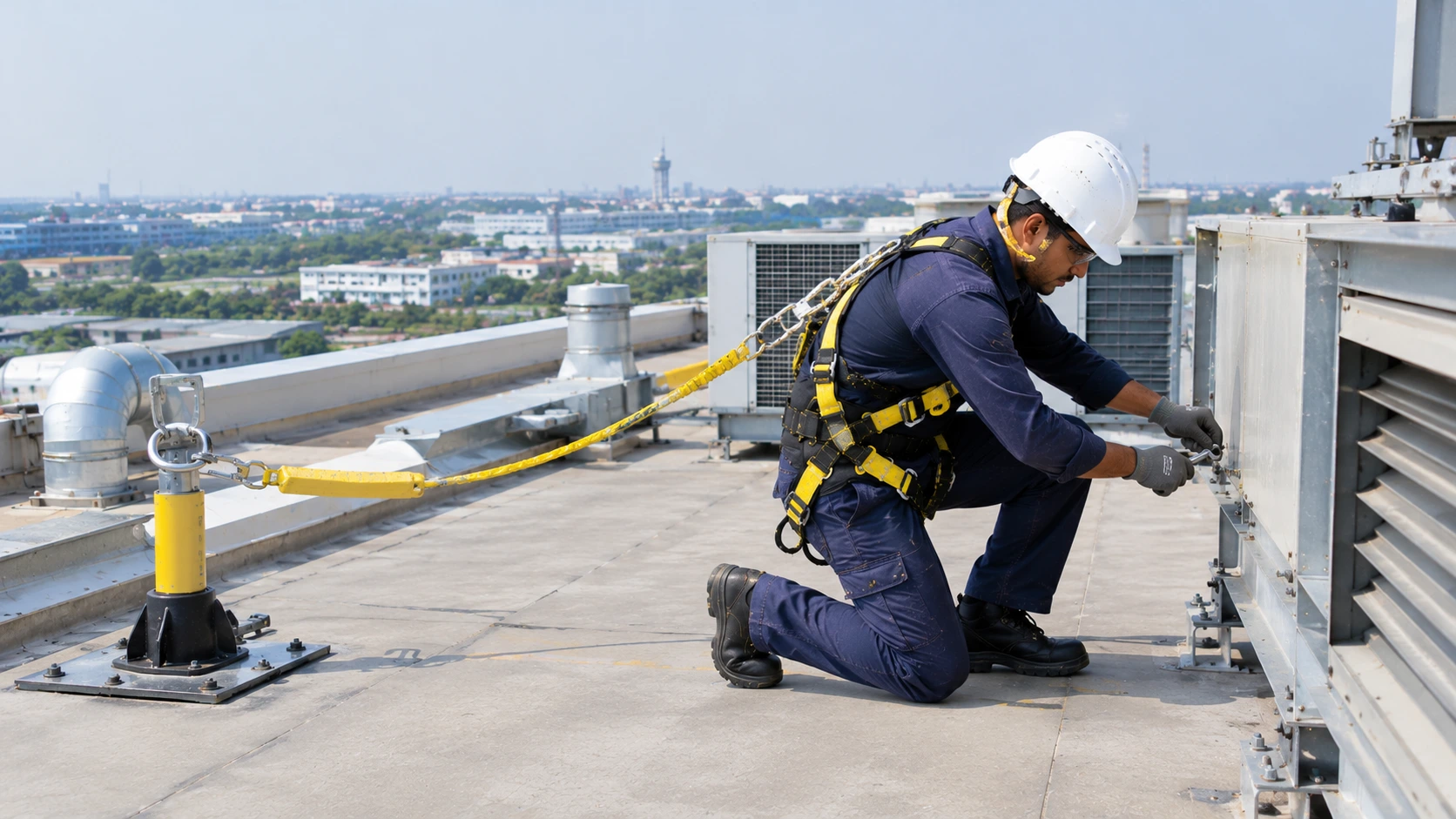
For example, consider a maintenance technician inspecting equipment on an industrial rooftop. A correctly configured restraint arrangement allows access to the equipment while preventing the technician from reaching the unprotected roof edge.
The system must be designed around the actual work area. A harness alone does not provide effective restraint if the worker can still reach the hazard.
How Does a Fall Restraint System Work?
A restraint arrangement limits the distance a worker can travel from an anchor point. The connection length and anchor position determine the permitted working area.
The basic setup process involves five steps:
- Identify the hazard: Locate roof edges, openings, fragile surfaces and other fall risks.
- Select the anchor: Determine whether the proposed anchor is suitable for the intended application.
- Connect the equipment: Use compatible harnesses, connectors and restraint devices.
- Set the permitted movement: Configure the system so the worker cannot reach the hazard.
- Verify the arrangement: Check the complete working route, equipment compatibility and site conditions before use.
The effective restraint distance depends on the anchor position, connecting device length, harness attachment location and possible slack. Workers must remain unable to reach the hazard throughout the permitted working area.
What Are the Main Components of a Fall Restraint System?
A fall restraint system combines compatible components to restrict worker movement. Each component must suit the intended application and the conditions at the worksite.
1. Full Body Safety Harness
A suitable harness connects the worker to the restraint arrangement. It must fit correctly and remain compatible with the intended equipment configuration.
The harness should be selected according to the task, adjustment requirements and manufacturer’s instructions.
2. Restraint Lanyard or Connecting Device
The restraint lanyard connects the harness to the anchor arrangement. Its length determines how far the worker can move within the work area.
A fixed length may suit a defined work area. An adjustable device may provide greater flexibility when the application permits it.
The configuration must prevent the worker from reaching the fall hazard. A lanyard intended for restraint must not automatically be treated as suitable for fall arrest.
3. Anchor Point
The anchor point connects the system to a suitable supporting structure. Its position influences the worker’s permitted movement.
Indian Inovatix manufactures anchorage equipment for different work at height applications. Explore the fall protection anchorages range to review available anchorage solutions.
An anchor must be suitable for the intended system and installed according to the applicable design and manufacturer’s requirements.
4. Connectors
Connectors link the harness, restraint device and anchorage. They must be compatible with the equipment and correctly secured during use.
Workers should inspect connectors before use and report visible damage or malfunction.
5. System Configuration
The equipment must be configured around the hazard, not simply assembled and assumed safe.
The anchor position, connecting device length and worker’s full range of movement must be assessed together. If the arrangement allows access to an unprotected edge, it does not provide the intended restraint.
What Are the Types of Fall Restraint Systems?
The types of fall restraint systems used at work depend on the movement required, the available anchorage and the nature of the hazard.
Common applications include rooftop restraint and travel restraint. Work positioning is a related method, but it must not automatically be classified as restraint.
Rooftop Fall Restraint Systems
Rooftop fall restraint systems restrict movement near roof edges and other identified hazards. They allow workers to perform tasks within a defined safe working area.
For example, a technician servicing rooftop ventilation equipment may use a suitable harness and restraint connection attached to an appropriately positioned anchor.
The arrangement must consider roof geometry, access routes, rooflights, openings and fragile surfaces. Where workers need to reach several pieces of equipment, the entire working route must be assessed.
Travel Restraint Systems
A travel restraint system limits how far a worker can move along a defined route. It may use an anchor arrangement or a suitable lifeline configuration.
For example, a maintenance team may need to inspect equipment along a designated rooftop route. The system must permit the required movement without allowing access to unprotected edges.
Changes in direction and transitions between work areas must also be assessed.
Work Positioning Systems
A work positioning system supports a worker in a working position. It may allow the worker to use both hands while carrying out a task.
However, work positioning does not automatically prevent falls. If the worker can lose their footing or move into a fall hazard, additional appropriate protection may be necessary.
The selection must reflect the actual task and the relevant safety requirements.
Temporary Restraint Arrangements
Temporary arrangements may suit specific maintenance or inspection tasks. They still require suitable anchorage, compatible equipment and proper planning.
The system must be checked before work begins and reassessed if the task or working area changes.
What Are Some Fall Restraint System Examples?
Fall restraint system examples include applications where equipment restricts movement before a worker reaches an identified hazard.
| Work environment | Example application | Safety objective |
| Industrial rooftops | Inspecting rooftop ventilation equipment | Prevent access to unprotected roof edges |
| Commercial buildings | Carrying out rooftop maintenance | Restrict movement near fall hazards |
| Warehouses | Servicing elevated equipment | Keep workers within a designated work area |
| Construction sites | Working near exposed edges | Prevent access to hazardous areas where feasible |
| Industrial facilities | Inspecting elevated structures | Control movement around identified hazards |
| Building maintenance | Servicing equipment near roof perimeters | Allow the task without permitting access to the edge |
These examples are illustrative. Each arrangement requires assessment of the site, task, anchorage and permitted movement.
What Should You Consider When Selecting Rooftop Fall Restraint Systems?
Rooftop fall restraint systems must be designed around the actual roof layout and the work that employees need to perform. The arrangement should prevent workers from reaching hazards throughout the permitted work area.
Assess the Roof Layout
Identify roof edges, access points, openings, fragile rooflights and changes in elevation.
A roof that appears solid may contain surfaces that cannot safely support a worker. These areas require appropriate assessment and controls.
Position Anchors Correctly
Anchor position determines the available working area. The arrangement should allow workers to complete their tasks without reaching an unprotected edge.
If workers must move between several locations, assess the entire route rather than checking only the initial connection.
Determine the Correct Connection Length
The restraint device must be configured to keep the worker outside the hazard zone.
Consider the anchor location, effective connection length, harness attachment and possible slack. Verify the arrangement against the actual roof geometry before use.
Consider Multiple Workers
Check whether the anchor or lifeline arrangement is suitable for the intended number of users.
Do not assume an anchor designed for one user can accommodate additional workers. Follow the equipment’s specifications and installation requirements.
Establish Access and Emergency Procedures
Workers should understand the approved route, permitted working area and procedures for reporting equipment defects.
Emergency arrangements remain important, even when the system is designed to prevent falls.
Fall Restraint vs Fall Arrest: What Is the Difference?
Fall restraint and fall arrest systems have different functions. Restraint prevents access to a fall hazard, while arrest equipment stops a fall after it begins.
| Feature | Fall restraint | Fall arrest |
| Primary purpose | Prevents access to a fall hazard | Stops a fall after it starts |
| Worker movement | Restricted to a defined safe area | May permit access to a fall hazard when the system is designed for that application |
| Typical components | Suitable harness, restraint connection and anchorage | Compatible full body harness, fall arrest connector or device, and suitable anchorage |
| Fall clearance | The arrangement must prevent reaching the hazard | Adequate fall clearance must be assessed |
| Rescue planning | Emergency procedures remain necessary | Prompt rescue planning is especially important following a fall |
| Suitable application | Work that can be completed without reaching the hazard | Work where exposure cannot be adequately prevented through restraint |
When planning work at height, first determine whether the task can be completed without allowing workers to reach the hazard.
If restraint cannot provide the required access, consider suitable alternative protection. This may include fall arrest equipment or other appropriate protective measures.
For a more detailed comparison, see fall restraint versus fall arrest systems.
What Are the Fall Restraint System Requirements in India?
Fall restraint system requirements depend on the work activity, applicable regulations, equipment specifications and site conditions. Employers should verify the requirements relevant to their workplace before selecting or installing equipment.
Review Applicable Standards
Review relevant Indian requirements and any applicable technical standards, project specifications and manufacturer instructions.
IS 3521 addresses industrial safety belts and full body harnesses through its relevant parts. EN 361 specifies requirements for full body harnesses used in personal fall protection systems. The appropriate standard depends on the equipment and its intended application.
A product’s certification alone does not establish that every installation or configuration is suitable.
Assess Anchorage and Equipment Compatibility
The anchor arrangement must be suitable for the intended system and supporting structure.
The harness, connecting device, connectors and anchorage must work together as a compatible arrangement. Confirm the specifications and limitations of the selected equipment.
Document the Work Method
A site specific risk assessment should identify fall hazards and establish suitable protective measures.
The assessment should address access routes, openings, fragile surfaces, permitted movement and changes in working conditions.
Train Workers and Supervisors
Workers must understand how to fit and connect the equipment, inspect it and remain within the permitted working area.
Supervisors should check that the installed arrangement matches the approved work method and remains suitable for the task.
How Should Fall Restraint Equipment Be Inspected?
Fall restraint equipment requires regular inspection to identify visible damage, wear and other defects. Follow the manufacturer’s instructions and the workplace inspection procedure.
Pre Use Checks
Before each use, workers should check the following:
- Webbing, stitching and other load bearing materials for cuts, fraying or abrasion.
- Buckles and connectors for damage or malfunction.
- Metal components for cracks, deformation or corrosion.
- Identification labels and markings required to verify suitability.
- Signs of unauthorised modification or improper repair.
Equipment with suspected defects should be removed from service in accordance with the relevant instructions.
Periodic Inspection
A competent person should inspect equipment at the intervals specified by the manufacturer and applicable workplace procedures.
Inspection records should identify the equipment, inspection date, findings and any corrective action required.
After a Fall or Suspected Damage
Remove affected equipment from service if it has been subjected to a fall arrest event or may have been compromised.
Do not return it to service unless the manufacturer’s instructions and an appropriate assessment permit this.
Storage and Maintenance
Store equipment according to the manufacturer’s recommendations. Protect it from damaging environmental conditions and unauthorised modification.
Inspection, maintenance and replacement procedures should be documented as part of the workplace safety process.
How Can You Choose the Right Fall Protection Arrangement?
The right system depends on the task, the identified hazards, the required movement and the available anchorage. A systematic assessment helps determine whether restraint can provide adequate protection.
- Define the task. Identify the work location, activity and required access.
- Identify the hazards. Locate edges, openings, fragile surfaces and other risks.
- Assess restraint feasibility. Determine whether workers can complete the task without reaching the hazard.
- Select compatible equipment. Choose a suitable harness, restraint connection and anchorage arrangement.
- Verify the permitted movement. Confirm that the worker cannot reach the hazard throughout the work area.
- Check installation suitability. Ensure the anchor and associated system meet the requirements of the intended application.
- Train the workforce. Provide suitable instructions for use, inspection and defect reporting.
- Review changes. Reassess the system if the work area, task or equipment configuration changes.
Indian Inovatix Limited. manufactures fall protection equipment at its facility in Ahmedabad, Gujarat, India. The company reports a production area of approximately 33,000 square feet and more than 1 lakh metres of fall arrest systems manufactured and installed.
For applications requiring anchorage equipment, review the Indian Inovatix fall protection anchor range.
Frequently Asked Questions
What is a fall restraint system?
A fall restraint system prevents a worker from reaching a location where a fall could occur. It typically uses a suitable harness, restraint connection and appropriate anchorage. The complete arrangement must restrict movement throughout the permitted working area.
What are the main types of fall restraint systems?
Common applications include rooftop restraint and travel restraint arrangements. Work positioning is a related method, but it does not automatically prevent a fall. Selection depends on the task and site hazards.
What equipment is required for rooftop fall restraint systems?
A typical arrangement includes a compatible harness, restraint lanyard or connecting device, connectors and suitable anchorage. The equipment must be configured according to the roof layout and the worker’s permitted movement.
How do fall restraint and fall arrest systems differ?
Fall restraint prevents a worker from reaching a fall hazard. Fall arrest stops a fall after it begins and requires assessment of fall clearance and rescue arrangements. The correct option depends on the task and risk assessment.
Which safety standards apply to fall protection equipment in India?
Relevant requirements depend on the equipment and application. IS 3521 addresses industrial safety belts and full body harnesses through its applicable parts, while EN 361 covers full body harnesses for personal fall protection. Confirm the current applicable requirements before selecting equipment.
How is the correct restraint lanyard length determined?
The length depends on the anchor location, harness attachment, required movement and hazard position. The complete configuration must prevent the worker from reaching the hazard, including when slack and other relevant movement are considered.
Can a fall restraint system be used on every roof?
No. Suitability depends on roof geometry, anchorage, surface conditions and the work required. Fragile rooflights, openings and changing access routes require additional assessment and appropriate controls.
How often should restraint equipment be inspected?
Workers should inspect equipment before use and follow the manufacturer’s requirements for periodic inspection. A competent person should assess equipment at the specified intervals. Suspected damage requires appropriate action before further use.
Can a single point anchor be used for fall restraint?
A single point anchor may be suitable for certain applications, subject to its specifications, installation and compatibility with the complete system. Its suitability must be verified for the intended restraint arrangement. Review the Indian Inovatix anchorage range for available options.
Does Indian Inovatix manufacture fall protection equipment in Ahmedabad?
Yes. Indian Inovatix Limited. is a fall protection equipment manufacturer based in Ahmedabad, Gujarat, India. The company reports protecting over 500,000 workers and manufacturing and installing more than 1 lakh metres of fall arrest systems.
Conclusion
A properly selected fall restraint system helps prevent workers from reaching unprotected edges and other identified fall hazards. Effective protection depends on suitable equipment, correct anchorage, verified movement limits, regular inspection and worker training.
Indian Inovatix Limited., Ahmedabad, Gujarat, India, designs and manufactures fall protection systems for industrial and infrastructure applications. Its reported manufacturing experience includes more than 1 lakh metres of installed fall arrest systems and equipment used by over 500,000 workers across India.
Can Your Rooftop Safety Setup Prevent Access to the Edge?
Selecting restraint equipment requires careful assessment of the roof layout, anchor locations and permitted working distance. Indian Inovatix can help your team identify relevant fall protection equipment for its application.
Request a consultation with an Indian Inovatix safety specialist to discuss the equipment and anchorage requirements for your site.
Call us at +91-8849452638 or write to info@indianinovatix.com to get started.


Talk to Our Safety & Protection Specialists
Have questions or need guidance? Our experts can help you choose the most reliable and high-performance safety solutions tailored to your industry and site requirements.
-

- Call Us +91-8849452638
Need Help Determining the Right Fall Protection for You?
With our vast experience, our experts will assist you in selecting the most relevant system for your needs.