November 10, 2026
A worker enters a storage tank for inspection. A few minutes later, communication stops. The attendant calls the entrant, but receives no response. The worker may have collapsed, become trapped or lost consciousness.
What happens next?
The response must not depend on someone making a quick decision under pressure. The site needs a tested confined space rescue plan that explains how to raise the alarm, assess the situation, retrieve the entrant and provide medical assistance.
Confined spaces can contain oxygen-deficient atmospheres, toxic gases, flammable vapours, engulfment hazards and restricted exit routes. An entrant may become unable to reach the opening without assistance. A rescuer who enters without the right equipment or protection can also become a casualty.
Indian Inovatix Ltd., Ahmedabad, Gujarat, India, manufactures confined space entry and retrieval equipment for industrial applications. Its product range includes tripods and modular davit systems designed for confined space access and retrieval applications.
This article explains how organisations can plan for an emergency when an entrant cannot self-rescue. It covers non-entry retrieval, entry rescue, rescue team responsibilities, equipment selection, emergency response steps and practical planning checks.
Key Takeaways
- A confined space rescue plan must explain how the site will recover an entrant who cannot exit independently.
- Non-entry rescue should be assessed before entry because it can allow retrieval without sending another worker into the hazardous space.
- A tripod or davit system is only one part of a complete retrieval arrangement.
- The rescue method must account for the opening, internal obstructions, atmosphere, entrant condition and available equipment.
- Entry rescue requires trained personnel, suitable respiratory protection and equipment selected for the identified hazards.
- Rescue arrangements must be available before entry begins, not assembled for the first time during an emergency.
What Is a Confined Space Rescue Plan?
A confined space rescue plan is a written emergency procedure that explains how an incapacitated or trapped entrant will be located, recovered and given medical assistance.
It identifies the likely emergency situations, rescue method, assigned personnel, equipment, communication process and emergency contacts. It also explains what the team must do if the planned retrieval method fails.
A rescue plan is not simply a phone number for emergency services. The team must understand the space and determine whether the available responders can reach and recover the entrant under the expected conditions.
A practical plan should address:
- Space details: Location, entry opening, depth, internal layout and access restrictions.
- Hazards: Atmospheric, mechanical, electrical, engulfment and other physical hazards.
- Rescue method: Non-entry retrieval, entry rescue or a combination of methods.
- Rescue personnel: Attendant, entry supervisor, retrieval operator and rescue team.
- Equipment: Harnesses, retrieval lines, tripods, davits, winches, breathing apparatus and communication devices, as applicable.
- Emergency communication: Alarm method, internal contacts and external emergency services.
- Medical response: First aid, casualty assessment and transfer to medical care.
- Backup arrangements: What happens if the primary rescue method cannot recover the entrant.
The plan must reflect the actual confined space. A rescue arrangement that works for a vertical tank opening may not work for a horizontal vessel entry or a space with internal obstructions.
Why Is Rescue Planning Necessary Before Entry?
Rescue planning is necessary because a confined space emergency can develop faster than an unprepared team can organise a response.
An entrant may lose consciousness due to an atmospheric hazard. A sudden change in process conditions may expose the worker to toxic substances. A mechanical incident may leave the person injured or unable to move.
The attendant may recognise the emergency but still be unable to retrieve the entrant without suitable equipment and trained assistance.
The UK Health and Safety Executive advises employers to establish emergency arrangements for confined space work. It specifically warns that relying on emergency services alone is not sufficient. The employer must consider how the entrant will be recovered and whether the available responders can perform the required rescue.
For this reason, the rescue method should be decided during the risk assessment and entry planning stage.
What Is Non-Entry Rescue in a Confined Space?
Non-entry rescue is a method of recovering an entrant from outside the confined space without another person entering the hazardous area.
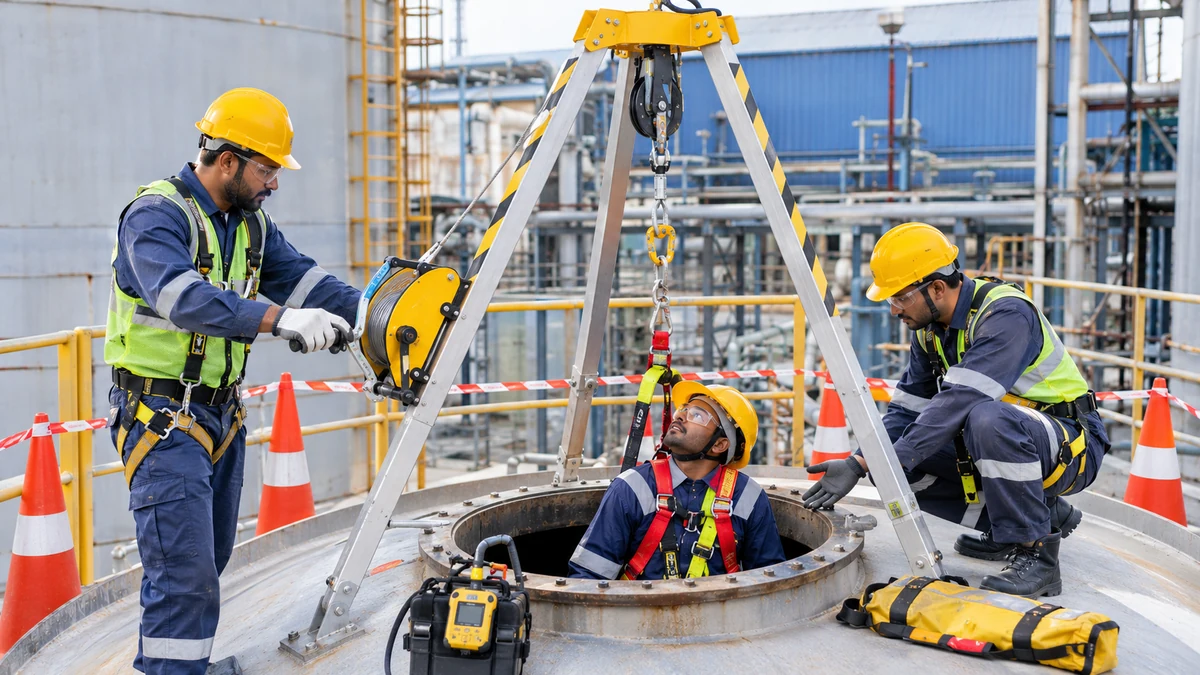
It commonly uses a suitable harness, retrieval line and mechanical retrieval device or fixed anchorage. Depending on the opening and space configuration, the arrangement may include a tripod or davit system.
The main objective is to remove the entrant while avoiding an additional entry into the hazardous environment.
For example, a worker enters a vertical tank through a top manhole. The worker wears a compatible full body harness connected to a retrieval line. The line runs to a suitable retrieval device outside the opening. If the worker becomes incapacitated, the trained attendant or rescue operator can initiate the planned retrieval procedure.
However, non-entry rescue is not suitable for every confined space.
The entrant may become caught on an internal obstruction. The retrieval line may become tangled. The opening may be too small for the worker’s body or equipment. A horizontal entry may prevent a straight retrieval path.
The rescue team must assess these limitations before approving the method.
How Does Non-Entry Rescue Work?
A typical non-entry rescue arrangement follows a planned sequence.
- The entrant wears a suitable harness
The harness must be appropriate for the intended retrieval method. The connection point and line arrangement should allow the entrant to be recovered without creating additional risk.
- The retrieval line connects to an external system
The retrieval line connects to a suitable mechanical device or fixed point outside the confined space. The system must be selected for the space and intended operation.
- The attendant monitors the entrant
The attendant remains outside the space, maintains communication and monitors the entrant’s condition. The attendant must not leave the assigned position or take on tasks that interfere with monitoring.
- The emergency response is activated
If the entrant cannot self-rescue, the attendant raises the alarm and follows the site rescue procedure. The designated rescue personnel take control of the retrieval operation.
- The entrant is recovered
The trained operator uses the planned retrieval arrangement. The team must control the movement of the entrant and prevent contact with the opening or internal obstructions.
- Medical assistance is provided
After recovery, trained personnel assess the entrant and arrange appropriate medical care. The worker may need urgent assessment even if they appear conscious.
The exact procedure depends on the equipment, space geometry and emergency conditions. It must follow the manufacturer’s instructions and the site’s approved rescue method.
When Should Non-Entry Rescue Not Be Used?
Non-entry rescue should not be attempted when the retrieval arrangement cannot recover the entrant safely.
Examples include:
- The entrant is caught behind internal structures.
- The retrieval line is trapped or obstructed.
- The opening cannot accommodate the entrant during extraction.
- The entrant’s position prevents safe retrieval.
- The harness or retrieval arrangement creates a greater hazard.
- The space geometry requires controlled movement or casualty packaging.
- The retrieval equipment cannot be operated safely from outside.
In these situations, the rescue plan must provide an alternative response. This may require a trained entry rescue team with suitable equipment and respiratory protection.
Do not keep pulling against an obstruction. An uncontrolled retrieval attempt can worsen injuries or create further hazards.
Non-Entry Rescue vs Entry Rescue: What Is the Difference?
Non-entry rescue retrieves the entrant from outside the confined space. Entry rescue requires trained rescuers to enter the space to reach and recover the casualty.
| Comparison factor | Non-entry rescue | Entry rescue |
| Rescuer enters the space | No, when the planned method works | Yes |
| Main objective | Retrieve the entrant from outside | Reach and recover an entrant who cannot be retrieved externally |
| Typical equipment | Harness, retrieval line, suitable winch, tripod or davit where appropriate | Respiratory protection, rescue harnesses, communication, retrieval equipment and casualty handling equipment as required |
| Main limitation | Internal obstructions or unsuitable retrieval geometry | Rescuers are exposed to the space’s hazards and need suitable protection |
| Personnel | Trained attendant or retrieval operator, according to the plan | Trained and equipped rescue team |
| Planning requirement | Confirm that the retrieval path and equipment are suitable | Confirm entry method, hazard controls, team capability and backup arrangements |
Neither method should be selected by convenience alone. The risk assessment must establish which method can recover the entrant safely.
A site may plan non-entry retrieval as its primary method and entry rescue as its backup. The backup must be available and capable of responding within a timeframe appropriate to the identified hazards.
How to Prepare a Confined Space Rescue Plan
A practical confined space rescue plan starts with understanding the space and the work. The organisation must then select the rescue method, assign responsibilities, arrange equipment and confirm that the team can perform the procedure.
1. Assess the Confined Space and Its Hazards
Begin by examining the space before anyone enters.
Record its location, access opening, depth, internal layout and likely obstructions. Review the work activity, materials previously stored and any process connections.
Identify hazards that could prevent the entrant from exiting independently.
These may include:
- Oxygen deficiency or oxygen enrichment.
- Toxic gases and vapours.
- Flammable or combustible atmospheres.
- Engulfment by liquids or free-flowing solids.
- Mechanical equipment or moving parts.
- Electrical hazards.
- Heat, pressure or unexpected process releases.
- Restricted movement and difficult access.
- Slippery surfaces and internal obstructions.
Atmospheric conditions may change during the task. The entry procedure should define the required testing and monitoring based on the risk assessment.
The rescue plan should also consider the possibility that the atmosphere becomes unsafe for rescuers.
2. Decide Whether Non-Entry Retrieval Is Feasible
Do not assume that a retrieval line automatically makes non-entry rescue possible.
Assess whether the entrant can be removed through the opening using the proposed equipment.
Consider:
- Opening dimensions and shape.
- Vertical or horizontal access.
- Space depth.
- Entrant position during normal work.
- Internal pipes, ladders, platforms or other obstructions.
- Possibility of entanglement.
- Harness and retrieval line routing.
- Ability to control the entrant during extraction.
A vertical entry with a clear retrieval path may support a mechanical retrieval arrangement. A vessel with a narrow side opening and internal obstructions may require a different method.
Document the selected rescue method and its limitations.
3. Select the Rescue Equipment
Equipment selection must match the space, rescue method and expected conditions.
Depending on the assessment, the arrangement may include:
- Full body harness suitable for the retrieval application.
- Retrieval line and compatible connectors.
- Mechanical retrieval winch or device.
- Tripod or davit system where appropriate.
- Atmospheric monitoring equipment.
- Communication equipment.
- Respiratory protection for trained entry rescuers, where required.
- Lighting and other task-specific rescue equipment.
- First aid and casualty handling equipment.
A tripod should not be treated as a complete rescue solution. It provides a support or anchorage arrangement when used in a suitable configuration. The retrieval device, line, harness, connectors, operator and rescue procedure must also be appropriate.
Indian Inovatix manufactures confined space equipment, including tripods for confined space applications. Its confined space entry equipment range also includes modular davit systems.
The correct configuration must be confirmed against the manufacturer’s technical documentation and the site’s requirements.
4. Assign Clear Rescue Responsibilities
Every person involved in the entry operation must understand their role.
| Role | Main responsibility |
| Entrant | Follows entry instructions, maintains communication and exits when instructed or when conditions require evacuation |
| Attendant | Remains outside, monitors the entrant, raises the alarm and performs assigned non-entry rescue duties |
| Entry supervisor | Verifies entry controls, confirms rescue arrangements and terminates entry when required |
| Retrieval operator | Operates the retrieval equipment according to the approved procedure |
| Rescue team | Performs the designated rescue method, including entry rescue when required |
| First aid personnel | Provide initial medical assistance and coordinate further care |
One person should not be expected to perform several duties if doing so prevents them from carrying out a critical safety responsibility.
For example, the attendant must not leave the entry point to search for equipment while the entrant remains inside. The plan should identify who will operate the retrieval device and who will contact the rescue team.
5. Establish Emergency Communication
The attendant must be able to recognise when the entrant needs assistance.
The communication method may include a radio, wired communication system, visual signals or another suitable method. Select it according to the space layout and the expected working conditions.
The rescue plan should state:
- How the entrant communicates with the attendant.
- How the attendant raises the alarm.
- Who receives the emergency call.
- How the rescue team is contacted.
- Which site emergency number or external service must be called.
- How communication continues during retrieval.
- What happens if communication fails.
A loss of communication should have a defined response. The attendant must not wait indefinitely for the entrant to respond.
6. Confirm the Rescue Team’s Availability and Capability
A rescue service must be capable of handling the actual hazards and access conditions.
Do not select a rescue provider only because it is nearby. Confirm whether its personnel have the training, equipment and practical ability to perform the required rescue.
Discuss the following with the rescue team:
- Types of confined spaces at the site.
- Entry openings and access restrictions.
- Atmospheric and physical hazards.
- Expected rescue methods.
- Equipment available at the location.
- Communication and mobilisation arrangements.
- Medical support and casualty transfer.
- Access to the space for familiarisation and practice.
If the organisation relies on an external rescue service, it should confirm that the service understands the site and can respond within a timeframe appropriate to the hazards.
The plan should not assume that a general emergency response team has confined space rescue capability.
7. Prepare a Backup Rescue Method
A primary rescue method may fail because the entrant is trapped, the retrieval line becomes obstructed or the equipment cannot move the casualty through the opening.
The rescue plan must state what happens next.
For example:
- Stop the retrieval attempt if it creates additional risk.
- Maintain communication if the entrant remains responsive.
- Activate the designated entry rescue team.
- Isolate or control the relevant hazards where possible.
- Confirm atmospheric conditions and required respiratory protection.
- Follow the approved entry rescue procedure.
- Arrange medical support for the recovered entrant.
The backup method must be practical. A line in the rescue document stating “call emergency services” is not enough if the service cannot perform the required rescue.
8. Plan for Medical Assistance After Retrieval
Recovery from the space is not the end of the emergency.
The entrant may have suffered oxygen deprivation, toxic exposure, heat stress, physical injury or another medical emergency.
The rescue plan should identify:
- Who will provide first aid.
- How the casualty will be assessed.
- Whether emergency medical services must be called.
- Where the ambulance or medical team will meet the rescue team.
- How exposure information will be communicated to medical personnel.
- How the casualty will be transferred safely.
The team should make relevant information about the space and suspected exposure available to medical personnel.
Confined Space Rescue Protocol: What to Do During an Emergency
A confined space rescue protocol gives the team a clear sequence of actions when an entrant cannot self-rescue. The exact sequence must follow the site’s approved procedure and the conditions at the time of the emergency.
Step 1: Recognise the Emergency and Raise the Alarm
The attendant must act when the entrant shows signs of distress, stops responding, reports symptoms or cannot exit independently.
An alarm should also be raised when monitoring equipment indicates a dangerous condition or the attendant identifies another emergency.
Do not wait for the entrant to become unconscious before activating the response.
Step 2: Stop the Entry Operation
The entry supervisor should stop the work and prevent further entry.
Where safe and appropriate, isolate the process, equipment or energy source responsible for the hazard. Follow the site’s isolation procedure.
No unauthorised person should enter the space.
Step 3: Assess the Situation from Outside
The attendant and designated rescue personnel should assess the available information without exposing themselves to the same hazard.
Check:
- Last known condition of the entrant.
- Communication status.
- Atmospheric readings and alarms.
- Nature of the work being performed.
- Possible cause of the emergency.
- Entrant location, if known.
- Whether the retrieval line is connected and unobstructed.
Do not enter the space to investigate without the required rescue authorisation, training and protection.
Step 4: Initiate Non-Entry Retrieval When Suitable
If the approved plan identifies non-entry rescue as feasible, the trained operator should initiate the retrieval procedure.
Operate the equipment in accordance with its instructions. Keep the line controlled and monitor the entrant’s movement.
Stop if the entrant becomes caught or the retrieval arrangement creates an additional hazard. Do not use uncontrolled force to overcome an obstruction.
Step 5: Activate the Entry Rescue Team if Required
If non-entry retrieval is not possible or fails, activate the designated entry rescue team.
The team must use the planned method and the equipment selected for the identified hazards. This may require suitable respiratory protection, atmospheric monitoring, communication and casualty recovery equipment.
Untrained coworkers must not enter the space to help.
Step 6: Recover the Entrant and Provide Medical Assistance
Once the entrant is outside, move the person to a safe area without creating additional exposure.
Trained personnel should assess the casualty and provide first aid within their competence. Call emergency medical services when required.
Provide medical personnel with relevant information about the suspected exposure, atmospheric readings and incident circumstances.
Step 7: Secure the Space and Suspend Further Entry
Keep the space closed to further entry until the incident has been investigated and the hazards have been reassessed.
Preserve relevant records, including the entry permit, monitoring readings, equipment details and rescue timeline.
The organisation should review the incident before authorising another entry.
What Equipment Is Required for Confined Space Rescue?
Confined space rescue equipment depends on the space, access arrangement, hazards and selected rescue method. No single equipment list is suitable for every confined space.
| Equipment | Purpose in the rescue arrangement | Selection consideration |
| Full body harness | Connects the entrant to the retrieval arrangement | Harness design and attachment must suit the rescue method |
| Retrieval line | Connects the entrant to the external retrieval point | Length, routing, compatibility and potential obstruction |
| Mechanical winch or retrieval device | Supports controlled retrieval | Must be approved for the intended application |
| Tripod | Provides an overhead support arrangement for suitable openings | Opening geometry, stability and compatible equipment |
| Davit system | Provides an alternative support arrangement for suitable access points | Reach, mounting configuration and working clearance |
| Gas detector | Identifies specified atmospheric hazards | Sensors, calibration, testing and monitoring requirements |
| Communication equipment | Maintains contact between entrant and attendant | Suitability for the environment and space layout |
| Respiratory protection | Protects trained rescuers where the hazard assessment requires it | Correct type, training, fit and operating limits |
| First aid equipment | Supports initial casualty care | Selected according to the site’s emergency arrangements |
The equipment must be compatible as a complete system. Check manufacturer instructions, product ratings, inspection status and approved configurations before use.
How Does a Confined Space Tripod Support Rescue?
A confined space tripod can provide an overhead support arrangement for suitable vertical access openings. When configured with compatible retrieval equipment, it may support controlled lowering, raising or retrieval.
It is commonly considered for applications involving tanks, vessels, manholes and similar access points.
However, a tripod cannot resolve every rescue challenge. It may not be suitable where the opening is awkwardly located, the retrieval path is obstructed or the space requires a different access arrangement.
Indian Inovatix lists its confined space tripod for applications including tanks, vessels, drainage and sewerage systems, pharmaceutical industry and chemical plants. The product page also identifies telescopic legs and a telescopic lowering arm among its listed features.
Review the Indian Inovatix confined space tripod and confirm the required configuration with the manufacturer.
Common Confined Space Rescue Planning Mistakes
A rescue plan can appear complete on paper while remaining difficult to execute in an actual emergency.
The following mistakes should be addressed during planning and drills.
1. Relying Only on Emergency Services
External emergency services may not have the equipment or training required for a particular confined space.
The employer should evaluate the service’s capability and response time. The site must have suitable arrangements for the hazards identified.
2. Assuming Every Entrant Can Be Pulled Out
A retrieval line does not guarantee successful extraction.
Internal platforms, pipes, ladders and other obstructions may prevent movement. The team must assess the actual retrieval path before entry.
3. Using an Untrained Person to Operate Rescue Equipment
Rescue equipment must be operated by personnel trained for the assigned task.
An unfamiliar operator may use the wrong procedure or create additional risk during retrieval.
4. Treating a Tripod as a Complete Rescue Plan
A tripod is a component of a rescue arrangement, not the entire response system.
The plan must also cover harness compatibility, retrieval equipment, personnel, communication, atmospheric hazards and medical support.
5. Failing to Plan for Entry Rescue
Some spaces cannot be cleared through non-entry retrieval.
If the entrant becomes trapped or the retrieval path is obstructed, the organisation needs a suitable alternative. This may require a trained entry rescue team.
6. Skipping Rescue Drills
A written procedure does not prove that the team can perform the rescue.
Practice should reflect the actual opening dimensions, space configuration, equipment and assigned roles. Record any problems and revise the procedure where needed.
How Often Should Confined Space Rescue Drills Be Conducted?
Rescue drills should be conducted at intervals established by the applicable requirements, risk assessment and site procedure. They should also be repeated when changes to the space, equipment or rescue method affect the team’s readiness.
A drill should test more than the operation of a winch.
It should evaluate whether the team can:
- Recognise an emergency.
- Raise the alarm promptly.
- Communicate with the entrant.
- Identify the correct rescue method.
- Operate retrieval equipment safely.
- Respond when the primary method fails.
- Activate the designated rescue team.
- Recover and transfer a casualty.
- Record and review the exercise.
Where possible, use the actual space or a representative space with similar opening dimensions, configuration and access restrictions.
OSHA’s general industry confined space standard, 29 CFR 1910.146, requires employers whose employees are designated to provide rescue to practise permit-space rescues at least once every 12 months. It also requires the practice spaces to represent the openings, configurations and accessibility of the spaces involved.
This is a US regulatory requirement, not a blanket statement of Indian law. Indian employers should identify and follow the requirements applicable to their workplace and industry.
What Standards and Guidance Should Employers Consider in India?
Confined space rescue planning in India should be based on applicable occupational safety requirements, relevant standards, the site’s risk assessment and the manufacturer’s equipment instructions.
The precise legal requirements can vary according to the workplace, industry and applicable regulations. Employers should confirm the current requirements with their EHS and legal compliance teams.
Useful technical references include:
IS 17893:2023: BIS material on confined-space hazards discusses atmospheric and physical hazards and the need for a written confined-space entry programme. Employers should consult the applicable standard text to identify the requirements relevant to their work.
OSHA 29 CFR 1910.146: This US general industry standard provides detailed provisions for permit-required confined spaces, including rescue and emergency services, attendant duties and retrieval systems. It is a useful technical reference but should not be presented as Indian legislation.
UK HSE confined space guidance: The HSE explains the need for suitable emergency arrangements and warns employers not to rely only on emergency services for confined space rescue.
For a site-level compliance review, confirm:
- Applicable Indian legislation and state or industry-specific requirements.
- Confined space identification and risk assessment.
- Entry permit and isolation procedure.
- Atmospheric testing and monitoring arrangements.
- Rescue team capability and availability.
- Equipment certification and manufacturer documentation.
- Training, competency and drill records.
- Medical and emergency response arrangements.
The organisation should not assume that a product certification alone makes the complete rescue arrangement compliant. The installed equipment, its use and the rescue procedure must all be suitable for the application.
Confined Space Rescue Plan Checklist
Use the following checklist during planning. It is a practical review aid, not a replacement for a site-specific risk assessment or approved procedure.
| Planning checkpoint | What should be confirmed |
| Space assessment | Location, opening, depth and internal configuration recorded |
| Hazard assessment | Atmospheric, mechanical, engulfment and physical hazards identified |
| Entry controls | Permit, isolation, testing and monitoring requirements established |
| Rescue method | Non-entry retrieval assessed and limitations documented |
| Backup method | Entry rescue or another suitable alternative arranged where required |
| Harness and retrieval | Compatible equipment selected and inspected |
| Retrieval support | Suitable tripod, davit or anchorage arrangement confirmed where needed |
| Personnel | Entrant, attendant, supervisor and rescue team responsibilities assigned |
| Communication | Alarm, contact and emergency communication methods tested |
| Rescue service | Capability, availability and response arrangements verified |
| Medical support | First aid and medical transfer arrangements identified |
| Practice | Rescue procedure rehearsed in a representative configuration |
| Documentation | Rescue plan, permit, equipment records and drill records available |
The entry supervisor should confirm that the required arrangements are in place before authorising work. If the rescue method is unavailable or unsuitable, entry should not begin.
Frequently Asked Questions
What is a confined space rescue plan?
A confined space rescue plan is a written procedure for recovering an entrant who cannot exit independently. It identifies the rescue method, personnel, equipment, communication process and medical response. The plan must reflect the actual space and its hazards.
What is non-entry rescue in a confined space?
Non-entry rescue retrieves an entrant from outside the confined space without sending another person inside. It may use a harness, retrieval line and mechanical retrieval device. It is suitable only when the opening and internal retrieval path allow safe extraction.
Is non-entry rescue always possible?
No. Internal obstructions, entanglement, restricted openings or the entrant’s position may prevent safe retrieval. The rescue plan must identify these limitations and provide an appropriate alternative.
What should an attendant do when an entrant becomes unresponsive?
The attendant should raise the alarm, follow the approved emergency procedure and summon the designated rescue personnel. They should perform non-entry retrieval only when trained and when the planned method is suitable. They must not enter the space without the required rescue training and protection.
Can a tripod be used for confined space rescue?
A suitable tripod can provide an overhead support arrangement for a compatible retrieval system at appropriate vertical openings. Its suitability depends on the opening, space configuration, equipment compatibility and manufacturer’s instructions. A tripod alone does not constitute a complete rescue plan.
What is the difference between entry rescue and non-entry rescue?
Non-entry rescue retrieves the entrant from outside the space. Entry rescue requires trained rescuers to enter and recover the casualty. The selected method depends on the retrieval path, hazards and whether external retrieval can work safely.
What equipment is needed for confined space rescue?
Equipment may include a suitable harness, retrieval line, mechanical retrieval device, tripod or davit, gas detector, communication equipment and first aid supplies. Entry rescue may require additional respiratory protection and casualty recovery equipment. The risk assessment determines the required configuration.
Should emergency services be the only rescue arrangement?
No. Employers should assess whether external emergency services have the capability and response time needed for the identified hazards. A site may need trained on-site rescuers or a contracted specialist rescue team. The plan must establish how the entrant will be recovered without relying on an unverified assumption.
How often should confined space rescue drills take place?
Drill frequency should follow applicable requirements, the site’s risk assessment and its emergency procedure. OSHA 29 CFR 1910.146 requires designated employee rescue teams in its scope to practise permit-space rescues at least once every 12 months. Indian employers should verify the requirements applicable to their workplace.
What should happen after a confined space rescue?
The entrant should receive an appropriate medical assessment and treatment. The organisation should secure the space, preserve relevant records and investigate the incident. Further entry should remain suspended until hazards and rescue arrangements have been reviewed.
Conclusion
A confined space emergency becomes more difficult when the entrant cannot self-rescue. The response must already be planned, with clear responsibilities, suitable retrieval equipment, trained personnel and a workable backup method.
Non-entry rescue should be assessed first where the space configuration allows safe retrieval. When it cannot work, the organisation must have an appropriate entry rescue arrangement with trained and equipped personnel.
A tripod, winch or retrieval line can support the rescue process, but no individual product replaces a complete emergency plan. The equipment must match the space, and the team must practise the procedure before an emergency occurs.
Indian Inovatix Ltd., Ahmedabad, Gujarat, India, manufactures confined space entry equipment, including tripods and modular davit systems for industrial applications. Selecting the right configuration starts with understanding the entry opening, retrieval path and site-specific rescue requirements.
Is Your Confined Space Rescue Arrangement Ready for an Emergency?
A rescue system should be selected around the actual confined space, not just the equipment available at the site. Review your entry opening, retrieval path, rescue method and equipment compatibility before approving the next entry operation.
Indian Inovatix provides confined space equipment for industrial entry and retrieval applications.
Contact the team to discuss confined space tripod, davit and retrieval equipment for your workplace.
Call us at +91-8849452638 or write to info@indianinovatix.com to get started.


Talk to Our Safety & Protection Specialists
Have questions or need guidance? Our experts can help you choose the most reliable and high-performance safety solutions tailored to your industry and site requirements.
-

- Call Us +91-8849452638
Need Help Determining the Right Fall Protection for You?
With our vast experience, our experts will assist you in selecting the most relevant system for your needs.