August 7, 2026
Adventure tourism is growing rapidly across India. Zipline parks, rope courses, giant swings, free-fall attractions, climbing walls, and aerial adventure parks are attracting thousands of visitors every day. While these activities provide exciting experiences, they also involve managed risks that require careful planning, engineering, inspection, and operation.
Following adventure park safety standards India is not simply about meeting legal expectations. It is about protecting visitors, operators, maintenance personnel, and the long-term reputation of an adventure facility. A well-designed park combines safe ride design, trained operators, documented inspection procedures, emergency planning, and certified personal protective equipment.
The Bureau of Indian Standards (BIS) has revised the IS 15475 series into six parts covering general requirements, safety requirements, design and manufacture, operator training, operation and maintenance, and performance testing for amusement rides. Internationally, ISO 17842 provides guidance for the design, manufacture, operation, inspection, and maintenance of amusement rides and devices.
For operators using activities such as ziplining, aerial trekking, or high ropes courses, selecting certified height safety equipment is equally important. Indian Inovatix Limited, Ahmedabad, Gujarat, India, manufactures fall protection systems, safety harnesses, and height safety equipment that support organisations in creating safer work-at-height and adventure environments.
Key Takeaways
- IS 15475 is the primary Indian standard series covering amusement ride safety and operational practices.
- ISO 17842 complements Indian requirements by providing internationally recognised guidance for ride design and operation.
- Compliance extends beyond rides to include inspections, documentation, operator training, maintenance, and personal protective equipment.
- Adventure parks should establish written safety procedures rather than relying solely on equipment inspections.
- Certified PPE plays an important role wherever participants or operators are exposed to fall hazards.
Why Safety Standards Matter for Adventure Parks
Adventure park safety standards India establish a structured framework for designing, operating, inspecting, and maintaining adventure attractions. These standards help operators reduce operational risks while improving consistency and participant safety.
Adventure activities involve multiple systems working together. A safe zipline, for example, depends not only on the cable but also on anchors, braking systems, platforms, harnesses, connectors, operator training, weather monitoring, and emergency procedures.
Without documented standards, safety practices may vary between operators. This creates unnecessary risks and makes it difficult to maintain consistent operating quality.
A comprehensive safety programme typically includes:
- Risk assessments before installation
- Engineering verification
- Scheduled equipment inspections
- Operator competency training
- Preventive maintenance
- Emergency response planning
- Visitor safety briefings
- PPE inspection procedures
Together, these elements create a structured safety management system rather than relying on individual judgement.
Understanding the IS 15475 Series for Amusement Ride Safety
The IS 15475 series is India’s principal code of recommended practice for amusement ride safety. The revised 2022 edition divides the standard into six specialised parts covering the complete lifecycle of amusement rides and devices.
Many operators are familiar with the standard’s name but are less familiar with what each part actually covers.
| Standard | Primary Focus |
| IS 15475 Part 1 | General information |
| IS 15475 Part 2 | Safety requirements |
| IS 15475 Part 3 | Design, manufacture and erection |
| IS 15475 Part 4 | Selection, training and supervision of operators |
| IS 15475 Part 5 | Operation and maintenance procedures |
| IS 15475 Part 6 | Performance tests |
Rather than treating compliance as a one-time exercise, operators should view these standards as guidance for the complete operational lifecycle of an attraction.
IS 15475 Part 1: General Information
Part 1 introduces the recommended practices for the safe use of permanent and temporary amusement rides. It also makes clear that operators remain responsible for complying with applicable statutory and regulatory requirements in addition to following the standard.
This section establishes the foundation for building a systematic safety programme across an adventure facility.
IS 15475 Part 2: Safety Requirements
Part 2 focuses on the general safety requirements applicable to amusement rides and devices.
These requirements support operators during planning, installation, inspection, and day-to-day operation by identifying practices that contribute to safer ride performance.
IS 15475 Part 3: Design, Manufacture and Erection
Every adventure attraction should begin with sound engineering principles.
Part 3 addresses design, manufacturing, and installation considerations to help ensure rides are constructed and erected according to recognised engineering practices.
This is particularly important for permanent adventure parks where structural integrity directly affects long-term operational safety.
What Does ISO 17842 Cover?
ISO 17842 provides internationally recognised requirements for the design, manufacture, installation, operation, inspection, maintenance, and testing of amusement rides and amusement devices.
Many organisations refer to ISO 17842 when developing operational procedures, particularly where projects involve international consultants, global tourism operators, or multinational investors.
Although Indian operators primarily follow applicable national requirements, understanding ISO guidance helps align operations with internationally accepted engineering and safety practices.
Some key areas addressed by ISO 17842 include:
- Ride design principles
- Manufacturing requirements
- Installation procedures
- Operational controls
- Maintenance planning
- Inspection practices
- Safety testing
- Operator responsibilities
Using internationally recognised practices also demonstrates a stronger commitment to systematic risk management.
Adventure Park Compliance Is More Than Ride Certification
Adventure park compliance India extends beyond installing a ride that meets engineering requirements. Safe operations depend on how the entire facility manages risk throughout the life of the attraction.
Many compliance failures occur because operators focus only on the equipment while overlooking operational procedures.
A comprehensive compliance programme should include:
| Compliance Area | Purpose |
| Risk assessments | Identify operational hazards |
| Operator training | Improve consistent decision-making |
| Daily inspection logs | Record equipment condition |
| Preventive maintenance | Reduce unexpected failures |
| Emergency procedures | Improve incident response |
| PPE management | Ensure suitable protective equipment is available |
Facilities that document these activities are generally better prepared for audits, inspections, and long-term operational management.
How Operator Training Supports Adventure Park Compliance
Adventure park compliance India depends as much on trained personnel as it does on properly designed attractions. Even the safest equipment can become ineffective if operators are not trained to inspect, fit, monitor, and respond correctly during daily operations.
The IS 15475 Part 4 standard focuses on the selection, training, and supervision of amusement ride operators. It recognises that competent personnel are essential for maintaining safe operations and reducing human error. Proper training helps operators make informed decisions before, during, and after every activity.
Adventure park staff should receive training in:
- Ride operating procedures
- Participant eligibility checks
- Harness fitting and adjustment
- Pre-opening inspection routines
- Emergency evacuation procedures
- Incident reporting
- Communication protocols
- Visitor safety briefings
Training should not be treated as a one-time activity. Refresher programmes and competency assessments help maintain consistent operating standards, particularly during peak visitor seasons when new staff may join the team.
Why Operation and Maintenance Procedures Matter
Routine maintenance is one of the most effective ways to prevent equipment-related incidents. Regular inspections help identify wear before it develops into a safety concern, reducing unexpected downtime and supporting long-term equipment performance.
IS 15475 Part 5 provides guidance on operation and maintenance practices for amusement rides and devices. These recommendations encourage operators to establish documented maintenance schedules rather than relying only on visual inspections.
A structured maintenance programme should include:
| Maintenance Activity | Recommended Purpose |
| Daily visual inspection | Identify obvious wear or damage |
| Functional testing | Verify correct operation before opening |
| Scheduled preventive maintenance | Reduce unexpected equipment failure |
| Replacement tracking | Monitor service life of critical components |
| Maintenance records | Support inspections and audits |
| Incident review | Improve future operating procedures |
Maintaining accurate records also demonstrates that safety management is an ongoing operational process rather than an occasional inspection exercise.
Why Performance Testing Is Essential Before Opening an Attraction
Performance testing verifies that an attraction operates as intended before it is made available to visitors. Testing should confirm that mechanical systems, structural components, braking systems, and safety equipment perform consistently under expected operating conditions.
IS 15475 Part 6 addresses performance testing requirements for amusement rides and devices. These tests help operators verify that attractions continue to perform safely after installation, maintenance, or modification.
Performance testing may include:
- Functional operation checks
- Braking system verification
- Structural inspections
- Load testing where applicable
- Emergency stop verification
- Safety system performance checks
Testing should always be documented as part of the park’s overall safety management programme.
The Role of Personal Protective Equipment in Adventure Park Safety
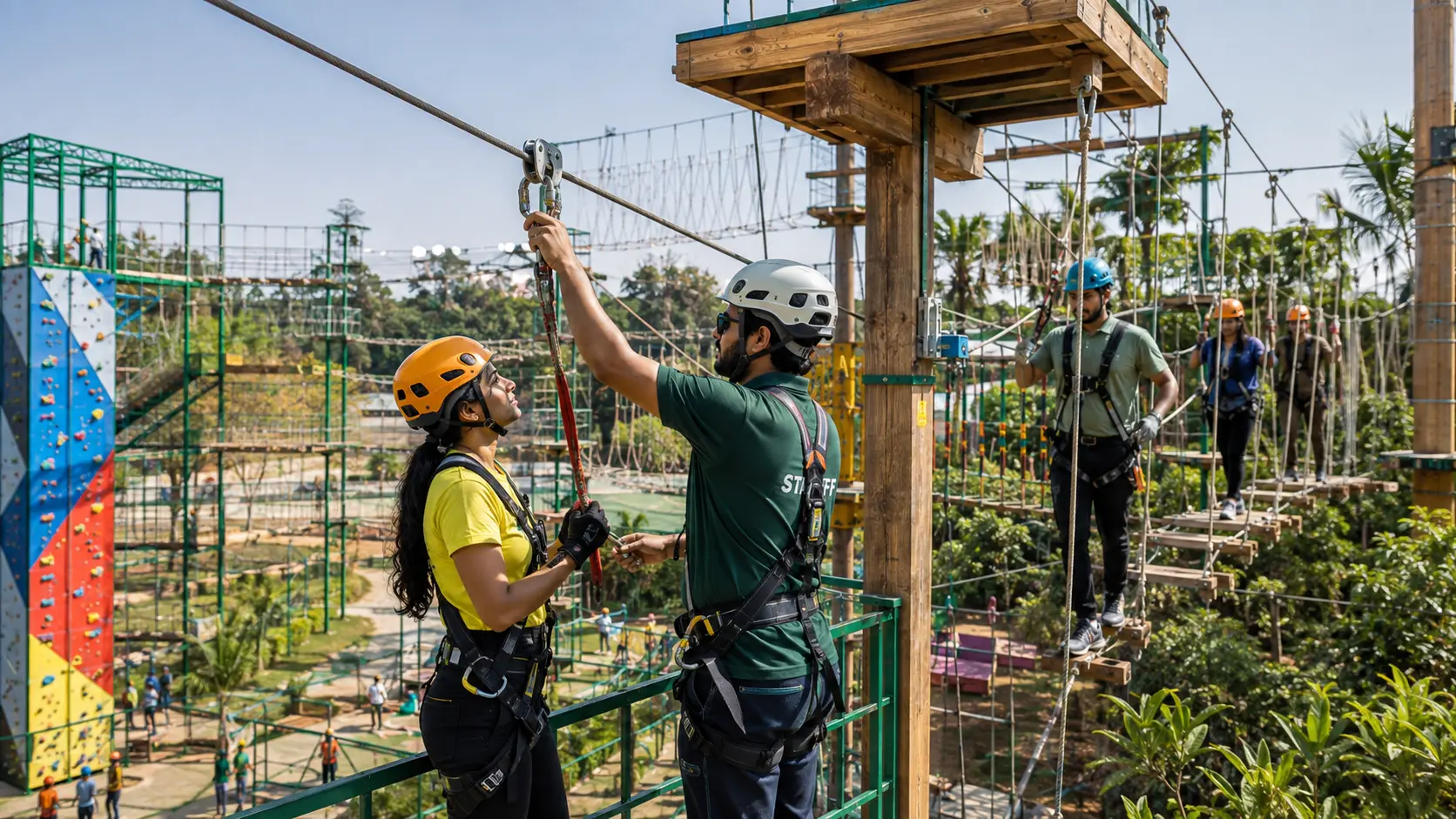
Personal protective equipment forms an important layer of protection wherever participants or staff are exposed to fall hazards. While engineering controls reduce many risks, PPE provides additional protection during activities such as ziplining, aerial trekking, climbing courses, and rescue operations.
Operators should select equipment appropriate for each activity rather than relying on a single product for every application.
Common PPE used in adventure parks includes:
- Full body safety harnesses
- Helmets
- Connectors and carabiners
- Energy absorbing lanyards
- Fall arrest devices
- Anchor connectors
- Lifeline systems
- Rescue equipment
Choosing certified equipment from experienced manufacturers also supports equipment traceability, inspection, and maintenance throughout its service life.
Indian Inovatix Limited, Ahmedabad, Gujarat, India, manufactures height safety equipment for industrial and specialised applications. Its portfolio includes safety harnesses, fall arrest systems, lifeline systems, rescue equipment, and anchor solutions that support organisations working at height.
Common Compliance Mistakes Made by Adventure Park Operators
Many compliance issues arise from operational practices rather than equipment failure. Identifying these gaps early helps operators improve safety while reducing operational risks.
Some of the most common issues include:
Treating Safety as a One-Time Inspection
Safety management should continue throughout the life of the attraction. Daily inspections, maintenance records, and operator training are equally important.
Incomplete Documentation
Inspection records, maintenance logs, and training records provide evidence that safety procedures are being followed consistently.
Using Incorrect PPE
Selecting equipment that does not match the activity or participant can reduce effectiveness. Harnesses, connectors, and helmets should always be suitable for their intended application.
Delaying Preventive Maintenance
Small issues often become larger problems when maintenance schedules are ignored. Preventive maintenance helps reduce unexpected failures and improves operational reliability.
Limited Staff Training
Operators should understand both routine procedures and emergency response actions. Regular refresher training helps maintain competency across the entire team.
Adventure Park Safety Audit Checklist
A documented safety audit helps operators identify areas for improvement before they become operational concerns.
The following checklist provides a useful starting point.
| Audit Item | |
| Risk assessment completed | |
| Ride inspections documented | |
| Maintenance schedule implemented | |
| Operator training records available | |
| Emergency response plan updated | |
| PPE inspected before use | |
| Visitor briefing procedure followed | |
| Incident reporting system maintained |
Completing regular audits encourages continuous improvement and helps establish a stronger safety culture across the facility.
Frequently Asked Questions
Which standard applies to amusement rides in India?
The IS 15475 series is the primary Indian standard covering the design, operation, maintenance, testing, and management of amusement rides and devices.
Does ISO 17842 replace Indian standards?
No. ISO 17842 provides internationally recognised guidance, while operators should also comply with applicable Indian regulations and standards.
Is operator training part of adventure park compliance?
Yes. IS 15475 Part 4 highlights the importance of selecting, training, and supervising operators responsible for amusement rides.
Why are maintenance records important?
Maintenance records demonstrate that inspections and servicing are carried out consistently. They also support audits and help identify recurring equipment issues.
What PPE is commonly used in adventure parks?
Common equipment includes full body harnesses, helmets, connectors, lanyards, lifeline systems, and rescue equipment depending on the activity.
Do adventure parks need documented inspection procedures?
Yes. Written inspection procedures help ensure every attraction is evaluated consistently before opening to visitors.
What are the most important adventure park safety standards in India?
The most recognised adventure park safety standards India include the IS 15475 series and internationally referenced ISO 17842 guidance for amusement rides and devices.
Why is preventive maintenance better than reactive maintenance?
Preventive maintenance identifies wear before it causes failures, helping operators improve safety, reduce downtime, and extend equipment service life.
Conclusion
Adventure parks combine engineering, operations, maintenance, and participant management into a single safety system. Compliance is achieved through consistent processes rather than individual inspections alone.
Understanding the IS 15475 series, recognising the role of ISO 17842, maintaining accurate documentation, and providing trained supervision all contribute to safer adventure environments. Selecting appropriate personal protective equipment further strengthens this safety framework wherever work at height or adventure activities are involved.
As a manufacturer with more than 50 years of experience, a 33,000 sq. ft. production facility, 500,000+ workers protected, and over 1 lakh metres of fall arrest systems installed, Indian Inovatix Limited continues to support organisations across India with certified height safety solutions designed for demanding applications.
Build a Safer Adventure Park With the Right Height Safety Equipment
Meeting safety standards requires more than compliant ride design. It also requires dependable personal protective equipment, documented inspection procedures, and experienced manufacturing partners.
If your adventure park is upgrading its safety programme or planning a new installation, Indian Inovatix Limited can help you identify certified height safety equipment suitable for your operational requirements.
Call us at +91-8849452638 or write to info@indianinovatix.com to get started.


Talk to Our Safety & Protection Specialists
Have questions or need guidance? Our experts can help you choose the most reliable and high-performance safety solutions tailored to your industry and site requirements.
-

- Call Us +91-8849452638
Need Help Determining the Right Fall Protection for You?
With our vast experience, our experts will assist you in selecting the most relevant system for your needs.