April 6, 2026
Falls from height continue to impact industrial sites, construction projects, and infrastructure work. Many teams purchase safety systems without checking clearance requirements. This creates unsafe working conditions and compliance gaps.
A system that stops a fall too late can still result in serious injury. Workers may hit lower levels even when connected to safety equipment.
Understanding fall distance calculation for fall arrest system selection helps teams avoid these risks. Indian Inovatix designs and supplies certified solutions that align with actual site heights, ensuring safe and reliable work at height.
Key Takeaways: Fall Distance Calculation for Fall Arrest System
- fall distance calculation for fall arrest system determines safe equipment selection
- Total fall distance includes multiple components
- Clearance must always exceed calculated fall distance
- Anchor height directly affects safety outcomes
- Shock absorbers increase stopping distance
- Incorrect calculation leads to unsafe setups
- Proper planning supports compliance and worker safety
What is Fall Distance in Fall Arrest Systems
Fall distance refers to the total vertical distance a worker travels before the system stops the fall completely. It includes several contributing elements, not just the initial drop.
Components That Make Up Fall Distance
- Free fall distance
- Deceleration distance
- Harness stretch
- D ring shift
- Safety margin
Each component must be included in the calculation. Missing even one factor can result in unsafe clearance.
When safety teams calculate correctly, they prevent ground impact and ensure reliable system performance.
Why Fall Distance Calculation Must Be Done Before Purchase
Many buyers focus on product type but ignore site conditions. This leads to incorrect system selection and unsafe installations.
Risks When Calculation is Ignored
- Worker strikes lower structure
- Increased injury severity
- Equipment overload
- Inspection failures
Impact on Projects and Operations
- Work stoppage during audits
- Higher costs due to reinstallation
- Delays in project completion
Accurate calculation ensures that equipment matches site requirements and safety expectations.
Detailed Breakdown of Fall Distance Components
Each element adds to total fall distance. Safety teams must understand how they interact during a fall.
Free Fall Distance
This is the distance a worker falls before the system engages.
Typical values:
- Up to 1.8 meters depending on setup
Anchor position affects this directly. Overhead anchors reduce free fall. Lower anchors increase it.
Deceleration Distance
This is the distance required for the system to absorb energy and stop the fall.
Typical value:
- Around 1.2 meters
Shock absorbers extend during this phase.
Harness Stretch
The harness stretches under load when a fall occurs.
Typical value:
- 0.3 to 0.5 meters
This factor must be included in every calculation.
D Ring Shift
The dorsal connection point shifts upward during a fall.
Typical value:
- Around 0.3 meters
This movement increases total fall distance.
Safety Margin
A safety buffer ensures clearance from lower surfaces.
Recommended value:
- Minimum 1 meter
This margin accounts for uncertainty and movement.
Total Fall Distance Formula with Example
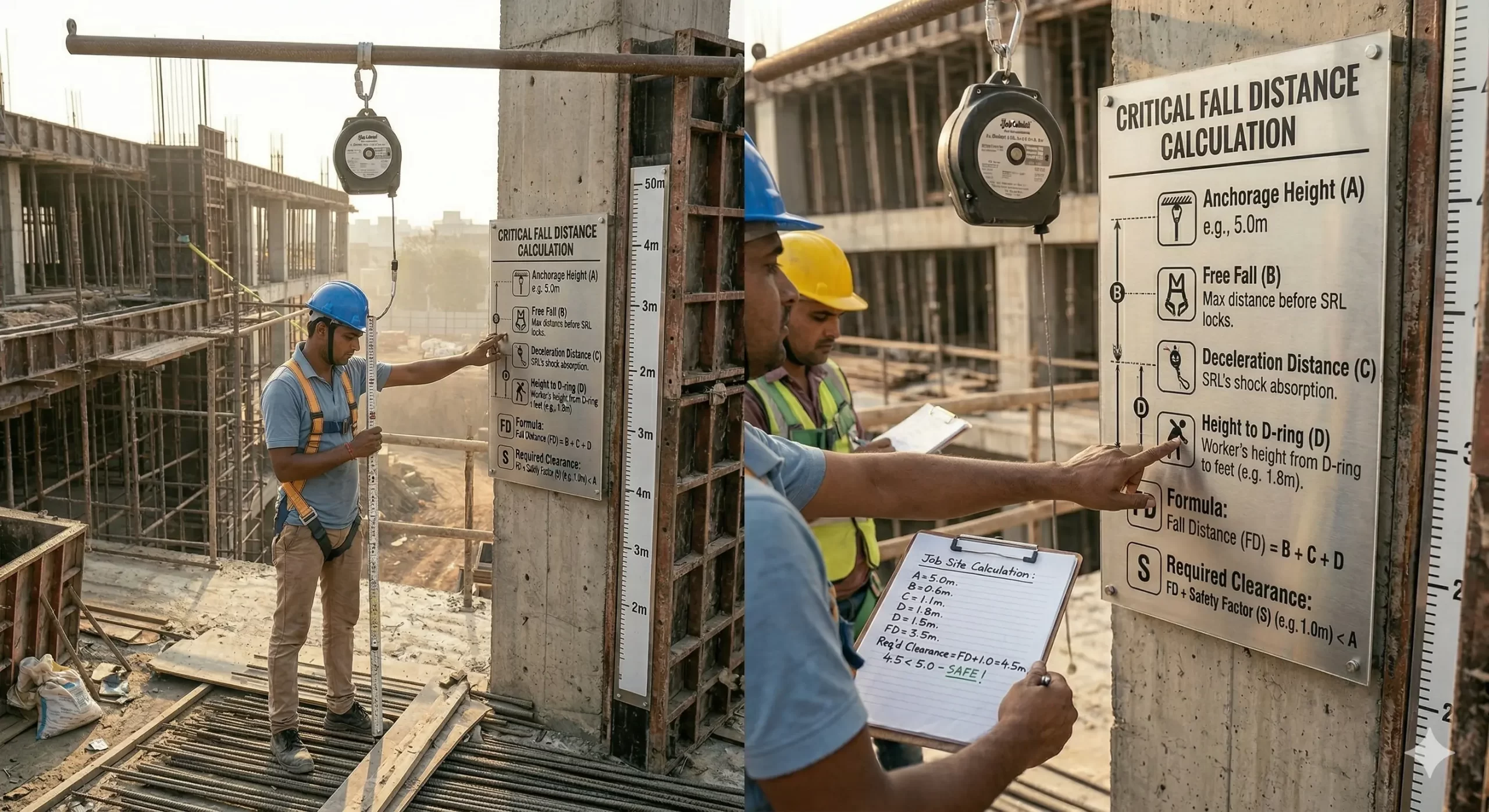
To determine total fall distance, all components must be added together.
Formula
Total Fall Distance = Free Fall + Deceleration + Harness Stretch + D Ring Shift + Safety Margin
Example Calculation Table
| Component | Value |
| Free fall | 1.8 m |
| Deceleration | 1.2 m |
| Harness stretch | 0.4 m |
| D ring shift | 0.3 m |
| Safety margin | 1.0 m |
Total fall distance = 4.7 meters
This result shows the minimum clearance required below the worker.
This calculation plays a direct role in fall distance calculation for fall arrest system selection.
Step by Step Process to Calculate Fall Distance
A structured method ensures accurate results and safe planning.
Step 1: Measure Available Clearance
Measure the vertical space from working level to the nearest obstruction.
Step 2: Identify Anchor Location
Check whether the anchor is above, at shoulder level, or below the worker.
Step 3: Determine Free Fall Distance
Use lanyard length and anchor height to estimate free fall.
Step 4: Add Deceleration Distance
Refer to product specifications for shock absorber extension.
Step 5: Include Harness and D Ring Movement
Add standard values to account for stretch and movement.
Step 6: Add Safety Margin
Include at least 1 meter as a buffer.
Step 7: Compare with Clearance
Ensure total fall distance is less than available clearance.
Following this process ensures safe equipment selection and proper installation.
Common Errors in Fall Distance Calculation
Even experienced teams make mistakes when planning fall protection systems.
Common Issues on Industrial Sites
- Ignoring anchor height
- Using longer lanyards without recalculation
- Skipping safety margin
- Assuming standard values without verification
Consequences of These Errors
- Contact with lower levels
- Increased injury risk
- Failure during inspections
Correcting these errors improves safety and operational continuity.
Fall Distance vs Clearance Requirement
Fall distance must always be lower than available clearance.
Comparison Table
| Scenario | Clearance | Fall Distance | Outcome |
| Scenario A | 5 m | 4.7 m | Safe |
| Scenario B | 4 m | 4.7 m | Unsafe |
This comparison highlights the importance of fall distance calculation for fall arrest system before selecting equipment.
If clearance is insufficient, system type must be changed.
Selecting Equipment Based on Fall Distance
The calculation result determines which system should be used on site.
Low Clearance Conditions
- Use self retracting lifelines
- Reduce free fall distance
Medium Clearance Conditions
- Use shock absorbing lanyards
- Position anchor above worker
High Clearance Conditions
- Standard fall arrest systems can be used
Selecting the correct system ensures both safety and compliance.
Practical Use Cases from Industrial Projects
Real site conditions show how calculations guide decisions.
Warehouse Maintenance Case
Low height restricts clearance.
Teams use retractable systems to limit fall distance.
PEB Roof Work Case
Moderate height with edge exposure.
Overhead anchors reduce free fall and improve safety.
Infrastructure Project Case
Bridge work provides higher clearance.
Standard systems operate effectively.
Each case shows the importance of planning based on actual site conditions.
Indian Inovatix Approach to Fall Protection Systems
Indian Inovatix acts as a manufacturer, supplier, and specialist in fall protection systems across industries.
What Indian Inovatix Provides
- Site specific fall distance evaluation
- Anchorage layout planning
- Equipment selection based on clearance
Product Range
- Self retracting lifelines
- Shock absorbing lanyards
- Horizontal lifeline systems
- Roof safety systems
Industry Applications
- Construction and infrastructure
- Manufacturing plants
- Warehousing operations
- Energy and power projects
Each solution is designed for reliability, compliance, and worker safety.
Compliance Considerations for Fall Distance
Calculation is part of safety compliance and audit readiness.
Key Requirements
- Use certified equipment
- Follow IS and international standards
- Conduct inspections and maintenance
- Train workers for correct usage
Role of Safety Officers
- Verify calculations before work
- Check anchor strength and placement
- Maintain safety documentation
Proper compliance supports safe operations and reduces liability.
FAQs: Fall Distance Calculation for Fall Arrest System
What is fall distance in a fall arrest system?
Fall distance is the total vertical distance a worker travels before the system stops the fall. It includes multiple components beyond free fall.
Why is fall distance calculation required before buying equipment?
It ensures that workers do not hit lower surfaces during a fall. It also helps select the correct system.
What is the standard free fall distance?
Most systems limit free fall to 1.8 meters. This depends on anchor position and setup.
How much clearance is needed for fall arrest systems?
Clearance usually ranges between 4 and 6 meters depending on system configuration.
Can fall distance be reduced?
Yes, using overhead anchors or retractable lifelines reduces total fall distance.
What happens if clearance is less than fall distance?
The worker may strike a lower level, leading to serious injury.
Does anchor position affect fall distance?
Yes, higher anchors reduce free fall. Lower anchors increase total fall distance.
How does fall distance calculation for fall arrest system affect system selection?
It determines whether to use retractable lifelines or lanyards based on available clearance.
Who should calculate fall distance?
Qualified safety professionals should perform calculations before selecting equipment.
Final Word
Safe work at height depends on correct planning and accurate system selection. fall distance calculation for fall arrest system ensures that safety equipment performs as expected during real fall situations.
Each site has different structures, heights, and operational needs. Indian Inovatix stands as a trusted manufacturer, supplier, and specialist delivering fall protection systems designed for these conditions.
Accurate calculation reduces risk, supports compliance, and ensures worker safety.
Every working height needs the right clearance calculation.
Connect with Indian Inovatix to request a quote, schedule a site consultation, or get a customized fall protection solution designed for your project conditions.


Talk to Our Safety & Protection Specialists
Have questions or need guidance? Our experts can help you choose the most reliable and high-performance safety solutions tailored to your industry and site requirements.
-

- Call Us +91-8849452638
Need Help Determining the Right Fall Protection for You?
With our vast experience, our experts will assist you in selecting the most relevant system for your needs.