July 23, 2026
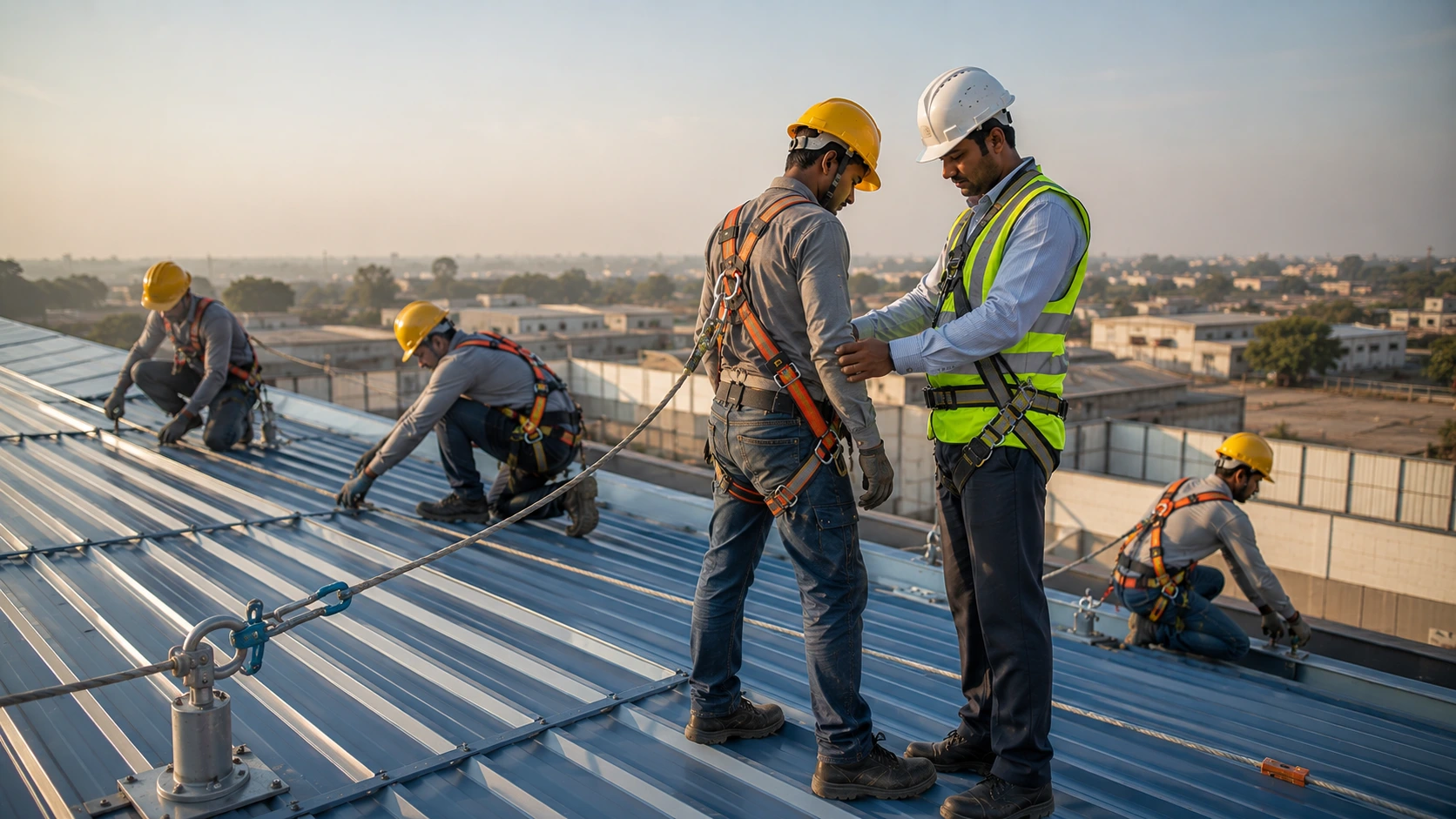
Roofing teams work near open edges, fragile surfaces, sloped roofs, and changing anchor locations. These conditions create serious fall risks.
Selecting the wrong safety harness for roofing can restrict worker movement, create connection problems, and reduce fall protection effectiveness. Roofing contractors need harnesses that fit correctly, meet applicable standards, and connect with the site’s complete fall protection system.
Indian Inovatix Limited, Ahmedabad, Gujarat, India, manufactures fall protection equipment for construction and industrial work at height. With 50 years of manufacturing experience, the company supports safety officers, EPC contractors, and roofing teams with certified height safety equipment.
Key Takeaways
- A safety harness for roofing should match the roof type, fall hazard, anchorage system, and required worker movement.
- Full body harnesses used for fall arrest should meet applicable standards such as IS 3521 or EN 361.
- A correctly positioned dorsal attachment point supports common roofing fall arrest applications.
- Adjustable straps, secure buckles, suitable webbing, and clear inspection labels support safe equipment use.
- Harnesses must remain compatible with lanyards, self retracting lifelines, lifeline systems, connectors, and anchorages.
Why Does Harness Selection Matter for Roofing Work?
A roofing harness must protect workers while allowing safe movement across elevated work areas. The correct harness should suit the roof design, fall protection method, anchorage location, working duration, and environmental conditions.
Roofing work differs from many other construction activities.
Workers frequently move across wide surfaces. They may climb ladders, handle roofing materials, work near edges, and change working positions.
The selected harness must support these movements without creating unnecessary restrictions.
Safety teams should assess:
- Roof slope and surface condition
- Working height
- Unprotected edges
- Fragile roof sections
- Skylights and openings
- Available anchor points
- Required worker movement
- Potential fall distance
- Available fall clearance
- Rescue arrangements
The hazard assessment should determine the complete fall protection system.
A harness alone cannot prevent every roofing fall.
What Features Should I Look for in a Safety Harness for Roofing?
A safety harness for roofing should provide applicable certification, correct sizing, secure adjustment, suitable attachment points, durable webbing, reliable buckles, equipment compatibility, clear inspection labels, and adequate comfort for the expected work duration.
Safety officers and roofing contractors should evaluate each feature before purchasing equipment.
The following features can guide the selection process.
1. Full Body Harness Construction
A full body harness distributes fall arrest forces across stronger areas of the worker’s body.
The harness should support the shoulders, chest, thighs, and pelvic area.
This construction is important because roofing workers can fall from edges, through openings, or from fragile roof surfaces.
A simple waist belt should not replace a full body harness where fall arrest protection is required.
Before selecting equipment, confirm that the harness is intended for the site’s fall protection application.
2. Certification to Applicable Safety Standards
Roofing contractors should verify whether the harness meets applicable national or international safety standards.
EN 361 specifies requirements for full body harnesses used in personal fall protection systems.
Indian buyers should also check applicable IS 3521 requirements and project specifications.
Certification documentation helps safety officers and procurement teams verify product compliance.
Before purchasing harnesses, request:
- Applicable certification information
- Product identification details
- Manufacturer instructions
- Inspection requirements
- Approved applications
- Equipment limitations
Documentation should remain available for safety audits and equipment inspections.
However, certification does not replace a site specific hazard assessment.
The harness must still match the roofing application.
What Safety Standard Should a Roofing Harness Meet?
A roofing harness used for fall arrest should meet applicable full body harness standards and project requirements. EN 361 and relevant IS 3521 requirements are important references for buyers evaluating fall protection equipment in India.
Different components of a roofing fall protection system may follow separate standards.
For example, connectors, energy absorbers, lanyards, lifelines, and anchorages have specific performance requirements.
Safety teams should evaluate the complete system rather than checking the harness certification alone.
3. Suitable Fall Arrest Attachment Points
Attachment points determine how the worker connects to the fall protection system.
A dorsal attachment point is commonly used for fall arrest applications.
Some roofing work methods may require an approved sternal attachment point.
Harness selection should follow the intended connection method and manufacturer’s instructions.
| Harness Attachment Point | Primary Function | Roofing Application |
| Dorsal attachment point | Fall arrest | General roofing and edge exposure |
| Sternal attachment point | Approved fall arrest or climbing systems | Selected vertical access systems |
| Side positioning D rings | Work positioning | Specialized positioning tasks |
| Rescue attachment point | Rescue and retrieval | Planned rescue operations |
More attachment points do not automatically provide better protection.
Each point must serve a defined purpose.
Workers should connect only to attachment points approved for the intended application.
4. Secure and Easy Harness Adjustment
A roofing harness should provide secure adjustment at the shoulders, chest, and legs.
Workers have different body dimensions.
The harness should remain correctly positioned while workers climb, bend, kneel, carry materials, and move across the roof.
Adjustment points should remain secure throughout the work period.
Before starting work, workers should:
- Inspect the harness.
- Put on the harness according to manufacturer instructions.
- Adjust shoulder straps.
- Position and secure the chest strap.
- Adjust both leg straps.
- Confirm the fall arrest attachment point position.
- Perform a movement check.
- Connect to the approved fall protection system.
Supervisors should verify fit during site safety inspections.
Correct adjustment helps maintain harness position during normal work and fall arrest.
How Should a Safety Harness Fit for Roofing Work?
A safety harness should fit securely without restricting movement, circulation, climbing, bending, or kneeling. Straps should remain correctly positioned and flat against the worker’s body during roofing activities.
Loose straps can allow excessive movement during a fall.
Overtightened straps may cause discomfort during long working periods.
Workers should follow manufacturer fitting instructions before every use.
Harness fit should also be checked after major changes in clothing or protective equipment.
5. Durable Webbing for Roofing Conditions
Harness webbing should suit the environmental conditions found on roofing projects.
Roofing equipment may face sunlight, moisture, dust, abrasive surfaces, sharp materials, cement contamination, and changing temperatures.
The selected harness should have materials suitable for the expected working environment.
Safety teams should inspect webbing for:
- Cuts
- Burns
- Abrasion
- Chemical damage
- Excessive contamination
- Broken fibres
- Damaged stitching
- Heat exposure
Damaged webbing can affect equipment condition and requires immediate evaluation.
Harnesses should be stored according to manufacturer instructions when not in use.
6. Reliable Buckles and Connectors
Harness buckles should allow correct adjustment and remain secure during roofing work.
Workers may wear gloves while adjusting equipment.
Therefore, buckles should support practical use without encouraging incorrect fastening.
Common harness buckle designs may include manual adjustment buckles and quick connection systems.
The best choice depends on the work environment, worker training, inspection procedures, and manufacturer specifications.
| Selection Factor | Manual Adjustment Buckles | Quick Connection Buckles |
| Adjustment | Requires manual fitting | Faster connection after adjustment |
| Inspection | Simple visual checks | Requires inspection of locking mechanism |
| Common use | General construction applications | Frequent harness use and repeated access |
| Selection priority | Secure adjustment | Correct locking and practical use |
Procurement teams should consider equipment usage frequency.
They should also evaluate inspection requirements and replacement costs.
7. Compatibility With Roofing Fall Protection Systems
A harness must connect correctly with the other components of the roofing fall protection system.
Roofing workers may use:
- Energy absorbing lanyards
- Self retracting lifelines
- Horizontal lifeline systems
- Vertical lifeline systems
- Rope grabs
- Anchorage connectors
- Permanent roof anchorages
Equipment compatibility is a major selection factor.
Incorrect combinations can create connection problems and affect fall clearance requirements.
Safety teams should verify connector dimensions, equipment instructions, anchorage location, and system configuration.
Indian Inovatix Limited manufactures fall protection equipment and engineered systems for work at height applications.
The company has manufactured and installed more than 1 lakh metres of fall arrest systems across India.
What Should a Roofing Harness Connect To?
A roofing harness should connect to an approved fall protection system through the designated fall arrest attachment point. The system may include a lanyard, self retracting lifeline, or lifeline system connected to a suitable anchorage.
The connection method depends on the roof design and work activity.
Safety teams must also calculate available fall clearance.
The system should prevent workers from striking lower levels, structures, or equipment during a fall.
8. Adequate Worker Comfort for Long Roofing Tasks
Comfort affects how workers wear and adjust harnesses during long roofing activities.
Roofing teams may work for several hours while climbing, kneeling, bending, and handling materials.
Poorly fitted equipment can create pressure around the shoulders, chest, and thighs.
Features that may support comfort include:
- Appropriate harness sizing
- Practical strap adjustment
- Correct weight distribution
- Suitable padding where required
- Breathable construction where available
Additional padding is not always necessary.
Padding can increase harness weight, retain heat, and require additional inspection.
Safety officers should evaluate comfort according to work duration and environmental conditions.
Worker trials can support equipment selection for large roofing teams.
9. Clear Labels and Equipment Traceability
Harness labels help safety teams identify equipment and manage inspection records.
The product should provide clear information according to applicable certification and manufacturer requirements.
Important information may include:
- Manufacturer identification
- Product model
- Applicable standard
- Manufacturing information
- Equipment identification
- User instructions reference
Safety teams should keep equipment records for inspection and replacement planning.
Harnesses with missing or unreadable identification information should be evaluated according to manufacturer requirements and company safety procedures.
Equipment traceability supports consistent fall protection management across multiple roofing projects.
10. Inspection and Maintenance Requirements
Roofing harnesses should support practical inspection and equipment management procedures.
Workers should inspect harnesses before every use.
Formal inspections should follow manufacturer instructions, applicable requirements, and company safety procedures.
Inspect:
- Webbing condition.
- Stitching.
- D rings.
- Buckles.
- Adjustment hardware.
- Labels.
- Signs of contamination.
- Evidence of fall arrest loading.
Equipment showing damage or questionable condition should be removed from service.
Harnesses involved in a fall arrest event should be handled according to manufacturer instructions and site procedures.
Roofing Harness Feature Comparison Checklist
A structured checklist helps safety officers and procurement teams compare harnesses before purchasing equipment.
| Feature | Why It Matters | What Buyers Should Check |
| Full body construction | Supports fall arrest force distribution | Harness designed for fall arrest applications |
| Certification | Supports compliance verification | Applicable IS or EN documentation |
| Dorsal attachment | Provides common fall arrest connection | Correct position and approved application |
| Adjustable straps | Supports correct worker fit | Shoulder, chest, and leg adjustment |
| Webbing | Affects durability | Suitability for site conditions |
| Buckles | Supports secure adjustment | Locking, operation, and inspection requirements |
| System compatibility | Affects complete system performance | Lanyard, lifeline, connector, and anchorage compatibility |
| Labels | Supports traceability | Clear product and certification information |
| Inspection requirements | Supports equipment management | Practical inspection procedures |
| Worker comfort | Supports prolonged use | Fit, movement, weight, and working conditions |
Buyers should use the checklist alongside a roofing hazard assessment.
The cheapest harness or the harness with the most features is not automatically the correct choice.
Should Roofing Contractors Buy the Same Harness for Every Worker?
Roofing contractors should not automatically issue one harness model or size to every worker. Selection should consider worker dimensions, work activities, attachment requirements, environmental conditions, and the site’s complete fall protection system.
Standardizing equipment can simplify procurement and inspections.
However, standardization should follow technical evaluation.
For example, teams performing general roof installation may use one harness configuration.
Workers using specialized access or positioning methods may require another configuration.
Large EPC contractors should conduct wearer trials before bulk procurement.
This process helps identify fitting problems and equipment management requirements before site deployment.
What Mistakes Should Buyers Avoid When Selecting Roofing Harnesses?
Buyers should avoid selecting roofing harnesses without checking certification, worker fit, attachment points, environmental conditions, equipment compatibility, fall clearance, inspection requirements, and supplier documentation.
Common mistakes include:
- Buying equipment only by price
- Assuming every harness fits every worker
- Choosing unnecessary D rings
- Ignoring available fall clearance
- Mixing incompatible system components
- Failing to review certification documentation
- Ignoring roof specific hazards
- Selecting equipment without wearer trials
- Failing to plan inspections and replacement
These mistakes can increase costs and create gaps in fall protection procedures.
Safety officers, EPC contractors, and procurement teams should evaluate both equipment and system requirements.
A harness is effective only when correctly selected, fitted, connected, inspected, and used.
Why Choose Indian Inovatix Limited for Roofing Fall Protection Equipment?
Indian Inovatix Limited is a manufacturer of fall protection equipment and engineered height safety systems based in Ahmedabad, Gujarat, India. The company supports roofing, construction, infrastructure, EPC, and industrial applications.
Indian Inovatix Limited has 50 years of manufacturing experience.
The company manufactured its first vertical fall arrest system in 1979.
It manufactured its first retractable block in 1985.
Since 1993, the company has manufactured and installed more than 100 overhead horizontal lifeline systems.
Indian Inovatix Limited operates a 33,000 sq ft production facility.
The company has protected more than 500,000 workers and manufactured and installed more than 1 lakh metres of fall arrest systems across India.
Its project experience includes supplying organizations such as ISRO and BARC.
Indian Inovatix Limited holds ZED Gold certification from the Ministry of MSME, awarded in February 2026.
Roofing contractors can work with Indian Inovatix Limited for harness selection, compatible fall protection equipment, technical documentation, and engineered height safety systems.
Frequently Asked Questions
What is the most important feature of a roofing safety harness?
Correct certification, fit, attachment configuration, and system compatibility are primary selection factors. A harness should match the roof hazards and complete fall protection system. No single feature can replace proper system evaluation.
Is a full body harness required for roofing work?
A full body harness is commonly required when workers use a personal fall arrest system. The harness distributes arrest forces across stronger body areas. Applicable regulations, project requirements, and site hazards should determine the final system.
Which D ring should roofing workers use for fall arrest?
A dorsal attachment point is commonly used for roofing fall arrest applications. Some systems may permit another approved attachment point. Workers must follow equipment instructions and use only designated fall arrest connections.
Should a roofing harness meet EN 361 requirements?
EN 361 specifies requirements for full body harnesses used in personal fall protection systems. Buyers should verify applicable standards and project specifications before purchasing. Indian organizations should also review relevant IS 3521 requirements.
Can roofing workers use a harness with a self retracting lifeline?
Yes, when the harness, self retracting lifeline, connector, and anchorage are compatible and approved for the application. Safety teams must also evaluate anchorage location and available fall clearance. Manufacturer instructions should guide system configuration.
How tight should a roofing safety harness be?
A safety harness should fit securely without restricting normal movement or circulation. Straps should remain correctly positioned while workers climb, bend, kneel, and move across the roof. Workers should follow manufacturer fitting instructions.
How often should roofing harnesses be inspected?
Workers should perform a pre use inspection before every use. Formal inspections should follow manufacturer instructions, company procedures, and applicable safety requirements. Damaged equipment should be removed from service.
Can one safety harness fit every roofing worker?
No. Workers have different body dimensions and may require different harness sizes or adjustment ranges. Contractors should verify fit before issuing equipment, especially for large teams.
Where can contractors source roofing safety harnesses in India?
Contractors in Ahmedabad, Gujarat, and other regions of India can source equipment from qualified fall protection manufacturers that provide applicable technical and certification documentation. Indian Inovatix Limited manufactures height safety equipment from its Ahmedabad facility.
Why is compatibility important when selecting a safety harness for roofing?
A safety harness for roofing works as one part of a complete fall protection system. The harness must connect correctly with lanyards, lifelines, connectors, and anchorages. Safety teams should verify the entire system before site use.
Conclusion
Selecting roofing fall protection equipment requires a structured assessment of site hazards and worker requirements.
Safety officers should evaluate certification, harness fit, attachment points, webbing, buckles, comfort, equipment traceability, inspection requirements, and complete system compatibility.
The correct safety harness for roofing supports worker protection, equipment management, and consistent fall protection procedures.
Indian Inovatix Limited, Ahmedabad, Gujarat, India, is a manufacturer, supplier, and specialist in fall protection equipment.
With 50 years of manufacturing experience, the company supports roofing contractors, EPC companies, procurement teams, and safety officers with certified height safety equipment and engineered systems.
Your Roofing System Is Only as Effective as Its Equipment Selection
Roofing workers depend on compatible equipment that matches roof hazards, anchor locations, working methods, and movement requirements.
Indian Inovatix Limited can help contractors assess their roofing fall protection requirements and select certified harness equipment suited to the application.
Request a quote for certified safety harnesses for roofing projects with applicable EN and ANSI compliance documentation.
Call us at +91-8849452638 or write to info@indianinovatix.com to get started.

Categories
Latest Post
- September 12, 2026 Work at Height Rules India: What Employers Need to Know in 2026
- September 5, 2026 Coconut Tree Climber Machine Buying Guide for Indian Farmers
- August 29, 2026 Best Safety Harness for Construction: How to Choose the Right One

Corporate Profile
Download CatalogueTalk to Our Safety & Protection Specialists
Have questions or need guidance? Our experts can help you choose the most reliable and high-performance safety solutions tailored to your industry and site requirements.
-

- Call Us +91-8849452638
Need Help Determining the Right Fall Protection for You?
With our vast experience, our experts will assist you in selecting the most relevant system for your needs.