August 19, 2026
Roofing teams work around open edges, roof openings, fragile surfaces, sloped areas, and changing work conditions. Choosing the wrong fall protection gear for roofing projects can increase fall exposure and create compliance gaps.
The right equipment must match the roof structure, worker movement, anchorage arrangement, fall distance, and work activity. A full body harness alone is not a complete fall protection solution. Roofing safety may also require lifelines, anchors, connectors, energy absorbing devices, and a planned rescue method.
Indian Inovatix Limited, Ahmedabad, Gujarat, India, manufactures fall protection equipment and engineered height safety systems for construction and industrial applications. The company has more than 50 years of manufacturing experience and has installed over 1 lakh metres of fall arrest systems across India.
Key Takeaways
- The right fall protection gear for roofing projects depends on roof design, work activity, worker movement, anchorage, and available fall clearance.
- A full body harness should connect to a compatible fall arrest or restraint system designed for the roofing application.
- Roof work may require horizontal lifelines, roof fall arrest systems, retractable devices, anchors, and suitable connectors.
- EN 361 and applicable IS 3521 requirements should be considered when selecting full body harnesses for Indian projects.
- Indian Inovatix manufactures roof fall protection systems, harnesses, lifelines, anchors, and related height safety equipment from its manufacturing facility in Gujarat.
What Fall Protection Gear Is Needed for Roofing Projects?
Fall protection gear for roofing projects is a combination of personal protective equipment and engineered systems designed to protect workers from roof falls. The equipment should match the roof structure, work method, hazards, and required movement.
A typical roofing setup can include a full body harness, connecting device, anchorage, and horizontal or vertical lifeline. The exact combination depends on whether workers are installing sheets, inspecting the roof, maintaining equipment, or accessing different roof areas.
Roofing teams should assess the following before selecting equipment:
- Roof height and slope
- Open roof edges
- Skylights and roof openings
- Fragile roofing materials
- Available structural anchorage
- Worker movement requirements
- Required fall clearance
- Weather and site conditions
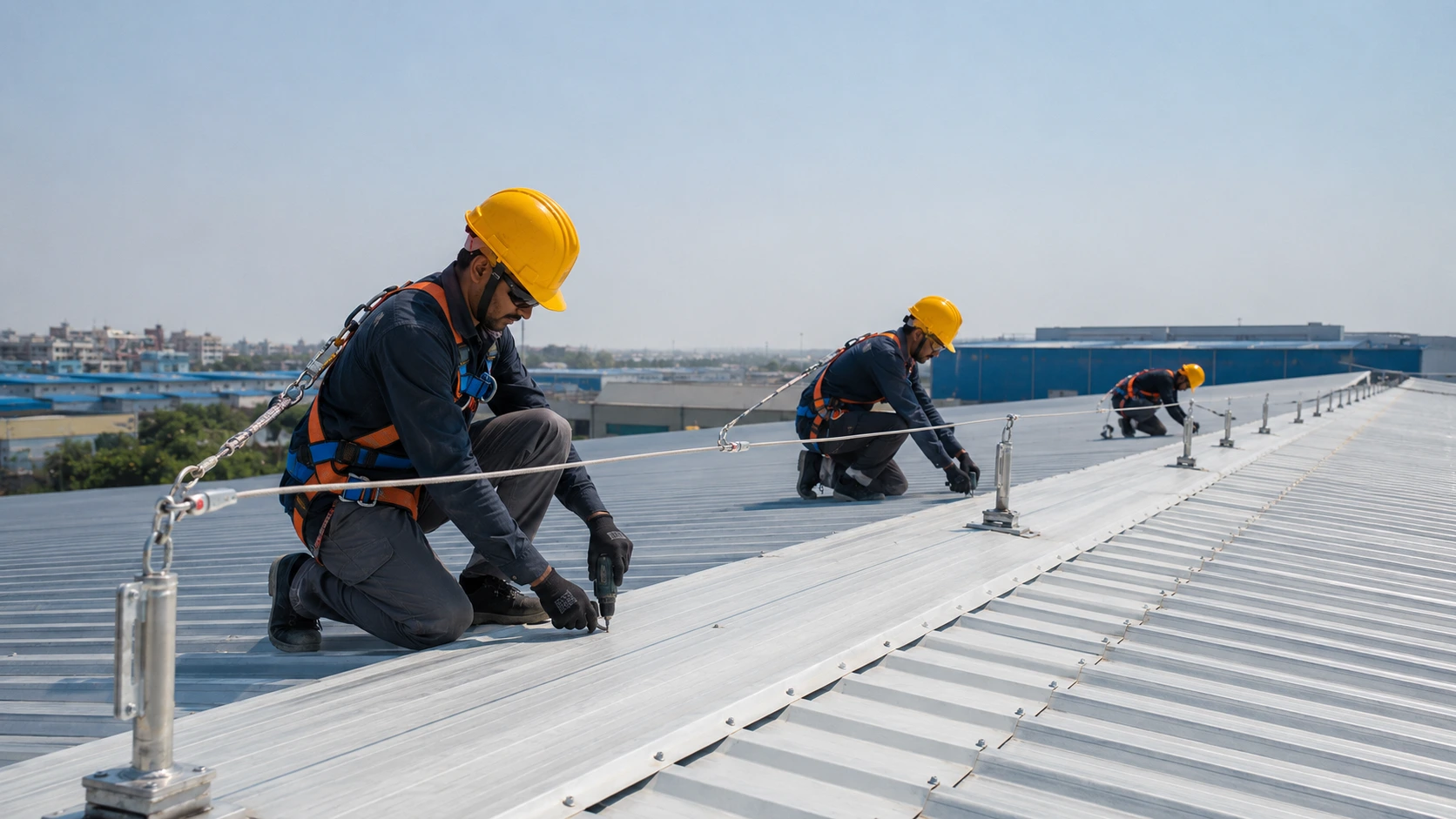
For example, a worker performing maintenance across a long roof span may need continuous movement. A suitable horizontal lifeline can provide attachment while allowing the worker to move along the work area.
Indian Inovatix provides a dedicated fall arrest systems that includes roof and horizontal lifeline solutions.
How Do I Choose the Right Roof Safety Harness?
A roof safety harness should provide full body support, suitable attachment points, correct sizing, and compatibility with the selected fall protection system. For fall arrest applications, a harness meeting applicable requirements such as EN 361 should be considered.
A full body harness distributes arrest forces across stronger areas of the body. It is different from a waist only belt, which does not provide the same fall arrest function.
When selecting a harness, check:
- Certification and applicable standards
- Correct size and adjustment range
- D ring configuration
- Webbing and stitching condition
- Compatibility with connectors and lifelines
- Suitability for the roofing environment
The dorsal attachment point is commonly used for fall arrest. Other attachment points may serve different functions, depending on the harness design and certified application.
Indian Inovatix manufactures full body harnesses designed for construction and industrial work. Its published product information identifies EN 361 and IS 3521 as important standards for harness selection.
Which harness standard should roofing teams check?
EN 361 specifies requirements for full body harnesses used in fall arrest systems. The IS 3521 series also provides applicable requirements for personal fall protection equipment in India.
| Selection factor | What to check |
| Harness type | Full body fall arrest harness |
| Main attachment | Suitable certified fall arrest point |
| Standard | EN 361 and applicable IS 3521 requirements |
| Material | Suitable for site exposure |
| Fit | Correct adjustment for each worker |
| Compatibility | Works with the selected connector and lifeline |
Certification should be verified through product documentation before procurement.
When Should You Use a Roof Fall Arrest System?
A roof fall arrest system is appropriate when workers remain exposed to a fall hazard and other prevention methods cannot provide adequate protection. The system must connect workers to suitable structural anchorage and provide enough clearance for safe fall arrest.
Roofing projects often involve long work areas. Workers may need to move while installing panels, inspecting joints, maintaining equipment, or servicing rooftop machinery.
A roof system can provide continuous protection across suitable roof sections.
Indian Inovatix manufactures an Over the Roof Fall Arrest System designed for roofs and pre engineered buildings. The published product information specifies a stainless steel 316 system, continuous movement over long spans, waterproofing, standing seam roof compatibility, and a shock absorber.
This type of engineered solution can be more suitable than relying on individual temporary attachment points when the work requires repeated movement across a roof.
How Do You Select the Right Lifeline for Roofing?
The correct lifeline depends on the direction of movement, roof layout, anchorage arrangement, and work activity. Horizontal lifelines are generally suited to tasks where workers need to move across a roof while remaining connected.
A roofing team should review the complete system before installation.
Important checks include:
- Roof construction and structural capacity
- Lifeline route
- Anchorage locations
- Number of workers using the system
- Required clearance
- Connector compatibility
- Rescue access
A horizontal lifeline can support movement along a roof, while a retractable fall arrest device may suit applications requiring controlled movement around a specific anchorage.
Indian Inovatix’s fall arrest range includes horizontal lifeline systems and roof fall arrest systems for construction and maintenance applications.
The choice should be based on engineering assessment rather than selecting equipment only because it is commonly used on other sites.
What Should You Check Before Buying Roofing Fall Protection Equipment?
Roofing safety equipment should be selected after reviewing the complete work method, site hazards, equipment certification, and compatibility. Procurement teams should evaluate the complete system rather than purchasing individual products without checking how they connect.
A practical selection process is:
- Identify all roof fall hazards.
- Determine whether prevention, restraint, or fall arrest is required.
- Identify suitable structural anchorage.
- Select the correct full body harness.
- Select compatible connectors and lifelines.
- Calculate required fall clearance.
- Confirm certification and technical documentation.
- Establish inspection and rescue procedures.
This process helps safety officers and EPC contractors avoid common procurement errors.
Buying a harness without checking the anchorage system is one example. Selecting a lifeline without reviewing roof structure is another. Both decisions can create system compatibility problems.
Indian Inovatix has manufactured and installed more than 1 lakh metres of fall arrest systems across India. Its 33,000 sq ft production facility in Gujarat supports manufacturing of height safety equipment and engineered systems.
What Is the Difference Between Roofing Harnesses and Roof Lifelines?
A roofing harness supports the worker’s body during fall arrest, while a roof lifeline provides the connection route between the worker and an approved anchorage system. They work together as parts of a complete fall protection arrangement.
| Equipment | Main function | Roofing application |
| Full body harness | Supports worker during fall arrest | General roof work |
| Energy absorbing lanyard | Helps control fall forces | Short movement areas |
| Retractable device | Controls connecting line movement | Maintenance and access |
| Horizontal lifeline | Allows continuous movement | Long roof spans |
| Roof anchorage | Provides structural connection | Fixed work locations |
| Connectors | Join system components | Harness and lifeline connection |
The system should be evaluated as a complete assembly. Using certified equipment individually does not automatically make an incorrectly configured system safe.
How Do Standards Affect Roofing Fall Protection Selection?
Safety standards provide defined requirements for equipment design, testing, and performance. For roofing projects in India, teams should review applicable IS requirements alongside project specifications and internationally recognised standards such as EN 361.
EN 361 applies to full body harnesses used in fall arrest systems. The IS 3521 series covers different components of personal fall protection systems, including harnesses, lanyards, connectors, lifelines, and related equipment.
For procurement teams, certification documentation is important because it helps demonstrate that equipment meets the specified requirements.
However, certification is only one part of selection. The equipment must also suit the roof structure, work method, anchorage arrangement, and available fall clearance.
How Should Roofing Teams Inspect Fall Protection Gear?
Roofing teams should inspect fall protection equipment before use and follow the manufacturer’s inspection and replacement requirements. Any equipment showing damage, excessive wear, compromised stitching, or other defects should be removed from service.
Workers and supervisors should check:
- Webbing for cuts, burns, or excessive wear
- Stitching for damage
- Buckles and adjustment points
- D rings and connectors
- Lifeline components
- Anchorage connections
- Product identification and certification information
Inspection becomes especially important on roofing projects because equipment can face sunlight, moisture, dust, sharp edges, and construction debris.
A documented inspection process also helps safety teams maintain equipment records and support site audits.
Why Choose Indian Inovatix for Roofing Fall Protection?
Indian Inovatix Limited, Ahmedabad, Gujarat, India, is a manufacturer and specialist in fall protection and height safety systems. The company has more than 50 years of manufacturing experience and supplies equipment across construction, infrastructure, industrial, and maintenance applications.
The company manufactured its first vertical fall arrest system in 1979 and its first retractable block in 1985. It has also protected more than 500,000 workers across India and installed over 1 lakh metres of fall arrest systems.
Indian Inovatix has supplied safety equipment to organisations including ISRO and BARC. The company also holds ZED Gold certification from the Ministry of MSME, awarded in February 2026.
For roofing applications, its product range includes full body harnesses, roof fall arrest systems, horizontal lifelines, retractable fall arrest blocks, anchors, and connectors.
How do I choose fall protection gear for roofing projects?
Choose fall protection gear for roofing projects according to the roof structure, work activity, worker movement, anchorage, fall clearance, and applicable standards. A complete setup may include a full body harness, lifeline, connectors, and engineered anchorage.
Is a full body harness enough for roof work?
No. A full body harness is one component of a complete fall protection system. Workers also need a suitable connection device and approved anchorage or lifeline system.
What standard applies to roofing safety harnesses?
EN 361 specifies requirements for full body harnesses used in fall arrest systems. Indian projects should also review applicable IS 3521 requirements and project specifications.
Are horizontal lifelines suitable for rooftop work?
Yes, horizontal lifelines can be suitable when workers need continuous movement across a roof. The system must be designed for the roof structure, anchorage arrangement, worker load, and required clearance.
What fall protection equipment is used on roofs in India?
Common equipment includes full body harnesses, energy absorbing lanyards, retractable fall arrest devices, horizontal lifelines, roof anchors, and connectors. The final selection depends on the specific roofing application.
What should EPC contractors check before installing roof lifelines?
EPC contractors should review roof construction, structural anchorage, worker movement, system layout, certification, fall clearance, and rescue arrangements. Engineering assessment should be completed before installation.
Can fall protection systems be used on pre engineered buildings?
Yes. Indian Inovatix’s Over the Roof Fall Arrest System lists roofs and pre engineered buildings among its applications. The published system also includes stainless steel 316 construction and continuous movement over long spans.
Where can companies source roofing fall protection equipment in India?
Companies can source certified roofing fall protection equipment from specialised manufacturers. Indian Inovatix Limited manufactures and supplies fall protection systems from Gujarat for construction and industrial applications across India.
Choose the Roof System Around the Work, Not Just the Equipment
The right fall protection gear for roofing projects must match the roof, work method, worker movement, anchorage, clearance, and applicable safety requirements. A certified harness cannot compensate for an unsuitable lifeline or poorly selected anchorage.
Indian Inovatix Limited, Ahmedabad, Gujarat, India, combines more than 50 years of manufacturing experience with engineered fall protection solutions for roofing and industrial applications. Its systems support construction teams, EPC contractors, and safety professionals seeking documented and application specific height safety equipment.
Does Your Roofing System Match the Actual Work?
Roofing teams need protection that supports movement while maintaining a properly engineered connection to the structure. Indian Inovatix can help evaluate the required harness, lifeline, anchorage, and related fall protection equipment for the application.
Request a roofing fall protection solution based on your roof structure and work requirements.
Call us at +91-8849452638 or write to info@indianinovatix.com to get started.


Talk to Our Safety & Protection Specialists
Have questions or need guidance? Our experts can help you choose the most reliable and high-performance safety solutions tailored to your industry and site requirements.
-

- Call Us +91-8849452638
Need Help Determining the Right Fall Protection for You?
With our vast experience, our experts will assist you in selecting the most relevant system for your needs.