August 10, 2026
Workers performing tasks at height often need more than fall arrest protection. They may need stable support while drilling, welding, maintaining equipment, climbing structures, or working on poles. Choosing the right best lanyards for work positioning helps workers maintain a controlled position while keeping both hands available for the task.
Work positioning lanyards are different from standard fall arrest lanyards. Their purpose is to support positioning and restraint, not to act as the primary protection against a free fall. Where a fall hazard remains, the positioning system should be combined with an appropriate fall arrest system.
Indian Inovatix Limited, Ahmedabad, Gujarat, India, manufactures height safety equipment for construction, infrastructure, telecom, industrial maintenance, and other work at height applications.
Key Takeaways
- The best lanyards for work positioning depend on the worker’s task, anchor arrangement, required adjustment, and exposure to fall hazards.
- EN 358 applies to belts and lanyards used for work positioning and restraint applications.
- Adjustable positioning lanyards are useful when workers need to change their working distance from the structure.
- A work positioning lanyard should not be treated as a substitute for a fall arrest system where a free fall remains possible.
- Indian Inovatix manufactures harnesses with lateral D rings designed for work positioning applications.
What Is a Work Positioning Lanyard?
A work positioning lanyard is a connecting device designed to support a worker in a stable working position while performing tasks at height. It normally connects the worker’s positioning attachment points to a suitable anchorage or structure.
Unlike a fall arrest lanyard, a positioning lanyard is intended to help workers maintain their position rather than arrest a free fall. This distinction is important when selecting equipment for industrial work.
Work positioning is common in applications where workers need hands-free support. Examples include telecom tower maintenance, utility work, steel erection, industrial maintenance, and structural inspection.
A suitable positioning system can help reduce unnecessary movement while allowing workers to concentrate on the task.
Common work positioning applications include:
- Telecom tower maintenance
- Utility and pole work
- Steel structure maintenance
- Industrial equipment servicing
- Construction activities
- Elevated inspection work
Indian Inovatix identifies work positioning systems as suitable for maintenance, inspection, and tower climbing applications. Its harness systems can include lateral D rings specifically intended for positioning applications.
Which Types of Lanyards Are Best for Work Positioning?
The best lanyard type depends on how much movement the worker needs and how the lanyard will connect to the supporting structure. Adjustable positioning lanyards are often useful because the worker can control the distance between the harness and the structure.
A fixed length positioning lanyard can be suitable where the working distance remains consistent. An adjustable version provides more flexibility when the worker changes position during the task.
The main options include:
| Lanyard type | Main purpose | Typical application |
| Adjustable positioning lanyard | Controlled positioning | Towers and structures |
| Fixed positioning lanyard | Stable working position | Repetitive fixed tasks |
| Rope positioning lanyard | Adjustable connection | Utility and maintenance work |
| Twin positioning arrangement | Greater positioning flexibility | Structural work |
| Energy absorbing fall arrest lanyard | Fall arrest | Where free fall protection is required |
The last option serves a different primary function. A fall arrest lanyard should not be selected simply because it looks similar to a positioning lanyard.
The correct selection starts with the work method and the hazard assessment.
How Does an Adjustable Work Positioning Lanyard Work?
An adjustable work positioning lanyard allows the worker to change the effective connection length while maintaining support against the structure. This makes it useful when workers need to lean, reach, or reposition themselves during elevated work.
Adjustment is particularly useful on towers and structures where the distance between the worker and anchorage changes throughout the task.
The worker typically connects the positioning lanyard between the lateral positioning attachment points on a compatible harness and an appropriate structural anchorage.
The basic selection process is:
- Identify the working position required.
- Determine the distance from the worker to the structure.
- Select a suitable adjustable lanyard length.
- Confirm compatibility with the harness attachment points.
- Verify the anchorage and connection arrangement.
- Check whether separate fall arrest protection is required.
Adjustment should always be controlled according to the manufacturer’s instructions. Workers should not modify, knot, or alter a certified lanyard.
What Standard Applies to Work Positioning Lanyards?
EN 358 is the key European standard associated with belts and lanyards used for work positioning and restraint. It addresses equipment intended to support workers during positioning tasks rather than primary fall arrest.
This distinction matters because EN 358 and EN 355 address different functions. EN 358 relates to work positioning and restraint, while EN 355 applies to energy absorbing lanyards used within fall arrest systems.
Indian buyers should also check the applicable IS 3521 requirements and the certification documentation supplied with the equipment.
| Standard | Primary function |
| EN 358 | Work positioning and restraint |
| EN 355 | Energy absorbing fall arrest lanyards |
| EN 361 | Full body fall arrest harnesses |
| IS 3521 | Indian personal fall protection requirements |
For procurement teams, the standard should match the intended application. A product certified for one function should not automatically be assumed suitable for another.
When Should You Use a Work Positioning Lanyard?
A work positioning lanyard is appropriate when a worker needs controlled support while carrying out a task at height. It is especially useful when the worker must remain close to a structure and use both hands for the job.
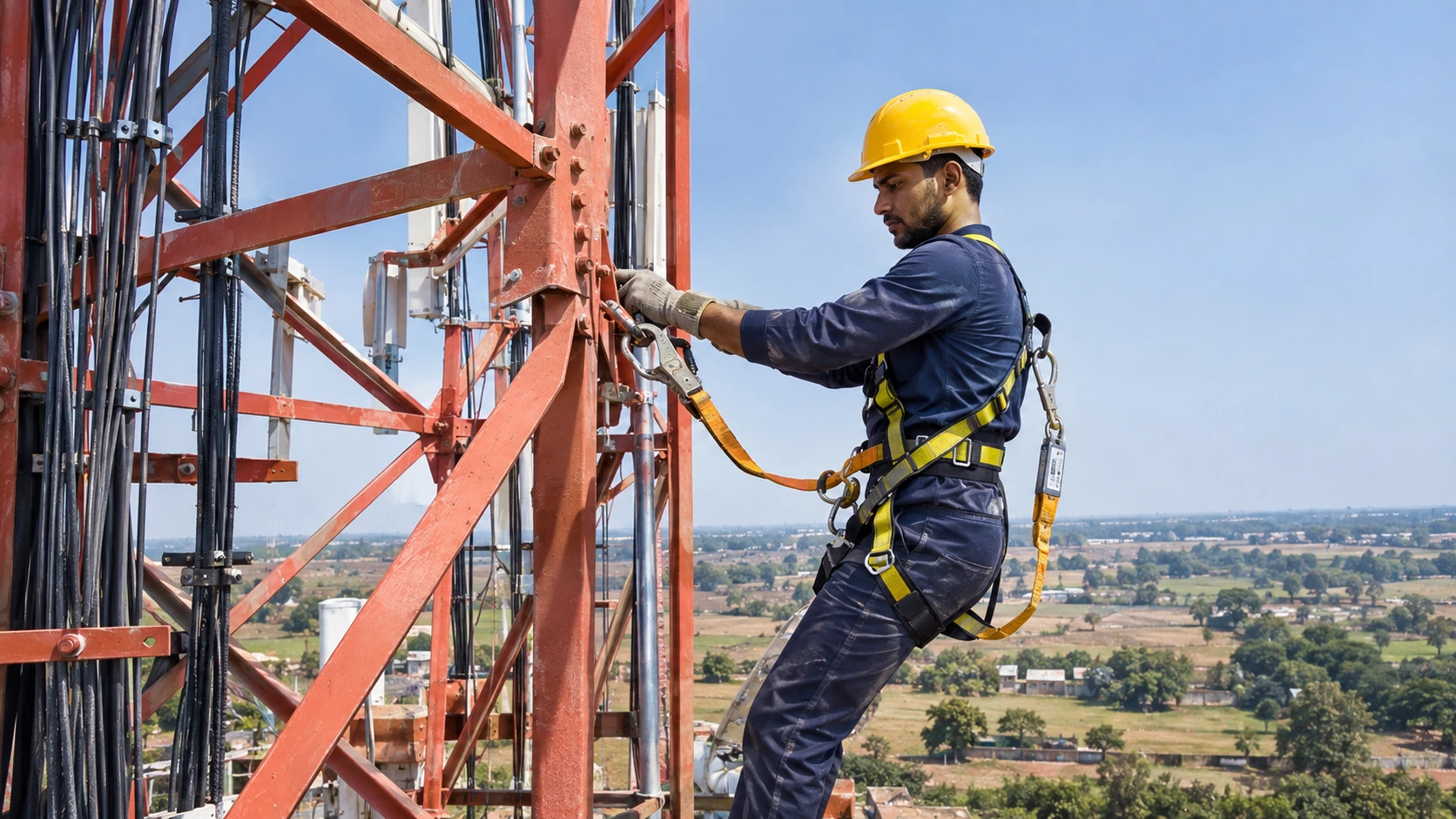
Telecom technicians are one common example. While maintaining equipment on a tower, workers may need to lean against the structure and maintain a stable working position.
Similarly, maintenance teams working on steel structures may use positioning equipment while performing inspection, bolting, painting, or servicing tasks.
However, positioning equipment has an important limitation. If the worker can fall from the working position, a separate fall arrest system may be necessary.
Indian Inovatix’s guidance on work positioning states that EN 358 systems should not be treated as primary fall arrest systems where free fall risk exists.
What Is the Difference Between Work Positioning and Fall Arrest Lanyards?
Work positioning and fall arrest lanyards perform different safety functions. A positioning lanyard supports the worker in a controlled position, while a fall arrest lanyard is designed to form part of a system that arrests a fall.
Understanding this difference prevents incorrect equipment selection.
| Feature | Work positioning lanyard | Fall arrest lanyard |
| Main function | Positioning | Fall arrest |
| Typical standard | EN 358 | EN 355 |
| Main attachment | Side positioning D rings | Approved fall arrest attachment |
| Hands-free work | Yes | Not its primary purpose |
| Fall arrest function | No | Yes, when correctly configured |
| Typical use | Tower and structural work | Construction and maintenance |
For example, Indian Inovatix’s IIL 111 Zeus Series full body harness includes two lateral D rings for work positioning, along with dorsal and sternal D rings for fall arrest. This configuration allows the harness to support different applications when used according to its intended design.
How Do You Choose the Right Lanyard Length?
Lanyard length should match the worker’s required working position and the distance between the harness and anchorage. Excess length can create unnecessary movement, while insufficient length can restrict the task.
For adjustable lanyards, workers can normally fine tune the connection distance within the permitted adjustment range.
Before procurement, safety teams should consider:
- Distance between worker and structure
- Required reach
- Structure geometry
- Anchorage position
- Worker movement
- Equipment compatibility
- Environmental exposure
The lanyard should allow the worker to perform the intended task without creating unnecessary slack or unsafe positioning.
A site assessment is useful when several workers perform different tasks across the same structure.
What Should You Check Before Buying Positioning Lanyards?
Procurement teams should verify the lanyard’s intended application, standard, material, length, adjustment mechanism, connectors, and compatibility with the selected harness.
A practical purchasing checklist includes:
- Confirm that the lanyard is designed for work positioning.
- Check EN 358 or applicable Indian certification requirements.
- Verify the correct harness attachment points.
- Check lanyard length and adjustment range.
- Review connector type and gate configuration.
- Confirm compatibility with the work environment.
- Review inspection and replacement requirements.
- Ensure workers receive suitable training.
Equipment selection should also consider exposure to sunlight, moisture, chemicals, dust, sharp edges, and mechanical wear.
For industrial buyers, documentation is equally important. Certification records, product identification, inspection procedures, and manufacturer instructions should be available for site audits.
Can a Work Positioning Lanyard Replace a Fall Arrest Lanyard?
No. A work positioning lanyard should not replace a fall arrest system when the worker remains exposed to a free fall. Positioning equipment supports stability, while fall arrest equipment provides protection when a fall occurs.
This distinction is one of the most important points for safety officers and supervisors.
A worker may need both systems during the same task. For example, a tower technician can use a positioning lanyard to maintain a stable working position while remaining connected to an independent fall arrest system.
The complete arrangement should be selected based on the site’s risk assessment, anchorage, worker movement, and fall clearance.
Indian Inovatix provides fall protection systems that can support applications requiring positioning and fall arrest equipment.
Why Choose Indian Inovatix for Work Positioning Equipment?
Indian Inovatix Limited, Ahmedabad, Gujarat, India, is a manufacturer of fall protection and height safety equipment with more than 50 years of experience. The company has manufactured its first vertical fall arrest system in 1979 and its first retractable block in 1985.
The company has protected more than 500,000 workers across India and installed over 1 lakh metres of fall arrest systems. Its 33,000 sq ft production facility supports manufacturing for construction, infrastructure, industrial, telecom, and other applications.
Its IIL 111 Zeus Series full body harness includes two lateral D rings for work positioning, along with dorsal and sternal D rings for fall arrest and a ventral D ring for rope access applications.
This type of multi application harness can support work positioning when used with a suitable positioning lanyard and according to the manufacturer’s instructions.
What Are the Best Lanyards for Work Positioning?
The best lanyards for work positioning are those designed and certified for the specific positioning task, with suitable adjustment, length, connectors, and harness compatibility. Adjustable lanyards are often useful where workers need to change their position around a structure.
For fall hazards, positioning equipment should be combined with a suitable fall arrest system.
Are work positioning lanyards covered by EN 358?
Yes. EN 358 covers belts and lanyards intended for work positioning and restraint. It does not make a positioning lanyard a substitute for a fall arrest system.
Can a work positioning lanyard stop a fall?
A work positioning lanyard is not intended to serve as the primary fall arrest device. Where a free fall is possible, an appropriate fall arrest system should also be provided.
What is the difference between EN 358 and EN 355?
EN 358 relates to work positioning and restraint equipment. EN 355 relates to energy absorbing lanyards used as part of fall arrest systems.
Which lanyard is suitable for telecom tower work?
Adjustable positioning lanyards are commonly suited to tower work because they allow technicians to maintain a controlled position around the structure. A separate fall arrest connection may also be required.
Can positioning lanyards be used with a full body harness?
Yes, when the harness has suitable positioning attachment points. For example, Indian Inovatix’s IIL 111 harness includes two lateral D rings for work positioning.
Are positioning lanyards used in India?
Yes. Positioning systems are used across applications such as telecom, utility, construction, steel structures, and industrial maintenance. The equipment should meet the applicable project and certification requirements.
How do I choose the right positioning lanyard length?
Select the length according to the working distance, structure geometry, required reach, and adjustment range. The lanyard should allow controlled positioning without creating unnecessary slack.
Select the Lanyard for the Task, Not Just the Application
The best lanyards for work positioning are selected by looking at the complete work system. Task requirements, harness attachment points, anchorage, lanyard length, adjustment, certification, and fall exposure all affect the final choice.
Indian Inovatix Limited, Ahmedabad, Gujarat, India, manufactures height safety equipment for industrial and infrastructure applications. Its work positioning harness configurations and fall protection systems support teams that require controlled positioning alongside appropriate fall protection.
Does Your Positioning Setup Match the Work?
Choosing a positioning lanyard without checking the harness, anchorage, and fall exposure can create an incomplete safety system. Indian Inovatix can help safety teams and procurement professionals identify suitable positioning equipment for their application.
Request a positioning lanyard and harness solution based on your work conditions and required safety system.
Call us at +91 88494 52638 or write to info@indianinovatix.com to get started.


Talk to Our Safety & Protection Specialists
Have questions or need guidance? Our experts can help you choose the most reliable and high-performance safety solutions tailored to your industry and site requirements.
-

- Call Us +91-8849452638
Need Help Determining the Right Fall Protection for You?
With our vast experience, our experts will assist you in selecting the most relevant system for your needs.