September 12, 2026
Work at height remains a major safety concern across construction, infrastructure, manufacturing, telecom, power, and industrial maintenance. The work at height rules India update for 2026 is important because India’s occupational safety framework has changed following implementation of the Occupational Safety, Health and Working Conditions Code, 2020.
The OSH&WC Code became effective from 21 November 2025 and consolidated several central labour laws, including the Factories Act, 1948 and the Building and Other Construction Workers Act, 1996.
For employers, safety officers, EPC contractors, and procurement teams, the practical focus remains clear: identify fall hazards, provide suitable protection, train workers, inspect equipment, and maintain compliance records.
Indian Inovatix Limited, Ahmedabad, Gujarat, India, manufactures fall protection equipment and engineered height safety systems for industrial and construction applications.
Key Takeaways
- The OSH&WC Code, 2020 has been effective across India since 21 November 2025.
- The Central Government published the Occupational Safety, Health and Working Conditions Central Rules, 2025 as draft rules on 30 December 2025.
- Employers must provide suitable safety arrangements based on workplace hazards and applicable requirements.
- IS 3521:2021 provides Indian specifications for personal fall arrest equipment, including full body harnesses, lanyards, energy absorbers, and lifelines.
- Companies should check central requirements, applicable state rules, project specifications, and relevant BIS standards before finalising a work at height system.
What Has Changed in India’s Work at Height Rules?
The biggest regulatory change is the implementation of the Occupational Safety, Health and Working Conditions Code, 2020. The Code came into force on 21 November 2025 and rationalised 29 central labour laws.
The Code includes provisions covering employer duties, occupational safety and health standards, safety committees, safety officers, construction work, factories, mines, plantations, and other workplaces.
The Ministry of Labour and Employment subsequently published the draft Occupational Safety, Health and Working Conditions Central Rules, 2025 on 30 December 2025. The draft states that the proposed rules would apply across India and would take effect upon publication in the Official Gazette.
This means safety teams should not rely only on older references to the Factories Act or BOCW framework. Compliance reviews should now consider the OSH&WC Code, applicable rules, BIS standards, and project specific requirements.
What Do Employers Need to Do for Work at Height?
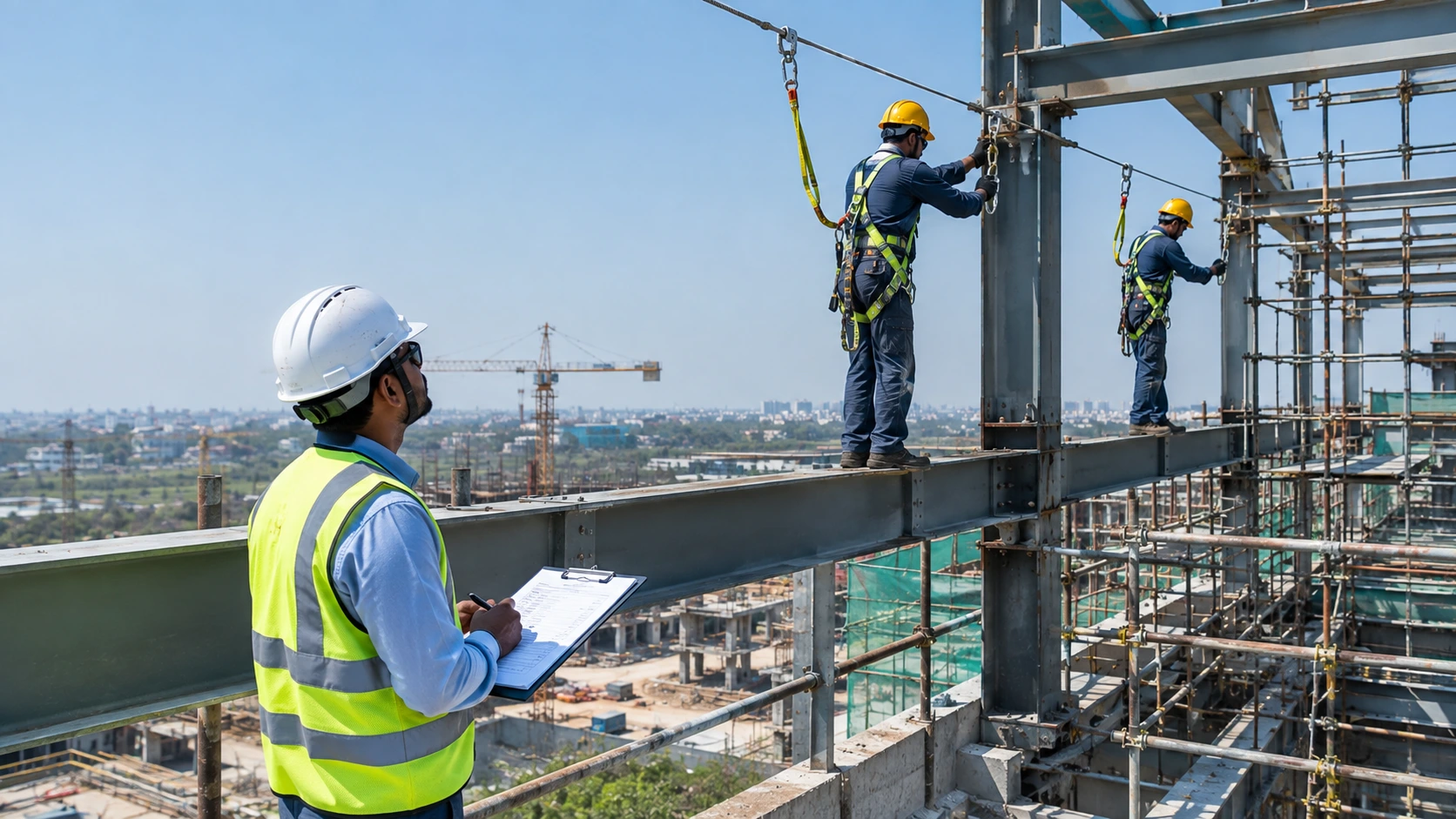
Employers should identify fall hazards and establish suitable controls before workers perform tasks at height. The protection method should match the workplace, activity, equipment, and level of risk.
A practical work at height programme should cover:
- Identify open edges, openings, fragile surfaces, scaffolds, roofs, towers, and elevated platforms.
- Assess the possibility and consequences of a fall.
- Use collective protection where suitable.
- Provide appropriate personal fall protection where required.
- Ensure anchorage and connecting systems are suitable.
- Train workers before assigning height related work.
- Inspect equipment before use.
- Maintain records of training, inspections, and corrective actions.
The OSH&WC Code specifically contains employer duties and provisions concerning occupational safety and health standards.
For a construction project, this approach should be incorporated into the site’s safety plan rather than treating a harness as an isolated PPE purchase.
Is There a 2 Metre Rule for Work at Height in India?
There is no single universal 2 metre threshold that should be treated as the complete national rule for every Indian work at height situation. The applicable requirement depends on the activity, workplace, applicable rules, and project requirements.
This distinction matters because older construction rules and sector specific requirements contain different measurements for particular protections.
For example, the earlier BOCW Central Rules contained requirements for guardrails and other construction safety measures at specified heights. They should not be presented as a universal 2 metre rule for every workplace.
Therefore, safety officers should avoid using a simple height number as the only basis for deciding whether fall protection is required.
The correct question is:
Does the work expose a person to a fall hazard, and what protection is required by the applicable law, standard, and site risk assessment?
Which Safety Harness Standard Applies in India?
IS 3521:2021 is the key Indian standard series for personal fall arrest systems. Part 1 covers full body harnesses, while other parts address lanyards and energy absorbers, self retracting lifelines, vertical systems, horizontal lifelines, and related equipment.
| Equipment | Relevant Indian Standard |
| Full body harness | IS 3521 Part 1:2021 |
| Lanyards and energy absorbers | IS 3521 Part 2:2021 |
| Self retracting lifelines | IS 3521 Part 3:2021 |
| Vertical rails and lifelines | IS 3521 Part 4:2021 |
| Flexible horizontal lifelines | IS 3521 Part 8:2021 |
| Descending devices | IS 3521 Part 9:2021 |
BIS identifies IS 3521 as a personal fall arrest system series. Its Part 1 specification covers full body harnesses used to protect workers from fall related injuries.
Procurement teams should therefore check the exact standard applicable to each component instead of treating all fall protection equipment as one product category.
Does IS 3521 cover only safety harnesses?
No. The IS 3521 series covers several personal fall arrest system components. The applicable part depends on the equipment being purchased.
What Fall Protection Equipment Should Companies Provide?
Fall protection equipment should be selected according to the work activity and the designed protection system. A full body harness alone does not create a complete fall arrest system.
Depending on the application, equipment may include:
- Full body harnesses
- Energy absorbing lanyards
- Self retracting lifelines
- Vertical lifelines
- Horizontal lifelines
- Anchorage systems
- Connectors
- Rescue and descent equipment
IS 3521 includes standards for several of these equipment categories.
For example, a worker installing equipment on a roof may require a horizontal lifeline. A worker climbing a tower may require a vertical fall protection system. The correct solution depends on the task and structure.
Indian Inovatix manufactures and supplies fall arrest systems and full body harnesses for construction and industrial applications.
What Training Is Required for Workers at Height?
Workers should be trained in the hazards associated with their tasks, safe operating procedures, equipment use, inspection, and emergency response. Training should be specific to the equipment and work activity.
A practical programme should cover:
- Fall hazard identification.
- Correct harness fitting.
- Correct attachment point selection.
- Lifeline and connector use.
- Pre use inspection.
- Safe movement at height.
- Rescue procedures.
- Reporting damaged equipment.
The draft Central Rules also include provisions dealing with employee duties and unsafe or unhealthy workplace conditions. They require workers to report unsafe conditions through the prescribed workplace safety channels.
Training should therefore be supported by supervision and documented site procedures.
How Should Fall Protection Equipment Be Inspected?
Fall protection equipment should be inspected before use and maintained according to the manufacturer’s instructions and applicable site procedures. Damaged equipment should not remain in service.
Inspectors should check:
- Webbing and stitching
- D rings and hardware
- Buckles
- Connectors
- Energy absorbers
- Lifelines
- Anchorage components
- Identification labels
The inspection record should identify the equipment, inspection date, condition, and corrective action where required.
A documented inspection process also helps safety teams demonstrate control during internal and external audits.
What Should EPC Contractors Check in 2026?
EPC contractors should review both regulatory requirements and project specifications before approving a fall protection system. The equipment should be compatible with the structure and work method.
A useful compliance checklist includes:
| Check | Requirement |
| Legal framework | OSH&WC Code and applicable rules |
| Equipment standards | Relevant IS 3521 parts |
| Risk assessment | Documented fall hazards |
| Anchorage | Suitable structural connection |
| PPE | Correct full body harness and connectors |
| Training | Worker and supervisor training |
| Inspection | Pre use and periodic checks |
| Rescue | Practical rescue arrangement |
| Documentation | Certificates, manuals, inspection records |
The OSH&WC Code includes provisions covering construction work and occupational safety responsibilities.
What Is the 2026 Compliance Priority for Indian Companies?
The priority is to move from simple PPE purchasing toward a documented fall protection programme. Equipment selection should follow risk assessment, system design, training, inspection, and rescue planning.
The regulatory framework is now centred on the OSH&WC Code, while technical equipment selection can be supported by relevant Indian Standards such as IS 3521.
Indian companies should also monitor applicable state rules because labour administration and detailed requirements can involve central and state frameworks.
For Gujarat projects, for example, safety teams should review the applicable Gujarat requirements alongside central legislation, BIS standards, and project specifications.
Frequently Asked Questions
Are work at height rules updated in India?
Yes. The OSH&WC Code, 2020 became effective on 21 November 2025. The Central Government published draft Central Rules on 30 December 2025.
Is a safety harness required for every job at height?
Not automatically. The required protection depends on the fall hazard, applicable rules, risk assessment, and work method.
What is the Indian standard for full body harnesses?
IS 3521 Part 1:2021 specifies requirements for full body harnesses used in personal fall arrest systems.
Is the 2 metre rule mandatory across India?
No. A universal 2 metre rule should not be applied to every workplace. Requirements depend on the applicable legislation, rules, activity, and project conditions.
Does the OSH Code replace the Factories Act?
The OSH&WC Code repealed the Factories Act, 1948 from its commencement, subject to the Code’s savings provisions.
Do construction companies need fall protection training?
Yes. Workers should receive training appropriate to their work, hazards, equipment, and emergency procedures.
Does IS 3521 cover lifelines?
Yes. Different parts of IS 3521 cover equipment such as vertical lifelines, self retracting lifelines, and flexible horizontal lifelines.
What records should safety teams maintain?
Maintain risk assessments, training records, equipment certificates, inspection records, maintenance details, and rescue procedures.
Do state requirements still matter?
Yes. Companies should check applicable central and state requirements, especially where detailed rules or local enforcement requirements apply.
Keep Your Work at Height Programme Ready for 2026
The work at height rules India update reflects a broader shift toward a consolidated occupational safety framework under the OSH&WC Code. However, compliance still requires more than buying a harness.
Employers should assess hazards, select suitable fall protection systems, use equipment meeting applicable standards, train workers, inspect equipment, and maintain documentation.
Indian Inovatix Limited, Ahmedabad, Gujarat, India, manufactures fall protection systems, full body harnesses, lifelines, anchorage systems, and other height safety equipment. The company has more than 50 years of manufacturing experience, with over 1 lakh metres of fall arrest systems installed across India.
Is Your Work at Height Compliance Ready?
Review your current fall protection equipment against the applicable OSH&WC requirements, project specifications, and IS 3521 standards. Indian Inovatix can support construction and industrial teams with suitable fall protection equipment and engineered systems.
Request a compliance focused fall protection assessment for your next project.

Categories
Latest Post
- September 12, 2026 Work at Height Rules India: What Employers Need to Know in 2026
- September 5, 2026 Coconut Tree Climber Machine Buying Guide for Indian Farmers
- August 29, 2026 Best Safety Harness for Construction: How to Choose the Right One

Corporate Profile
Download CatalogueTalk to Our Safety & Protection Specialists
Have questions or need guidance? Our experts can help you choose the most reliable and high-performance safety solutions tailored to your industry and site requirements.
-

- Call Us +91-8849452638
Need Help Determining the Right Fall Protection for You?
With our vast experience, our experts will assist you in selecting the most relevant system for your needs.