October 5, 2026
Harness training for workers should happen before anyone uses a full body harness for the first time. Workers need practical knowledge of fall hazards, harness components, correct fitting, inspection, attachment points, equipment limitations, and emergency procedures.
A full body harness is one component of a complete fall protection system. Depending on the application, it may work with an anchorage, lanyard, energy absorber, lifeline, connector, or rescue equipment. Correct training helps workers understand how these components work together and how the equipment should be used according to the manufacturer’s instructions.
OSHA’s fall protection guidance also emphasizes training before workers use personal fall protection systems.
Key Takeaways
- Harness training for workers should be completed before first use and should include practical demonstration.
- Workers should understand harness components, fitting, approved attachment points, inspection, and equipment limitations.
- Pre use inspection should cover webbing, stitching, D rings, buckles, labels, and visible damage.
- A harness should be used as part of a compatible fall protection system, not as a standalone solution.
- A PPE training checklist India sites can adapt should include hazards, fitting, inspection, practical assessment, emergency procedures, and training records.
What Is Full Body Harness Training?
Full body harness training teaches workers how to use fall protection equipment correctly for the work they perform. It covers hazards, equipment identification, inspection, fitting, connection, movement, limitations, and emergency response.
A harness should not be treated as a simple wearable PPE. It is part of a fall protection arrangement that must match the work activity, anchorage, connection equipment, and site conditions.
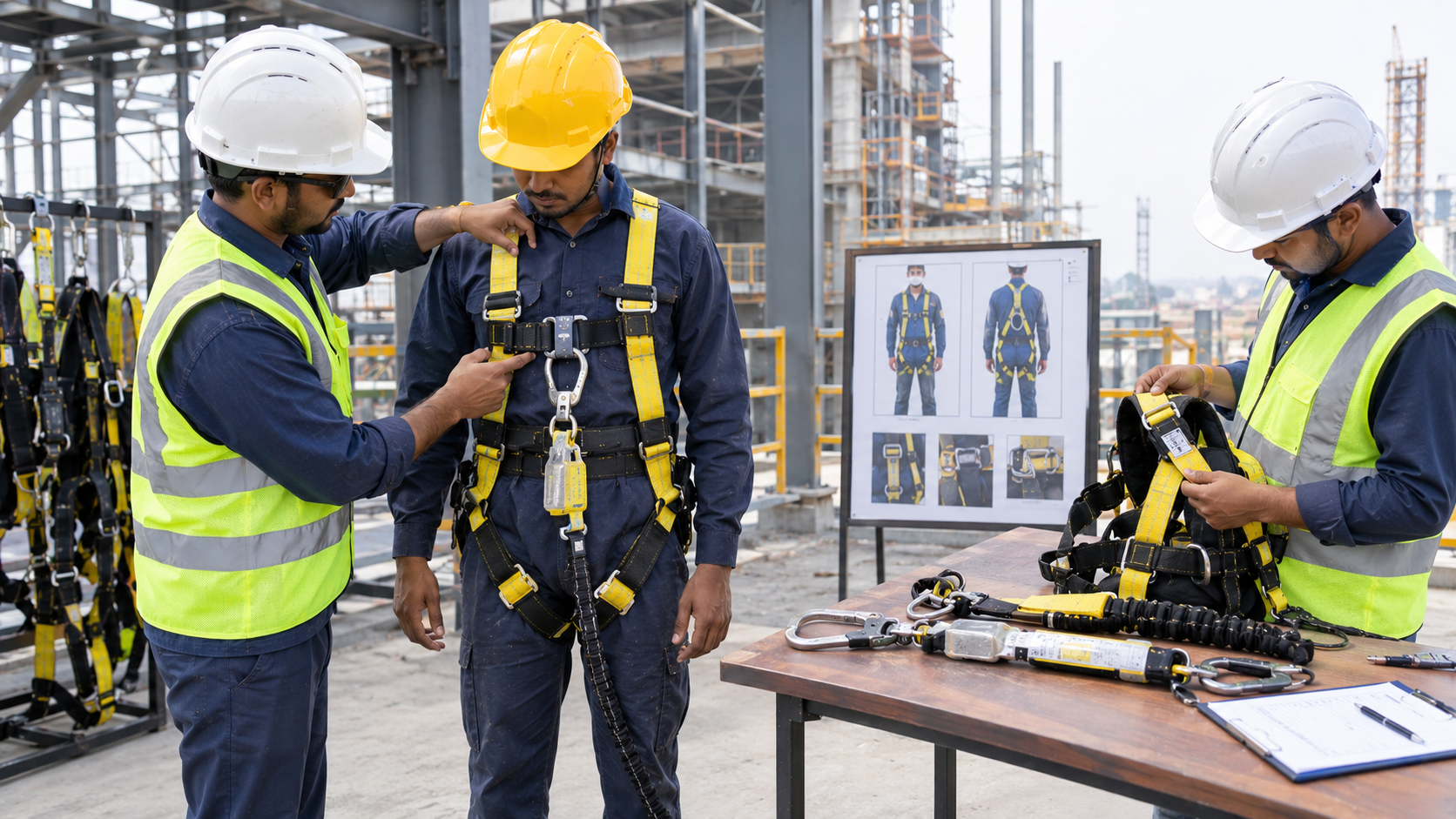
Training should therefore combine classroom explanation with hands-on practice. Workers should demonstrate that they can independently put on the harness, adjust it, identify the correct attachment point, connect compatible equipment, and complete a pre-use inspection.
Why Is Harness Training Required Before First Use?
Workers need to understand both the equipment and the fall hazards they may encounter. A correctly manufactured harness can still be used incorrectly if the worker does not know how to adjust, inspect, connect, or use it within its limitations.
OSHA construction requirements state that workers exposed to fall hazards should receive training from a competent person covering fall hazards and procedures used to minimize those hazards. The requirements also address inspection, use and operation of fall protection systems, equipment handling, and applicable requirements.
For Indian worksites, training should be aligned with applicable Indian requirements, project specifications, site procedures, manufacturer instructions, and the selected fall protection system.
How to Train Workers on Fall Protection
A practical fall protection training program should combine explanation, demonstration, worker practice, and assessment.
How to Train Workers on Fall Protection: Practical Steps
- Explain the fall hazards
Start with the actual work area. Show workers where falls may occur, such as:
- Open edges
- Roofs
- Scaffolds
- Towers
- Elevated platforms
- Structural steel
- Access areas
Explain the difference between fall prevention, restraint, positioning, and fall arrest where these systems are used.
- Identify the harness components
Use the actual harness during training. Workers should be able to identify:
- Shoulder straps
- Leg straps
- Chest strap, where provided
- Buckles and adjustment points
- Fall arrest attachment points
- Labels and identification markings
- Webbing and stitching
Explain the purpose of each component and which attachment points are approved for the intended application.
- Demonstrate correct fitting
Show workers how to adjust the harness according to the manufacturer’s instructions. The shoulder, chest, and leg straps should be adjusted correctly so the harness remains properly positioned during work.
Each worker should put on the harness independently while the trainer checks the fit and corrects mistakes.
- Teach connection and tie off
Demonstrate how the harness connects to the selected lanyard, lifeline, or other compatible equipment.
Workers should understand the approved attachment point, correct connection method, anchorage requirements, clearance considerations, and potential swing fall hazards applicable to their system.
- Demonstrate inspection
Workers should learn how to inspect the harness before use.
Check for:
- Cuts, fraying, burns, or chemical damage
- Broken or loose stitching
- Deformed or damaged D rings
- Damaged buckles
- Missing or unreadable labels
- Contamination or deterioration
- Evidence of previous fall or impact
Equipment that does not meet the site’s inspection criteria should be removed from service and handled according to the employer’s procedure.
- Conduct a practical assessment
Training should not end with a classroom explanation. Ask workers to demonstrate:
- Putting on the harness
- Adjusting the straps
- Identifying the correct attachment point
- Connecting compatible equipment
- Performing a pre use inspection
- Explaining what to do during an emergency
Workers should receive additional instruction if they cannot demonstrate the required steps correctly.
What Should Workers Know Before First Use?
Before using a full body harness, every worker should be able to answer five basic questions:
- What fall hazard am I exposed to?
- Which attachment point should I use?
- What equipment connects to my harness?
- What should I inspect before use?
- What should I do if I fall or the equipment is damaged?
If a worker cannot answer these questions or demonstrate the required procedures, additional instruction should be provided before work begins.
PPE Training Checklist India
A practical PPE training checklist India sites can adapt should cover both knowledge and demonstrated skills.
| Training Item | What to Verify |
| Fall hazard awareness | Worker identifies the main fall hazards |
| Harness identification | Worker recognizes major components |
| Fit and adjustment | Worker correctly fits and adjusts the harness |
| Attachment points | Worker identifies approved connection points |
| System compatibility | Worker understands compatible equipment |
| Inspection | Worker performs a pre use inspection |
| Equipment limitations | Worker understands application limits |
| Storage and care | Worker knows how to protect equipment |
| Emergency response | Worker understands site rescue procedures |
| Practical assessment | Worker demonstrates required steps |
| Training record | Worker and trainer details are recorded |
The checklist should be adapted to the harness model, fall protection system, work activity, and site procedures.
Which Harness Standards Should Workers Know?
Workers do not need to memorize every technical clause in a harness standard. They should, however, understand the certification and intended application of the equipment they use.
IS 3521 is an important Indian standards series for personal fall arrest equipment, with Part 1 covering full body harnesses. EN 361 is a key European standard for full body harnesses used in fall arrest systems. ANSI Z359 standards may also be specified on projects using US based requirements.
The important training point is that certification does not replace correct use. The harness must be used within its approved application and with compatible fall protection equipment.
What Common Harness Training Mistakes Should Be Avoided?
Common training gaps include:
- Providing only classroom instructions
- Allowing use before workers demonstrate correct fitting
- Failing to explain attachment point selection
- Treating the harness as a complete fall arrest system
- Skipping pre use inspection training
- Ignoring manufacturer instructions
- Not explaining clearance and swing fall considerations
- Failing to explain post fall procedures
- Allowing damaged equipment to remain in service
Training should reflect the actual work rather than relying only on generic PPE instructions.
When Should Workers Be Retrained?
Retraining should be considered when the workplace changes, the fall protection system changes, new equipment is introduced, or worker performance shows that required knowledge or skills have not been retained.
OSHA construction requirements specifically identify workplace changes, changes in fall protection equipment or systems, and inadequate worker knowledge or use as circumstances requiring retraining.
For site management, additional training may also be appropriate following incidents, near misses, significant procedural changes, or findings during safety inspections.
What Should Happen After a Fall?
A harness involved in a fall or impact event should not simply be returned to service. It should be handled according to the manufacturer’s instructions and the employer’s inspection and incident procedures.
Workers should know how to raise an alarm, communicate with the site rescue team, and follow the established rescue plan.
Training should cover post fall response because correct communication and rescue procedures form part of the overall fall protection arrangement.
How Can Employers Make Harness Training More Effective?
Use the actual harness and fall protection equipment workers will use on site. Keep training practical and task specific.
A useful training session can follow this structure:
- Explain work at height hazards.
- Introduce harness and system components.
- Demonstrate fitting and adjustment.
- Demonstrate connection and inspection.
- Let every worker practice.
- Conduct a practical assessment.
- Record the training.
- Schedule retraining when conditions, equipment, or worker performance require it.
Indian Inovatix manufactures full body harnesses and fall protection equipment for construction and industrial applications. Its published harness range includes solutions for different work at height applications.
FAQ
1. Is harness training required before first use?
Yes. Workers should be trained before using a personal fall protection system.
2. What does harness training cover?
It covers hazards, fitting, inspection, attachment, use, limitations, storage, and emergency procedures.
3. Who should conduct fall protection training?
Training should be conducted by a person qualified or competent for the subject and applicable requirements.
4. How often should workers be retrained?
Retraining is needed when conditions, equipment, or worker knowledge and skills change or are inadequate.
5. What should workers inspect before using a harness?
Check webbing, stitching, D rings, buckles, labels, contamination, damage, and evidence of impact.
6. Can a full body harness be used with any lanyard?
No. The harness, connector, anchorage, and other components must be compatible with the complete system.
7. Should workers receive practical harness training?
Yes. Workers should demonstrate fitting, adjustment, inspection, and connection before independent use.
8. What should happen to a harness after a fall?
Remove it from service and follow the manufacturer’s and employer’s inspection procedure.
9. What is included in a PPE training checklist India?
It can include hazards, equipment identification, fitting, inspection, connection, limitations, emergency response, assessment, and training records.
10. Does a certified harness remove the need for training?
No. Certification does not replace correct selection, fitting, inspection, connection, and use.
Conclusion
Effective harness training for workers starts before the first climb, roof task, tower job, scaffold activity, or maintenance operation. Workers need more than instructions on how to wear a harness. They need to understand the fall hazard, fit the equipment correctly, inspect it, connect it properly, recognize its limitations, and respond correctly after an incident.
For employers, a practical training process supported by a clear PPE training checklist India sites can adapt helps create consistent worker assessments and training records.
Indian Inovatix manufactures full body harnesses and engineered fall protection equipment for construction and industrial applications. To discuss full body harness selection or a task specific fall protection setup, contact the Indian Inovatix safety team.


Talk to Our Safety & Protection Specialists
Have questions or need guidance? Our experts can help you choose the most reliable and high-performance safety solutions tailored to your industry and site requirements.
-

- Call Us +91-8849452638
Need Help Determining the Right Fall Protection for You?
With our vast experience, our experts will assist you in selecting the most relevant system for your needs.