April 12, 2026
Falls from height remain one of the leading causes of workplace fatalities across construction, oil and gas, and industrial maintenance in India. Unsafe anchorage choices and incorrect equipment selection often lead to severe injuries, compliance failures, and project delays.
Many safety teams face confusion when choosing between retractable fall arrester vs lanyard systems. A wrong decision can increase arrest forces, reduce mobility, and expose workers to higher risks during routine operations.
What Is a Retractable Fall Arrester and How Does It Work
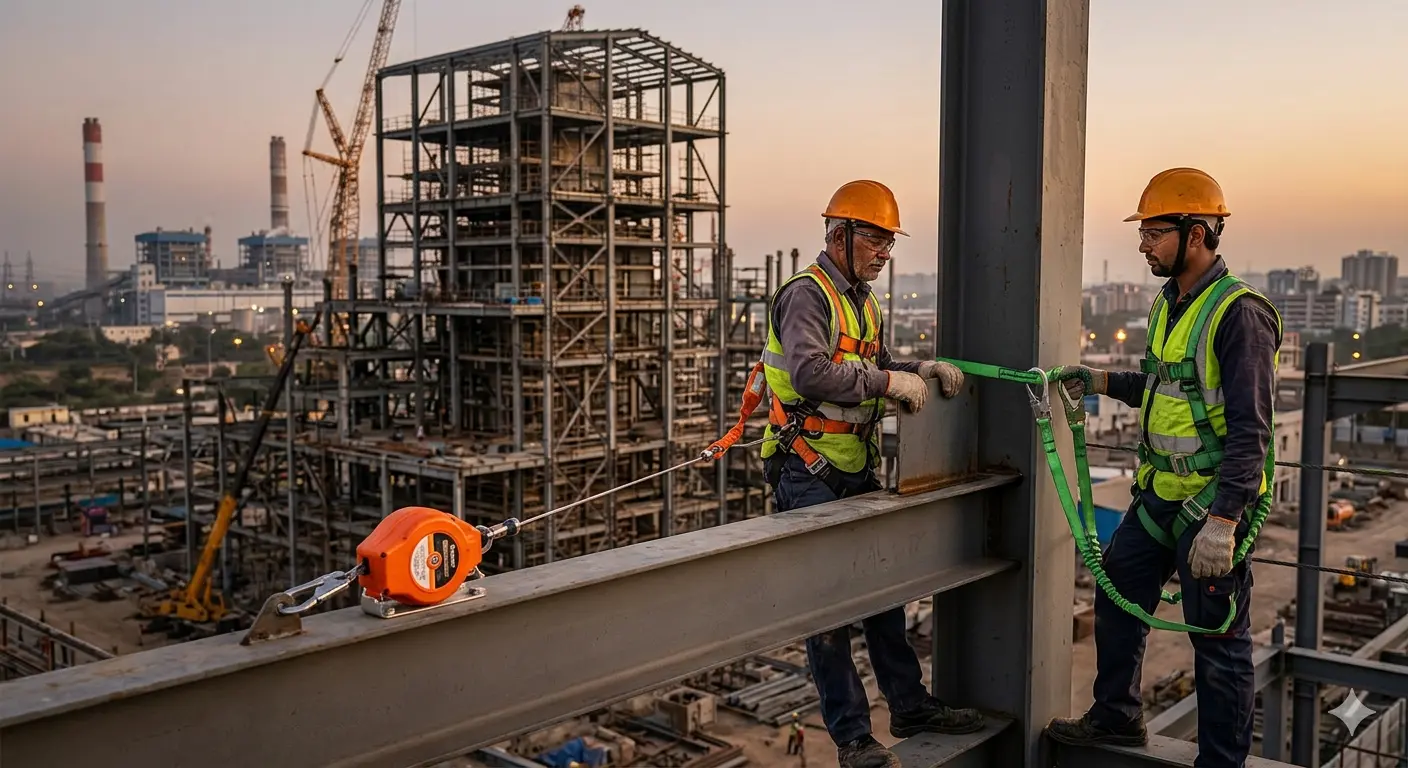
A retractable fall arrester is a self-retracting lifeline device that automatically adjusts length and locks instantly during a fall, reducing free fall distance and arrest force on the worker.
Unlike fixed systems, this device keeps the lifeline taut as the worker moves. The internal braking mechanism activates within milliseconds during sudden acceleration, which limits fall distance.
Key characteristics include:
- Self-retracting cable or webbing system
- Instant locking mechanism during fall
- Reduced free fall distance
- Higher mobility for workers
- Typically EN 360 or ANSI Z359 certified
In an oil refinery maintenance project handled by Indian Inovatix Ltd., retractable fall arresters reduced swing fall risk by 32% compared to traditional lanyards due to continuous tension in the line.
This makes retractable systems suitable for dynamic work environments where workers frequently change position.
What Is a Fixed Lanyard and When Is It Used
A fixed lanyard is a static connection between the harness and anchor point, designed to limit fall distance and absorb shock through an integrated energy absorber.
Fixed lanyards have a predefined length, typically 1.5 to 2 metres. They are simple, cost-effective, and widely used in construction and general maintenance tasks.
Typical features include:
- Fixed-length webbing or rope
- Energy absorber to reduce arrest force
- Compatible with EN 355 and IS 3521 standards
- Simple inspection and usage
- Lower initial cost compared to retractable systems
On a telecom tower installation project in Gujarat, Indian Inovatix Ltd. deployed fixed lanyards where anchor points were consistent and worker movement was limited.
This makes lanyards effective in controlled environments with predictable movement patterns.
Retractable Fall Arrester vs Lanyard: Key Differences
A retractable fall arrester provides dynamic fall protection with minimal free fall, while a lanyard offers fixed-length protection with higher fall distance but simpler operation.
Understanding the differences helps safety officers and procurement teams select the correct system based on site conditions.
| Feature | Retractable Fall Arrester | Fixed Lanyard |
| Fall Distance | Minimal | Higher |
| Mobility | High | Limited |
| Arrest Force | Lower | Higher |
| Cost | Higher initial investment | Lower cost |
| Maintenance | Requires periodic inspection | Simple inspection |
| Best Use Case | Dynamic movement work | Static position work |
Based on EN 361 and OSHA guidelines, reducing free fall distance directly lowers impact forces, making retractable systems safer in complex environments.
The correct choice depends on application, not preference.
Which Is Better Fall Arrester for Industrial Use
The better fall arrester depends on work conditions, movement range, and anchor positioning rather than a universal preference.
For industries such as oil and gas, infrastructure, and EPC projects, retractable fall arresters often perform better due to their ability to minimise fall distance and improve mobility.
Choose retractable fall arresters when:
- Workers move frequently across large areas
- Anchor points are overhead
- Swing fall risk is present
- Precision and flexibility are required
Choose fixed lanyards when:
- Work is stationary
- Anchor points are fixed and close
- Budget constraints are significant
- Simplicity is required for large teams
In a BARC facility maintenance project, Indian Inovatix Ltd. recommended a hybrid approach, using retractable systems for access zones and lanyards for confined working areas.
This combination improved compliance and reduced incident risk.
How to Choose Between Retractable Fall Arrester vs Lanyard
Choosing between these systems requires evaluating worksite conditions, compliance requirements, and operational risks.
Follow this process for correct selection:
- Identify work height and movement range
- Evaluate anchor point location and strength
- Assess fall clearance requirements
- Check applicable standards such as IS 3521 and EN 360
- Calculate arrest force tolerance
- Consider maintenance and inspection capacity
According to the Factories Act 1948 and OSHA guidelines, employers must ensure fall protection systems are suitable for the specific hazard, not just available.
A structured evaluation ensures safety and audit compliance.
Technical Specification Comparison
Below is a sample comparison based on typical Inovatix product specifications:
| Specification | Retractable Fall Arrester | Fixed Lanyard |
| Maximum Arrest Force | ≤ 6 kN | ≤ 6 kN (with absorber) |
| Lifeline Length | Up to 30 metres | 1.5 to 2 metres |
| Material | Galvanised steel or webbing | Polyester webbing |
| Certification | EN 360, ANSI Z359 | EN 355, IS 3521 |
| Weight Capacity | 100 to 140 kg | 100 to 140 kg |
Indian Inovatix Ltd. manufactures systems that comply with both Indian and international standards, ensuring compatibility across global projects.
Real Use Case: Infrastructure Project Application
A metro rail infrastructure project required workers to operate at varying heights with continuous movement.
Challenge:
Workers using fixed lanyards faced restricted movement and increased fall distance risks.
Solution:
Indian Inovatix Ltd., Ahmedabad, deployed retractable fall arresters integrated with overhead lifeline systems.
Result:
- 40% reduction in near-miss incidents
- Improved worker productivity
- Faster compliance approvals during audits
This demonstrates how selecting the right system directly impacts safety and efficiency.
Key Takeaways
- retractable fall arrester vs lanyard decisions depend on application, not cost alone
- Retractable systems reduce fall distance and improve mobility
- Lanyards are effective for controlled, static work environments
- Compliance with EN, ANSI, and IS 3521 standards is essential
- Indian Inovatix Ltd., Ahmedabad, delivers certified systems for diverse industries
FAQs
What is the main difference between a retractable fall arrester and a lanyard
A retractable fall arrester adjusts automatically and limits fall distance, while a lanyard has a fixed length. Retractable systems reduce free fall and improve mobility. Lanyards are simpler but less flexible.
Which is better fall arrester for construction sites
The better fall arrester depends on movement and anchor points. Retractable systems work well for dynamic movement. Lanyards suit fixed-position work areas with stable anchor points.
Are retractable fall arresters safer than lanyards
Retractable fall arresters can be safer in dynamic environments because they reduce fall distance. They minimise arrest force when used correctly. However, both systems must meet EN or IS standards.
What standards apply to fall arrest systems in India
Fall arrest systems in India must comply with IS 3521, along with EN and ANSI standards. These standards define performance, strength, and safety requirements.
Can both systems be used together
Yes, both systems can be used together depending on the work zone. Many projects combine retractable devices and lanyards for optimal safety coverage.
Which system is used in Ahmedabad industrial projects
In Ahmedabad and Gujarat industrial projects, both systems are used based on site needs. Indian Inovatix Ltd. provides customised solutions for each application.
What is the typical lifespan of a retractable fall arrester
The lifespan depends on usage and maintenance. With proper inspection, it can last several years. Regular checks are required under EN standards.
Do lanyards require maintenance
Yes, lanyards require periodic inspection for wear and damage. They are simpler than retractable systems but still critical for safety compliance.
Conclusion
Selecting the right fall protection system is critical for worker safety, compliance, and operational efficiency. The choice between retractable systems and lanyards should always be based on work conditions and risk assessment.
Indian Inovatix Ltd., Ahmedabad, Gujarat, India, brings 50 years of manufacturing expertise, certified systems, and proven installations across high-risk industries.
Choose the Right System for Your Site Safety
Every worksite demands a specific fall protection approach.
Speak to an Inovatix safety specialist to evaluate your application and request a customised solution today.


Talk to Our Safety & Protection Specialists
Have questions or need guidance? Our experts can help you choose the most reliable and high-performance safety solutions tailored to your industry and site requirements.
-

- Call Us +91-8849452638
Need Help Determining the Right Fall Protection for You?
With our vast experience, our experts will assist you in selecting the most relevant system for your needs.