November 16, 2026
Industrial buildings, warehouses, manufacturing facilities, and pre-engineered buildings (PEBs) often require workers to access elevated roofs for inspections, equipment maintenance, HVAC servicing, solar panel installation, and repairs. Without suitable protection, roof edges, fragile sheets, skylights, and access openings can expose workers to serious fall hazards.
A roof fall protection system helps control these risks by preventing workers from reaching dangerous edges or arresting a fall when prevention alone is insufficient. The correct solution depends on the roof design, structural strength, work activities, frequency of access, number of users, and available anchorage points.
For industrial and PEB facilities in India, selecting the right system also means considering installation requirements, inspections, applicable standards, worker training, and rescue planning.
Indian Inovatix Ltd. manufactures fall protection solutions for industrial and work at height applications, including over the roof fall arrest systems, reusable roof anchors, and horizontal lifeline systems.
Key Takeaways
- A roof fall protection system should be selected after assessing the roof structure, fall hazards, access routes, and work requirements.
- A roof fall restraint system helps prevent workers from reaching a fall hazard, while a roof fall arrest system stops a fall after it begins.
- Horizontal lifelines support controlled movement across larger roof areas.
- Reusable roof anchors can provide anchorage for suitable applications when installed according to their instructions.
- Compliance requires more than selecting equipment. Installation, training, inspection, compatible components, and rescue planning also matter.
- The system must be suitable for the actual roof construction, including standing seam and other PEB roof configurations.
What Is a Roof Fall Protection System?
A roof fall protection system is a combination of equipment and safety measures designed to protect workers from falling while accessing or working on elevated roofs.
Depending on the application, it may include anchorage points, horizontal lifelines, full body harnesses, connectors, energy absorbers, and other compatible components.
The main approaches are:
- Fall prevention: Physical barriers, such as guardrails, prevent workers from reaching exposed edges.
- Fall restraint: A connected worker is restricted from reaching a hazardous edge.
- Fall arrest: A connected worker is protected by a system designed to stop a fall if one occurs.
Prevention and restraint should be considered before relying on fall arrest wherever practicable. A fall arrest system requires suitable clearance below the worker and a workable rescue plan.
What Are the Main Types of Roof Fall Protection Systems?
The most suitable rooftop fall protection depends on how workers move, where the hazards are located, and whether the system is permanent or temporary.
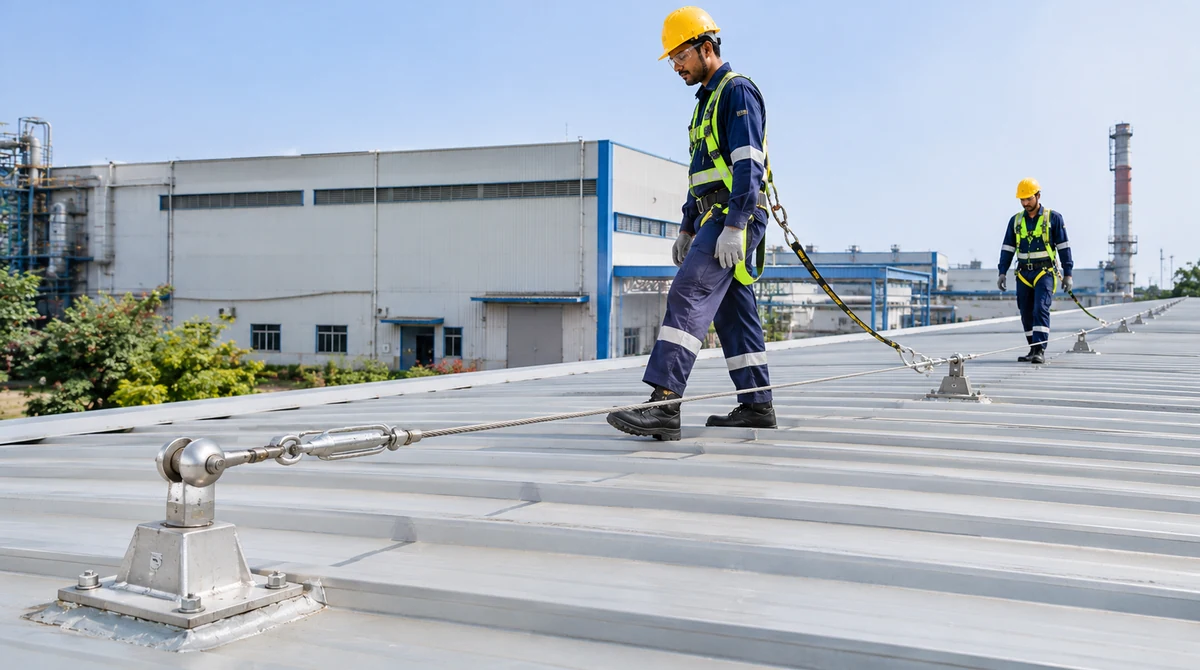
1. Over the Roof Fall Arrest System
Indian Inovatix’s Over the Roof Fall Arrest System is designed for roofs and pre-engineered buildings.
According to the product information, its features include:
- Stainless steel SS 316 system construction.
- Continuous movement with fall protection over long spans.
- Compatibility with standing seam roof applications.
- Waterproofing considerations.
- A shock absorber intended to reduce impact loads on the user and structure.
This system may be considered for industrial roofs where workers need to move across a roof for recurring maintenance, inspections, or other planned work at height.
The specific roof profile, support structure, installation method, user configuration, and fall clearance must be assessed before selection.
2. Reusable Roof Anchor
A reusable roof anchor provides an anchorage point for an appropriate personal fall protection arrangement.
The Reusable Roof Anchor from Indian Inovatix is a roof anchoring product. Its product page lists ANSI Z359.1:2007 conformity.
Potential applications include suitable roof work where a compatible anchorage point is required. However, suitability depends on the roof substrate, attachment method, structural capacity, anchor configuration, and manufacturer’s instructions.
A reusable anchor should never be assumed suitable for every roof material or every fall protection arrangement.
3. Overhead Horizontal Lifeline System
The Horizontal Lifeline System: Over the Head is designed for applications including truck loading and unloading, train top work, EOT cranes, and locations requiring horizontal and vertical safety.
The product information identifies SS 316 construction, continuous movement over long spans, a shock absorber, and ATEX approval for use in potentially explosive areas.
For roof related work, an overhead lifeline may be worth evaluating when the building structure and work layout allow an appropriate overhead installation. Its suitability must be established through an application specific assessment rather than assumed from the product category alone.
Roof Fall Arrest System vs Roof Fall Restraint System
A roof fall arrest system and a roof fall restraint system serve different purposes. The right choice depends on whether workers need to approach the edge and whether the system can physically prevent them from reaching it.
| Factor | Roof Fall Restraint System | Roof Fall Arrest System |
| Primary purpose | Prevents access to a fall hazard | Stops a fall after it begins |
| Worker movement | Limited by system configuration | Allows movement within the designed protected area |
| Edge access | Designed to prevent reaching the edge | May allow access near the edge |
| Main equipment | Suitable anchors, connectors, harness, restraint line | Suitable anchors, harness, connectors, energy absorber or compatible fall arrest device |
| Clearance below worker | Depends on the arrangement | Must be calculated for the complete system |
| Rescue planning | Part of the overall work plan | Essential because a worker may remain suspended after a fall |
A fall restraint arrangement is appropriate only when its configuration reliably prevents access to the hazard. If a worker can reach an edge, the arrangement should not be treated as effective restraint.
How to Choose the Right Roof Fall Protection System
Choosing equipment based only on price or product type can leave important hazards unaddressed. Follow a structured selection process.
Step 1: Assess the Roof Structure
Identify whether the roof is made from standing seam sheets, other metal sheeting, concrete, or another construction type.
Review structural drawings and the roof manufacturer’s specifications where available. Confirm that the proposed anchors and supports can be installed using an approved method.
Step 2: Identify Fall Hazards
Inspect the work area for:
- Unprotected roof edges.
- Fragile roof sheets.
- Skylights and roof openings.
- Sloped or slippery surfaces.
- Access ladders and hatches.
- Obstructions and changes in roof level.
Fragile surfaces require particular attention because a worker may fall through a roof sheet without reaching an external edge.
Step 3: Understand Worker Movement
Consider how often the roof is accessed, the distance workers travel, the tasks performed, and the number of users.
A single anchor may suit a limited work zone. A horizontal lifeline may be more appropriate where workers need to travel along a long roof while remaining connected.
Step 4: Calculate Fall Clearance
For fall arrest systems, assess the total distance required to arrest a fall safely. This includes relevant lanyard or device deployment, energy absorber extension, lifeline deflection, harness movement, and a suitable safety margin.
Do not assume that a roof system is suitable simply because the roof is high above the ground.
Step 5: Plan for Rescue and Maintenance
Determine how a worker will be retrieved following a fall. Assign trained personnel, identify rescue equipment, and establish a response procedure.
Also define inspection intervals, pre use checks, maintenance responsibilities, and the conditions under which equipment must be removed from service.
What Compliance Requirements Apply to Roof Fall Protection Systems in India?
Compliance depends on the work activity, applicable Indian legislation, relevant standards, project specifications, and the equipment selected.
For fall protection systems for roofs, consider the following references:
- IS 3521: Relevant Indian Standard series covering industrial safety belts and full body harnesses. Confirm the applicable part and current edition for the equipment being specified.
- ANSI/ASSP Z359 series: A family of standards addressing fall protection and fall arrest systems. Check the specific standard applicable to the selected equipment.
- EN 795: A standard addressing anchor devices for personal fall protection. Confirm the applicable scope and product requirements.
- OSHA requirements: US regulations can provide useful international reference points, but they are not automatically Indian legal requirements.
A product’s stated conformity does not establish compliance for every installation. The entire arrangement, including the anchor, supporting structure, connectors, harness, installation, and intended use, must be suitable.
For a PEB roof, particular attention should be paid to roof sheet design, structural supports, attachment methods, weather exposure, and the manufacturer’s installation requirements.
Common Roof Fall Protection Mistakes to Avoid
Even suitable equipment can fail to provide the intended protection if the system is incorrectly selected or used.
Avoid these mistakes:
- Installing anchors without verifying structural suitability.
- Attaching equipment to roof sheets that are not approved to support the intended loads.
- Using a restraint arrangement that allows workers to reach the edge.
- Ignoring skylights and fragile roof panels.
- Failing to calculate fall clearance.
- Combining incompatible harnesses, connectors, lanyards, and lifelines.
- Skipping inspections after damage or an incident.
- Allowing untrained workers to use the system.
- Failing to establish a rescue plan.
- Assuming that a product certificate alone confirms compliance of the complete installation.
Roof Fall Protection Checklist for Industrial and PEB Buildings
Before approving a system, review the following checklist.
| Checkpoint | What to Verify |
| Roof assessment | Roof type, structure, access, and condition |
| Hazard assessment | Edges, openings, fragile sheets, and work zones |
| System selection | Prevention, restraint, or arrest requirements |
| Anchorage | Approved attachment method and structural suitability |
| Compatibility | Harness, connector, lifeline, and anchor compatibility |
| Fall clearance | Required distance and potential obstructions |
| Installation | Approved drawings and installation instructions |
| Training | Worker and supervisor competence |
| Rescue | Documented and practical rescue arrangements |
| Inspection | Pre use checks and planned competent person inspections |
| Records | Installation, inspection, training, and maintenance documentation |
This checklist supports site planning. It does not replace a project specific risk assessment or the manufacturer’s technical instructions.
Why Choose Indian Inovatix for Roof Fall Protection?
Indian Inovatix Ltd. is an Indian manufacturer of fall protection equipment and systems, with more than 50 years of manufacturing experience.
Its product range includes solutions for rooftop work, industrial maintenance, anchorages, and horizontal lifeline applications.
For industrial and PEB roof projects, the team can help assess the application and identify a suitable product or system configuration. The final recommendation should account for roof construction, work movement, anchorage requirements, user numbers, fall clearance, and rescue arrangements.
Explore the relevant solutions:
- Over the Roof Fall Arrest System
- Reusable Roof Anchor
- Horizontal Lifeline System: Over the Head
- Complete Fall Arrest Systems Range
Frequently Asked Questions
1. What is a roof fall protection system?
A roof fall protection system combines equipment and safety measures to prevent falls or arrest a fall when workers operate at height.
2. What is the difference between roof fall restraint and fall arrest?
Restraint prevents workers from reaching a fall hazard. Fall arrest stops a fall after it begins.
3. Which rooftop fall protection system is suitable for a PEB roof?
The choice depends on the roof profile, structural supports, work activities, access routes, and installation requirements.
4. Can a reusable roof anchor be used on any roof?
No. The roof material, structural capacity, attachment method, and manufacturer’s instructions must be checked first.
5. What is a rooftop lifeline system in India used for?
It provides a connection route that can allow workers to move along an elevated work area while remaining attached to a suitable fall protection system.
6. Are horizontal lifelines suitable for large industrial roofs?
They can be suitable where the system is designed for the roof layout, intended users, structural supports, and required movement.
7. Which standards should be considered for roof fall protection?
Depending on the application, relevant references may include the applicable IS 3521 standard, EN 795, and the ANSI/ASSP Z359 series. Confirm the specific requirements for each component and installation.
8. How often should roof fall protection equipment be inspected?
Users should perform pre use checks, while periodic inspections should follow manufacturer instructions, applicable requirements, and site procedures. Equipment exposed to a fall, damage, or another significant event must be assessed before reuse.
9. Is a rescue plan necessary for a roof fall arrest system?
Yes. A practical rescue plan is needed to retrieve a worker following a fall and manage suspension related risks.
10. Can Indian Inovatix help select a roof fall protection system?
Yes. Contact the team with details of the roof type, working height, work activity, roof drawings, and access requirements to begin a product and application assessment.
Conclusion
Selecting the right roof fall protection system is essential for industrial facilities, warehouses, and PEB buildings where workers perform maintenance, inspections, installation, and repairs at height.
The selection process should begin with a roof assessment and hazard analysis, followed by choosing between prevention, restraint, and fall arrest. Anchoring, fall clearance, equipment compatibility, installation quality, inspection, and rescue planning must all be considered before the system is put into use.
Indian Inovatix offers roof fall arrest systems, reusable roof anchors, and horizontal lifeline solutions for different industrial applications. Choosing the right configuration requires matching the product to the actual roof structure and work requirements.
Need a Roof Fall Protection Solution for Your Industrial or PEB Building?
Planning a new PEB building, upgrading an existing industrial roof, or arranging safe access for maintenance teams? Indian Inovatix Ltd. can help you evaluate your application and identify suitable fall protection options.
Share your roof type, drawings, work activity, access requirements, and number of users so the team can understand your project needs.
Call: +91 88494 52638
Email: info@indianinovatix.com

Categories
Latest Post
- November 16, 2026 Roof Fall Protection Systems in India: Types, Selection and Compliance for Industrial and PEB Roofs
- November 10, 2026 Confined Space Rescue Planning: What to Do When the Entrant Cannot Self-Rescue
- November 8, 2026 Vertical Fall Arrest Systems: Rigid Rail vs Rigid Cable vs Flexible Rope, How to Choose

Corporate Profile
Download CatalogueTalk to Our Safety & Protection Specialists
Have questions or need guidance? Our experts can help you choose the most reliable and high-performance safety solutions tailored to your industry and site requirements.
-

- Call Us +91-8849452638
Need Help Determining the Right Fall Protection for You?
With our vast experience, our experts will assist you in selecting the most relevant system for your needs.