September 23, 2026
A safety harness protects workers only when its materials, stitching, hardware, and attachment points remain fit for use. Understanding the safety harness expiry date is therefore important for safety officers, construction companies, EPC contractors, and industrial teams.
Many organizations ask whether a harness automatically becomes unsafe after a fixed number of years. The answer depends on the manufacturer’s stated service life, usage conditions, inspection results, storage, and exposure to damaging environments.
Indian Inovatix Limited, Ahmedabad, Gujarat, India, manufactures full body harnesses for construction, industrial, infrastructure, and maintenance applications. Its published guidance states that a typical full body harness lifespan can range from 3 to 5 years under normal conditions, while damaged equipment should be removed from service immediately.
Key Takeaways
- The safety harness expiry date should be checked against the manufacturer’s stated service life and product documentation.
- Full body harness validity depends on condition, usage, storage, environmental exposure, and inspection history.
- A harness involved in a fall should be removed from service and assessed according to manufacturer procedures.
- Cuts, burns, frayed webbing, damaged stitching, corrosion, deformation, or missing labels are reasons to remove a harness from service.
- Regular inspection is required even when the harness has not reached its stated service life.
What Is the Typical Full Body Harness Lifespan?
A full body harness typically has a service life defined by the manufacturer, often based on materials, usage, environmental exposure, and inspection history. Indian Inovatix states that typical harness lifespan can range from 3 to 5 years under normal conditions.
This does not mean every harness remains safe until the final year. A harness exposed to chemicals, heat, moisture, UV radiation, abrasion, or heavy use may deteriorate sooner.
Therefore, companies should maintain product records and inspect equipment regularly.
| Factor | Effect on harness life |
| Daily use | Increases wear |
| UV exposure | Can weaken webbing |
| Chemicals | May damage fibers |
| Moisture | Can affect materials and hardware |
| Abrasion | Can damage webbing |
| Fall arrest event | Requires immediate removal and assessment |
| Poor storage | Can shorten service life |
The manufacturer’s instructions should always take priority when determining service life.
Does a Safety Harness Have an Expiry Date?
A safety harness may have a manufacturer specified service life or replacement period, but the safety harness expiry date should not be treated as the only replacement criterion. Condition based inspection remains important throughout the equipment’s service life.
Product labels, manufacturing dates, batch information, instructions, and certification markings can help safety teams identify equipment and manage replacement records.
A harness that looks old is not automatically defective. Similarly, a relatively new harness can become unsafe after chemical exposure, severe abrasion, incorrect storage, or a fall.
Safety managers should therefore track both:
- Manufacturer specified service life.
- Actual physical condition of the harness.
Indian Inovatix recommends removing harnesses from service when inspection identifies damage or when the equipment has been involved in a fall.
How Long Is Full Body Harness Validity?
Full body harness validity depends on the manufacturer’s instructions, product condition, inspection results, and operating environment. A harness should remain in service only while it meets the manufacturer’s requirements and passes required inspections.
The concept of full body harness validity is therefore different from simply counting years from the manufacturing date.
For example, two harnesses manufactured in the same month may have different service histories. One may have been used indoors with controlled storage. The other may have been exposed to sunlight, dust, moisture, chemicals, and frequent outdoor work.
Their replacement decisions may therefore differ.
Safety officers should maintain records covering:
- Manufacturing or purchase date
- Product identification
- Inspection dates
- Inspection findings
- Usage history
- Fall incidents
- Repairs or manufacturer assessments
- Final withdrawal date
This creates a clearer replacement process for large workforces.
What Is the Safety Belt Expiry Date?
A safety belt expiry date should be checked according to the manufacturer’s product documentation. However, a waist only belt should not be treated as a substitute for a full body harness where fall arrest protection is required.
Modern fall arrest systems use full body harnesses designed to distribute fall forces across appropriate body areas. Indian Inovatix identifies EN 361 and IS 3521 requirements for full body harness systems.
Therefore, organizations should first identify the required application before deciding which equipment requires replacement.
For work positioning applications, equipment selection may differ from fall arrest applications. Safety officers should follow the manufacturer’s instructions and the applicable project requirements.
When Should You Replace a Safety Harness?
A safety harness should be replaced immediately when it has been involved in a fall, fails inspection, or shows damage that can affect its performance. Waiting for the normal service life to end is not appropriate when a defect is present.
Common replacement indicators include:
- Cut or frayed webbing
- Burn marks
- Chemical damage
- Broken or loose stitching
- Deformed D rings
- Corroded hardware
- Damaged buckles
- Missing identification labels
- Unauthorised modifications
- Unknown equipment history
Indian Inovatix specifically recommends immediate replacement when a harness has arrested a fall or shows significant damage.
A defective harness should be clearly identified and removed from service so another worker does not accidentally use it.
How Often Should a Safety Harness Be Inspected?
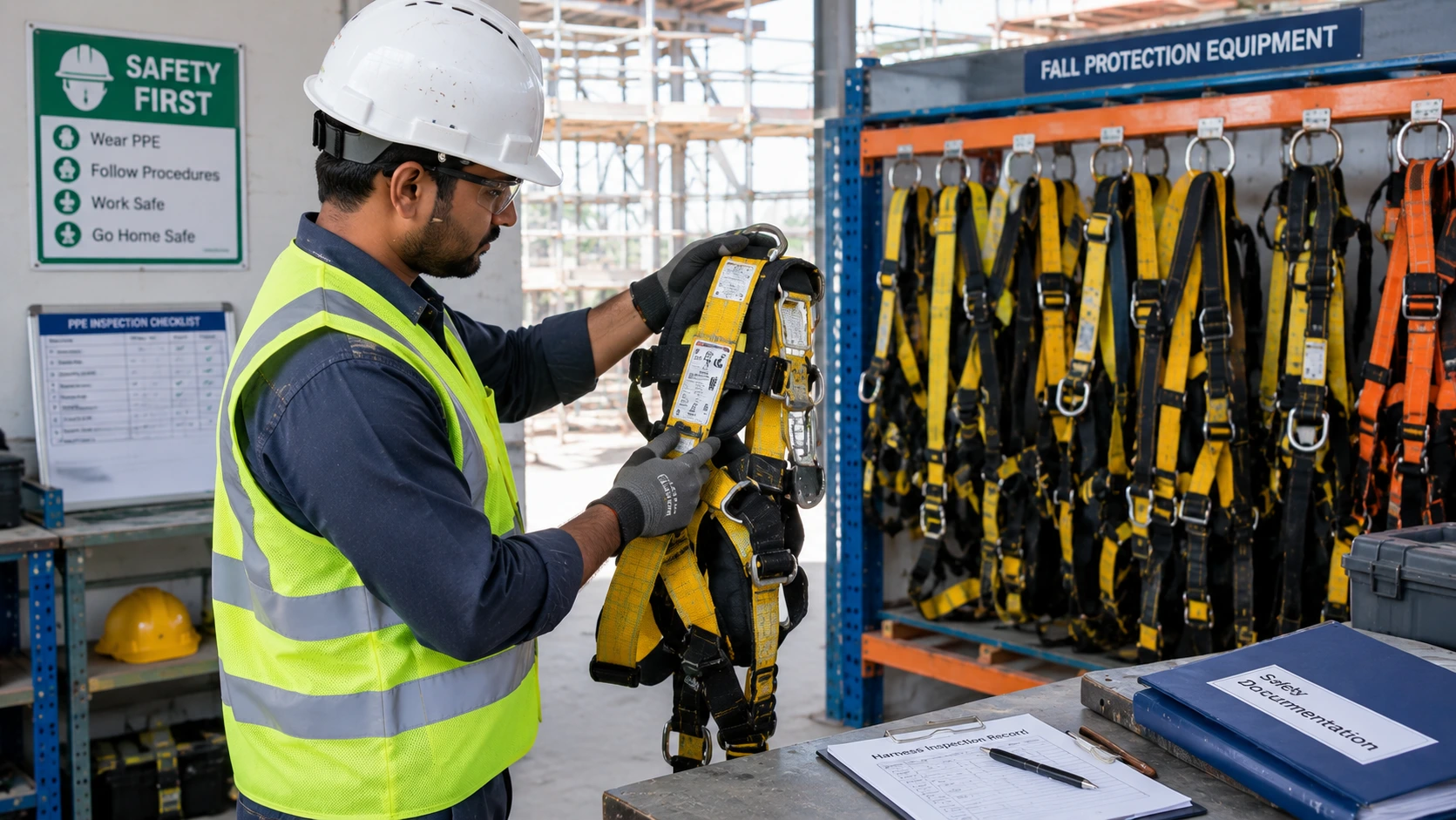
A safety harness should be visually inspected before every use, with detailed periodic inspections according to the manufacturer’s recommendations and site safety procedures. Inspection frequency should also reflect usage and environmental conditions.
A pre use inspection should check the main components before the harness is connected to a fall protection system.
Workers should examine:
- Webbing for cuts, abrasion, burns, and fraying.
- Stitching for broken or pulled threads.
- D rings and metal hardware for deformation or corrosion.
- Buckles for proper operation.
- Labels and markings for identification.
- Signs of chemical, heat, or environmental damage.
Indian Inovatix’s inspection guidance recommends checking harnesses before use and conducting periodic inspections by competent personnel.
Inspection records should be maintained for equipment used across construction and industrial sites.
Does a Fall Automatically Expire a Safety Harness?
Yes, a harness involved in a fall should be removed from service immediately. It should not simply be returned to use because there is no visible damage.
A fall can place significant loads on webbing, stitching, hardware, and attachment components. Some damage may not be obvious during a basic visual inspection.
The manufacturer should be consulted for the correct assessment and disposal or replacement procedure.
This is one of the most important harness lifespan replacement rules for safety teams.
Does UV Exposure Affect Safety Harness Lifespan?
Yes. Long term UV exposure can degrade synthetic fibers used in harness webbing. Outdoor construction, telecom, infrastructure, and industrial workers may therefore experience different equipment life compared with workers using harnesses indoors.
Indian Inovatix’s published harness lifespan guidance identifies UV exposure as one of the factors affecting service life.
Harnesses should be stored away from direct sunlight and damaging environmental conditions when not in use.
Storage areas should be clean, dry, and protected from chemicals, excessive heat, sharp objects, and unnecessary mechanical damage.
How Do You Know When to Replace a Safety Harness?
Knowing when to replace safety harness equipment requires both condition inspection and service life tracking. A harness should be removed when it reaches the manufacturer’s stated service life or earlier if it fails inspection.
A simple replacement decision can follow this process:
- Check the product identification and service life.
- Review inspection records.
- Inspect webbing and stitching.
- Check hardware and attachment points.
- Review exposure to chemicals, heat, UV, and moisture.
- Confirm whether the harness has arrested a fall.
- Remove and replace equipment that fails any required condition.
This approach prevents teams from relying only on age.
Safety Harness Lifespan Replacement Rules for Companies
Companies should establish documented harness lifespan replacement rules covering inspection, service life, storage, incident handling, and disposal. The rules should apply consistently across all workers and work locations.
A practical company policy can include:
| Control | Recommended practice |
| Pre use inspection | Before every use |
| Periodic inspection | According to manufacturer guidance |
| Fall event | Remove immediately |
| Visible damage | Remove immediately |
| Service life reached | Replace according to manufacturer |
| Missing identification | Remove from service |
| Storage | Clean, dry, protected location |
| Records | Maintain inspection and replacement history |
Indian Inovatix manufactures full body harnesses to applicable EN and IS requirements and supplies fall protection equipment for construction, industrial, infrastructure, and maintenance applications.
Safety Harness Expiry FAQ
What is the typical safety harness expiry period?
A typical full body harness lifespan can range from 3 to 5 years under normal conditions. The manufacturer’s instructions and inspection results should determine actual replacement.
Does a safety harness expire after 5 years?
Not necessarily. Follow the manufacturer’s stated service life, inspection requirements, and replacement criteria for the specific harness.
What is full body harness validity?
Full body harness validity depends on service life, physical condition, inspection results, and usage conditions. It is not determined by age alone.
What is the safety belt expiry date?
Check the manufacturer’s stated service life and product documentation. For fall arrest, use an appropriate full body harness rather than a waist only belt.
When should I replace a safety harness?
Replace it immediately after a fall, failed inspection, or visible damage such as cuts, burns, broken stitching, corrosion, or deformation.
How often should a safety harness be inspected?
Inspect it before every use. Conduct detailed periodic inspections according to manufacturer instructions and site procedures.
Can a harness be used after its expiry date?
No. Do not use a harness beyond the manufacturer’s stated service life. Replace it or obtain the manufacturer’s documented assessment where applicable.
Does UV exposure reduce harness life?
Yes. Long term UV exposure can weaken synthetic webbing. Outdoor harnesses need careful inspection and suitable storage.
What happens if a harness is used after a fall?
Remove it from service immediately. Have it assessed according to the manufacturer’s procedure and replace it when required.
Do Not Wait for the Harness to Show a Failure
The safety harness expiry date is only one part of safe equipment management. Service life, inspection results, environmental exposure, storage, and fall history must all be considered.
Indian Inovatix Limited, Ahmedabad, Gujarat, India, manufactures full body harnesses and fall protection systems for industrial and construction applications. Its published guidance supports regular inspection and timely replacement when equipment is damaged or reaches its specified service life.
Is Your Harness Still Fit for Use?
Review your harness inventory against service life, inspection records, and physical condition. Replace equipment that has reached its manufacturer’s service limit or shows damage.
Request certified replacement full body harnesses for your workforce.
Call us at or write to to get started.


Talk to Our Safety & Protection Specialists
Have questions or need guidance? Our experts can help you choose the most reliable and high-performance safety solutions tailored to your industry and site requirements.
-

- Call Us +91-8849452638
Need Help Determining the Right Fall Protection for You?
With our vast experience, our experts will assist you in selecting the most relevant system for your needs.