November 22, 2026
Workers in construction, manufacturing, electrical maintenance and infrastructure projects face different head injury hazards. Falling objects, accidental impact, electrical contact and overhead obstructions can create serious risks. Selecting suitable head protection is an important part of workplace safety planning.
The types of safety helmets available for industrial and occupational use differ in design, construction and intended application. Some protect workers against impact from falling objects. Others are designed for electrical work, firefighting or climbing activities. Bump caps serve a more limited purpose in workplaces with minor bump hazards.
Choosing the correct type requires more than comparing helmet colours or appearance. Employers must consider the workplace risk assessment, applicable standards, fit, accessories and manufacturer instructions.
This guide explains five different types of helmets, their uses and common applications in India. It also covers selection factors, safety standards and inspection practices.
Key Takeaways
- Different types of safety helmets address different workplace hazards and applications.
- General industrial helmets are commonly used in construction, manufacturing and infrastructure.
- Electrical and firefighting helmets require designs suitable for their specific work environments.
- Climbing helmets and bump caps serve different purposes and should not be treated as interchangeable with general industrial helmets.
- IS 2925:1984 is the Indian Standard reference for industrial safety helmets.
- Helmet selection should consider certification, fit, compatibility, inspection and manufacturer instructions.
What Are the Different Types of Safety Helmets?
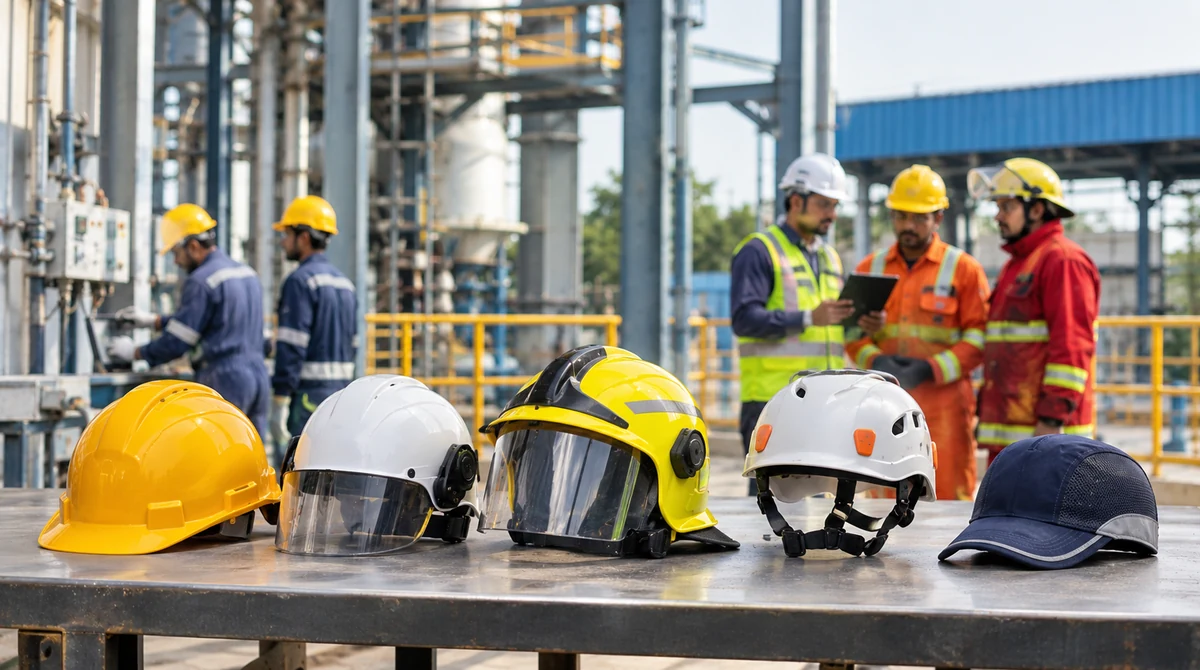
The five common categories discussed in this guide are general industrial helmets, electrical safety helmets, firefighting helmets, climbing helmets and bump caps. Each serves a different application and has specific limitations.
These categories describe common occupational head protection products. They are not five classifications defined under one Indian Standard.
1. General Industrial Safety Helmets
General industrial safety helmets are designed to protect workers against specified head impact hazards in industrial and construction environments. They typically consist of an outer shell and an internal suspension system.
The outer shell provides the protective structure. The suspension helps position the helmet on the worker’s head and maintains the designed clearance.
Common uses:
- Protection against impact from falling objects.
- Protection against accidental contact with fixed structures.
- Head protection in construction and manufacturing areas.
- Use in warehouses and material handling operations.
- Maintenance work in industrial facilities.
Typical applications:
General industrial helmets are commonly used by construction workers, factory operators, warehouse personnel, maintenance technicians and infrastructure teams.
For example, workers at a construction site may operate below scaffolding, lifting equipment and material storage areas. A suitable industrial helmet forms part of their required PPE.
What should buyers check?
- Applicable industrial helmet standard.
- Shell condition and construction.
- Suspension and adjustment system.
- Correct fit and wearing position.
- Product markings and certification documents.
- Compatibility with approved accessories.
In India, IS 2925:1984 is the standard reference for industrial safety helmets. Buyers should verify the latest BIS status and product certification before procurement.
2. Electrical Safety Helmets
Electrical safety helmets are selected for work environments where workers may face electrical hazards in addition to mechanical impact risks. Their suitability depends on the helmet’s tested electrical performance and intended application.
Electrical maintenance technicians, utility workers and personnel working near electrical installations may require this category of head protection.
Common uses:
- Electrical maintenance work.
- Utility and power distribution activities.
- Work near electrical installations.
- Selected industrial operations involving electrical hazards.
- Maintenance of electrical equipment and infrastructure.
Typical applications:
An electrical maintenance team may work around switchgear, distribution panels or other electrical equipment. The safety team must select a helmet that meets the electrical protection requirements identified in the risk assessment.
Not every industrial helmet provides the same level of electrical protection. Ventilation openings, metal accessories and unapproved attachments may affect suitability.
What should buyers check?
- Manufacturer’s stated electrical protection rating.
- Relevant test and certification documentation.
- Helmet design and permitted accessories.
- Compatibility with other electrical PPE.
- Restrictions on use and maintenance.
Do not assume that a helmet is electrically protective simply because it is made from a non-metallic material. Confirm its tested performance and intended use.
3. Firefighting and Fire-Rescue Helmets
Firefighting helmets are designed for fire and rescue environments where personnel may face heat, flames, falling debris and impact hazards. Their construction and accessories differ from those of general industrial helmets.
Firefighters and emergency response teams may need head protection suited to the specific fire or rescue activity.
Common uses:
- Firefighting operations.
- Emergency response activities.
- Rescue work in hazardous environments.
- Selected industrial fire response duties.
- Operations involving exposure to heat and falling debris.
Typical applications:
A fire response team at an industrial facility may enter an emergency area to support evacuation or firefighting operations. Its helmet must be designed for the hazards associated with the task.
Firefighting helmets may include features such as visors, neck protection and compatible communication accessories. The exact arrangement depends on the helmet model and its intended application.
In India, IS 2745:1983 is the standard reference for non-metal helmets for firemen and civil defence personnel. This is different from IS 2925, which covers industrial safety helmets.
What should buyers check?
- Applicable firefighting helmet standard.
- Heat and flame performance documentation.
- Impact protection requirements.
- Visor and neck protection compatibility.
- Manufacturer’s use and maintenance instructions.
- Suitability for the specific emergency response activity.
A general industrial helmet should not be treated as a firefighting helmet unless its certification and manufacturer documentation support that application.
4. Climbing and Work-at-Height Helmets
Climbing and work-at-height helmets are designed for activities where workers need head protection while moving on elevated structures, climbing routes or restricted access areas. Helmet retention is an important consideration during these activities.
Workers may need to bend, look upward, climb ladders or move around structures. A suitable retention system helps keep the helmet in its intended position.
Common uses:
- Telecommunication tower maintenance.
- Wind turbine access.
- Industrial climbing activities.
- Rope access work.
- Elevated structure inspection.
- Selected rescue and maintenance operations.
Typical applications:
A technician climbing a telecommunications tower may need head protection that remains secure during movement. The helmet should be selected according to the climbing activity and the manufacturer’s stated application.
Some climbing helmets include chin straps and accessory attachment points. These features do not automatically establish compliance with an industrial helmet or climbing helmet standard.
What should buyers check?
- Intended climbing or work-at-height application.
- Applicable product standard and certification.
- Retention system and chin strap design.
- Compatibility with hearing and eye protection.
- Fit during normal climbing movement.
- Manufacturer’s instructions for accessories.
Head protection is only one part of work-at-height safety. Workers may also need a suitable full body harness, connectors and an engineered fall protection system.
Explore full body harness range for equipment used in industrial work-at-height applications.
5. Bump Caps
Bump caps are lightweight head coverings designed to help protect workers against minor bumps from stationary objects. They are intended for low-level contact hazards rather than significant impact from falling objects.
They may be useful in workplaces where employees frequently move beneath low ceilings, shelves, machinery or fixed structures.
Common uses:
- Protection against minor head bumps.
- Work in low-clearance areas.
- Selected warehouse activities.
- Certain assembly operations.
- Maintenance work with minor contact hazards.
Typical applications:
A warehouse employee may move beneath storage structures or work around equipment with low overhead clearance. A bump cap may help reduce minor bump injuries in suitable conditions.
However, bump caps are not substitutes for industrial safety helmets where workers face falling-object or significant impact hazards.
What should buyers check?
- Intended application and limitations.
- Product construction and fit.
- Manufacturer’s care instructions.
- Compatibility with other PPE.
- Whether the workplace risk assessment permits a bump cap.
Do not assume that a bump cap meets IS 2925. Verify the product’s actual certification before use.
Comparison of the 5 Different Types of Helmets
The table below summarises the main differences between these five occupational head protection categories.
| Type of helmet | Main purpose | Common applications | Important consideration |
| General industrial helmet | Protection against specified industrial impact hazards | Construction, factories, warehouses | Verify IS 2925 certification where applicable |
| Electrical safety helmet | Head protection for specified electrical work conditions | Electrical maintenance, utilities | Confirm tested electrical performance |
| Firefighting helmet | Protection for fire and rescue activities | Fire response, emergency services | Verify firefighting standard and heat performance |
| Climbing helmet | Head protection during climbing and elevated access | Towers, rope access, wind turbines | Check retention system and intended application |
| Bump cap | Protection against minor bumps | Warehouses, low-clearance work areas | Not a substitute for an industrial safety helmet |
The categories are based on intended application, not a universal ranking of protection. A helmet should always match the actual workplace hazard.
How Do You Choose the Right Type of Safety Helmet?
The right type of safety helmet depends on the hazards, work activity, applicable standard and required compatibility with other PPE. Employers should complete a risk assessment before specifying equipment.
1. Identify the Workplace Hazard
Start by reviewing the tasks workers perform and the conditions around them.
Consider whether workers face:
- Falling objects.
- Impact against fixed structures.
- Electrical hazards.
- Heat or flame exposure.
- Low-clearance obstructions.
- Climbing and elevated access conditions.
- Flying particles or other face hazards.
Different hazards may require different equipment. A helmet designed for one application should not automatically be used for another.
2. Verify the Applicable Safety Standard
Check the standard relevant to the helmet’s intended use.
For industrial safety helmets in India, IS 2925:1984 is the key reference. Firefighting helmets have a separate Indian Standard reference, IS 2745:1983.
Buyers should verify the latest BIS status, product certification and manufacturer’s documentation. Do not rely only on a supplier’s verbal assurance.
For more information about protective equipment requirements, read our guide to Personal Protective Equipment (PPE) Standards in India.
3. Check the Helmet Fit
A helmet should sit securely on the worker’s head in the position specified by the manufacturer.
Check the following:
- Headband adjustment.
- Suspension condition.
- Correct wearing position.
- Chin strap adjustment, where fitted.
- Stability during normal movement.
A loose or incorrectly positioned helmet may not provide the intended protection.
4. Review Material and Construction
The shell material and construction should suit the helmet’s intended application.
Check the manufacturer’s documentation for material, limitations, cleaning instructions and environmental restrictions. Avoid selecting a helmet based only on appearance or weight.
5. Check Accessory Compatibility
Some workers need face shields, hearing protection, lamps or other attachments.
These accessories must be approved for the helmet model. Unauthorised drilling, cutting or modification can affect the helmet’s protective structure.
6. Consider Workplace Conditions
Outdoor and industrial environments may expose helmets to sunlight, moisture, chemicals, heat and dust.
Review the manufacturer’s instructions for storage, cleaning and replacement. Consider environmental exposure when setting inspection schedules.
7. Review Certification and Product Documentation
Before procurement, ask the supplier for relevant product documentation.
Verify:
- Product model and manufacturer.
- Applicable Indian or international standard.
- Certification details.
- Technical specifications.
- Intended applications and limitations.
- Inspection and maintenance instructions.
- Approved accessories.
This is particularly important when purchasing helmets for multiple departments or project locations.
What Safety Helmet Standards Apply in India?
The applicable safety helmet standard depends on the product category and its intended application. IS 2925:1984 covers industrial safety helmets, while IS 2745:1983 covers non-metal helmets for firemen and civil defence personnel.
IS 2925:1984: Industrial Safety Helmets
IS 2925:1984 is titled Industrial Safety Helmets. It provides requirements for industrial helmets used in relevant occupational environments.
The BIS product manual identifies tests and checks that include:
- Sizes and dimensions.
- Construction and workmanship.
- Mass.
- Shock absorption resistance.
- Penetration resistance.
- Flammability resistance.
- Heat resistance.
These checks help establish whether a product meets the relevant specification.
IS 2745:1983: Firefighting Helmets
IS 2745:1983 is the Indian Standard reference for non-metal helmets for firemen and civil defence personnel.
It applies to a different product category from general industrial helmets. Buyers should check the standard and certification applicable to the exact firefighting helmet model.
How Should Buyers Verify Certification?
Procurement teams should review the helmet’s marking and supporting documents before accepting a supply.
Check the standard number, manufacturer details, model identification and BIS licence information where applicable.
The BIS product manual and official product certification resources can help buyers understand the certification process. Consult the BIS product certification scheme for official information.
How Should Safety Helmets Be Inspected and Maintained?
Safety helmets should be inspected before use and maintained according to the manufacturer’s instructions. Damaged or unsuitable helmets should be removed from service.
Pre-Use Inspection
Workers should check:
- The shell for cracks, dents or deformation.
- The suspension for damaged or missing parts.
- The headband and adjustment mechanism.
- Chin strap condition, where fitted.
- Product markings and identification.
- Unapproved modifications or accessories.
A helmet with visible damage should not remain in use until its condition has been assessed.
Periodic Inspection
A designated person should inspect helmets at intervals set by the manufacturer and the organisation’s PPE procedure.
Inspection records can include the helmet model, identification details, inspection date, condition and action taken.
The inspection should consider the helmet’s exposure to sunlight, heat, chemicals and other environmental conditions.
When Should a Helmet Be Replaced?
Replace a helmet when the manufacturer requires it or when inspection identifies damage or deterioration.
Common reasons for replacement include:
- Cracks or deformation in the shell.
- Damaged or broken suspension components.
- Faulty adjustment mechanisms.
- Damaged chin straps or attachments.
- Exposure beyond the manufacturer’s stated limits.
- An impact event where the manufacturer requires replacement.
- Uncertain product history or identification.
There is no single replacement period that applies to every helmet. Follow the manufacturer’s stated service life and replacement instructions.
Common Mistakes to Avoid When Selecting Safety Helmet Types
Incorrect selection and poor maintenance can reduce the protection expected from a helmet. Employers and workers should avoid these common mistakes.
Choosing Only by Colour
Helmet colours are often used to identify departments, roles or visitor categories. However, colour does not establish certification or protective performance.
Select the helmet according to the workplace hazard and applicable standard.
Using a Bump Cap for Falling-Object Hazards
Bump caps are intended for minor bump hazards. They should not replace an industrial safety helmet where falling objects or significant impact risks exist.
Assuming Every Helmet Provides Electrical Protection
Electrical protection depends on the helmet’s design and tested performance. Check the product documentation before using it near electrical hazards.
Also read: Safety Helmet Colour Code in India
Ignoring Helmet Fit
A helmet that moves excessively or sits incorrectly may not provide the intended protection. Workers should adjust the suspension and headband according to manufacturer instructions.
Attaching Unapproved Accessories
Unapproved accessories and modifications can affect the helmet’s construction or fit. Use only compatible attachments permitted by the manufacturer.
Continuing to Use Damaged Equipment
Cracks, damaged suspension components and other defects require attention. Remove questionable helmets from service and follow the manufacturer’s assessment or replacement instructions.
Frequently Asked Questions About Types of Safety Helmets
What are the five main types of safety helmets?
Five common occupational categories are general industrial helmets, electrical safety helmets, firefighting helmets, climbing helmets and bump caps. Each serves a different application. Selection depends on the hazard, certification and manufacturer instructions.
Which type of safety helmet is used in construction?
General industrial safety helmets are commonly used in construction environments where workers face falling-object and impact hazards. The helmet should meet the applicable industrial safety requirements. Employers should also assess whether additional head or face protection is needed.
What is the difference between an industrial helmet and a bump cap?
An industrial helmet is designed for specified workplace impact hazards, including falling-object risks covered by its certification. A bump cap is intended for minor bumps against stationary objects. It cannot replace an industrial helmet where significant impact hazards exist.
Which safety helmet is suitable for electrical work?
Workers should use a helmet whose tested electrical performance matches the identified workplace hazard. Not every industrial helmet provides electrical protection. Check the model’s certification and manufacturer’s instructions before use.
Which IS standard applies to industrial safety helmets in India?
IS 2925:1984 is the Indian Standard reference for industrial safety helmets. Buyers should verify the current BIS status and the certification of the exact product model before procurement.
Which standard applies to firefighting helmets in India?
IS 2745:1983 is the Indian Standard reference for non-metal helmets for firemen and civil defence personnel. Buyers should confirm the applicable requirements and certification for the selected firefighting helmet.
Are climbing helmets the same as industrial safety helmets?
Not necessarily. Climbing helmets are selected for climbing and elevated access activities, while general industrial helmets address their specified industrial hazards. The correct choice depends on the application and the helmet’s certification.
Can one helmet be used for every industrial activity?
No. Different activities create different hazards and may require different helmet designs. Employers should select equipment through a workplace risk assessment and verify the manufacturer’s intended application.
How often should safety helmets be inspected?
Workers should inspect helmets before use and follow the manufacturer’s instructions for periodic inspection. A designated person should also review their condition at the intervals established by the organisation. Damaged helmets should be removed from service.
Can workers use face shields with industrial safety helmets?
Some helmets support compatible face shields, but not every shield fits every helmet. Check the manufacturer’s approved accessory list and installation instructions. The face and eye protection selected must also match the workplace hazard.
Conclusion
Understanding the different types of safety helmets helps employers select suitable head protection for their workforce. General industrial, electrical, firefighting and climbing helmets serve distinct applications, while bump caps address only minor bump hazards.
The correct selection depends on the work environment, risk assessment, applicable standard, fit and compatibility with other PPE. Employers should verify product certification, train workers in correct use and maintain a regular inspection process.
For industrial safety helmets in India, IS 2925:1984 is the key standard reference. Firefighting helmets have a separate reference under IS 2745:1983. Procurement teams should verify the latest BIS information before placing orders.
A suitable helmet is one part of a wider workplace safety programme. It should work alongside safe work procedures, engineering controls, worker training and other task-specific protective equipment.
Need Help Planning Head and Fall Protection for Your Workplace?
Choosing the right helmet is one part of workplace PPE planning. Workers operating at height may also need suitable harnesses, connectors and engineered fall protection systems.
Indian Inovatix Ltd., Ahmedabad, Gujarat, India, manufactures fall protection and height safety equipment for industrial and infrastructure applications.
Speak with the team about the equipment requirements for your workplace or project.
Call us at +91-8849452638 or write to info@indianinovatix.com to get started.


Talk to Our Safety & Protection Specialists
Have questions or need guidance? Our experts can help you choose the most reliable and high-performance safety solutions tailored to your industry and site requirements.
-

- Call Us +91-8849452638
Need Help Determining the Right Fall Protection for You?
With our vast experience, our experts will assist you in selecting the most relevant system for your needs.