November 20, 2026
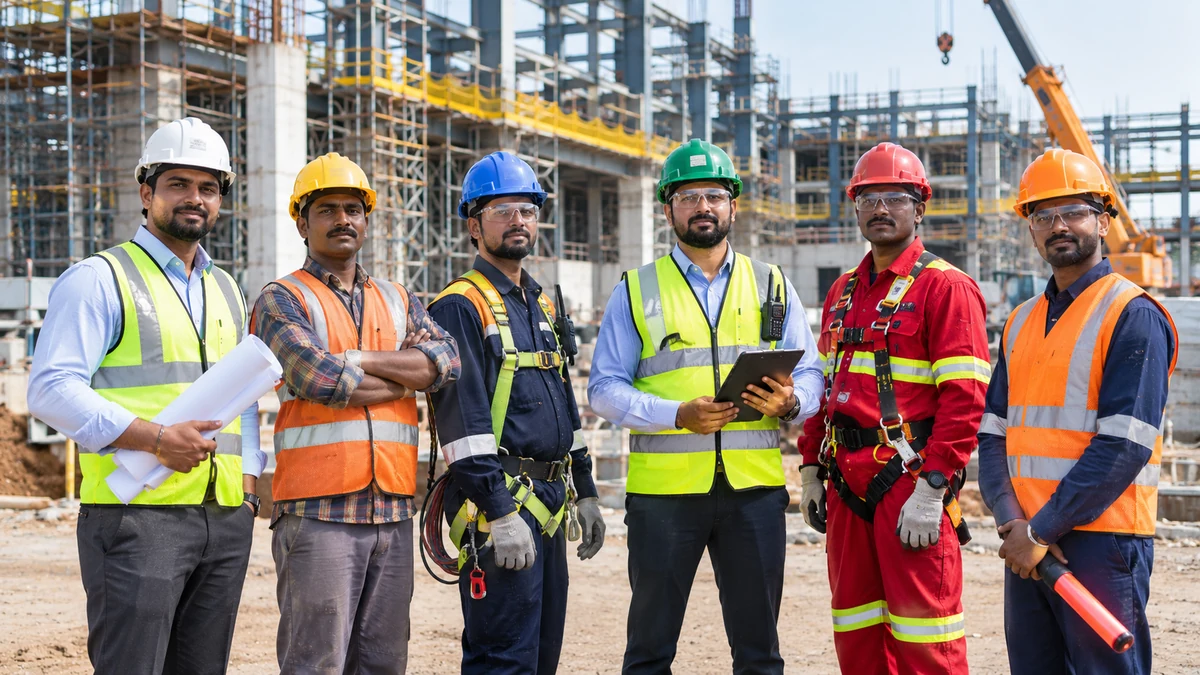
Walk onto a construction site in India and you may notice workers wearing helmets in different colours. Some wear white, others yellow, blue, green or red. These colours often help identify a person’s role, responsibilities or work group.
The safety helmet colour code is a visual identification system used by many construction sites, factories and infrastructure projects. It helps workers recognise supervisors, engineers, electricians, safety personnel, contractors and visitors.
However, one important point needs clarification. India does not have one universal helmet colour chart that every workplace must follow. Colour assignments can differ between companies, contractors and project sites. The site’s safety policy determines what each colour represents.
This guide explains the common helmet colour meaning in India, the uses of different safety helmet colours, examples from project safety documents and how organisations can establish a consistent colour identification system.
Key Takeaways
- A safety helmet colour code helps identify workers, supervisors, technical staff and visitors.
- White commonly identifies engineers, supervisors or management personnel.
- Yellow is frequently used for general workers and labourers.
- Blue, green, red and orange can identify technical staff, safety personnel, emergency teams or traffic marshals.
- Helmet colour assignments vary between projects and organisations in India.
- Colour does not determine a helmet’s protective performance or certification.
- Employers should document the colour scheme in their site safety policy and explain it during worker induction.
What Is a Safety Helmet Colour Code?
A safety helmet colour code is a workplace identification system that assigns different helmet colours to specific worker roles, departments or responsibilities. It helps people recognise who is working in a particular area.
Construction sites often involve several groups working at the same time. These may include engineers, contractors, electricians, machine operators, labourers, safety officers and visitors.
Identifying each group can be difficult, particularly on large projects. A colour-based system makes identification easier without requiring workers to check identification cards or ask every person’s designation.
For example, a site may assign white helmets to engineers and yellow helmets to general workers. A green helmet may identify the safety team.
The exact assignment depends on the site’s rules. Another project may use the same colours differently.
Why Do Workplaces Use Helmet Colour Coding?
A well-defined helmet colour system supports site coordination and worker identification.
Common reasons include:
- Quick role identification: Workers can recognise supervisors, engineers and safety personnel.
- Better site coordination: Teams can identify the right person for work-related questions.
- Visitor identification: A separate helmet colour or sticker helps distinguish visitors from regular workers.
- Emergency communication: Staff can identify designated response personnel more easily when the site’s scheme includes them.
- Contractor management: Large projects can distinguish employees from different contractors and subcontractors.
- Site discipline: A documented system supports consistent PPE identification during daily operations.
Helmet colours are an identification aid. They do not replace site induction, identity cards, supervision or other safety procedures.
What Is the Safety Helmet Colour Code in India?
The safety helmet colour code in India varies by workplace and project. However, several colours are commonly used to identify different roles on construction and industrial sites.
The following table describes common industry conventions. It is a practical reference, not a mandatory national colour chart.
| Helmet colour | Commonly assigned role | Typical workplace use |
| White | Engineers, supervisors, managers and site in-charge | Site supervision and project management |
| Yellow | General workers, labourers and helpers | Construction and routine site activities |
| Blue | Electricians, technicians and machine operators | Technical and maintenance work |
| Green | Safety officers and EHS personnel | Workplace safety monitoring |
| Red | Fire wardens and emergency response teams | Emergency preparedness and response |
| Orange | Traffic marshals, signalers and selected lifting teams | Traffic and movement coordination |
| Grey | Visitors, consultants or inspectors | Temporary site access |
| Brown | Welders and workers handling certain hot-work activities | Welding and selected industrial tasks |
The assignments above are not consistent across every Indian workplace. For example, some projects assign orange helmets to security guards and traffic marshals, while other sites may use different colours for technical workers.
The site safety plan must therefore remain the final reference.
What Does Each Safety Helmet Colour Mean?
Each helmet colour can represent a different workplace role. Understanding these common conventions helps workers identify people and responsibilities across construction and industrial environments.
1. White Safety Helmet: Engineers, Supervisors and Managers
<text-placeholder></text-placeholder>
White helmets are commonly assigned to engineers, supervisors, project managers and senior site personnel.
These individuals may coordinate construction activities, review work progress, supervise contractors and communicate project requirements.
Typical users include:
- Site engineers.
- Project managers.
- Construction supervisors.
- Architects.
- Consultants.
- Client representatives.
- Senior management personnel.
On some projects, visitors also receive white helmets with a separate visitor sticker. Other projects use a different colour for visitors.
Common use: White helmets help workers identify personnel responsible for supervision, coordination and project decisions.
2. Yellow Safety Helmet: General Workers and Labourers
Yellow helmets are widely used for general workers and labourers at construction and industrial sites.
These workers may perform activities such as material handling, masonry, loading, unloading, housekeeping and other site operations.
Typical users include:
- Construction labourers.
- Helpers.
- General site workers.
- Material handling teams.
- Selected equipment operators.
Yellow helmets are often used for the general workforce because they are easy to identify in busy work areas.
Common use: Yellow helmets help distinguish general workers from supervisory and technical personnel.
3. Blue Safety Helmet: Electricians and Technical Workers
Blue helmets are commonly assigned to electricians, technicians and selected machine operators.
These workers may perform electrical installation, equipment maintenance, troubleshooting and technical operations.
Typical users include:
- Electricians.
- Electrical maintenance technicians.
- Mechanical technicians.
- Machine operators.
- Selected skilled trades.
Some organisations use blue helmets for subcontractor engineers and supervisors instead. This is why workers should check the project’s official colour chart.
Common use: Blue helmets can help identify technical personnel responsible for specialised work.
4. Green Safety Helmet: Safety Officers and EHS Personnel
Green helmets are commonly associated with safety officers and EHS personnel on many construction and industrial sites.
These professionals monitor workplace safety procedures, conduct inspections and support risk management activities.
Typical users include:
- Safety officers.
- EHS executives.
- Safety inspectors.
- HSE supervisors.
- Occupational safety personnel.
Their responsibilities may include checking PPE compliance, reviewing work permits, identifying hazards and coordinating safety briefings.
Common use: Green helmets help workers identify personnel responsible for workplace safety monitoring.
5. Red Safety Helmet: Fire and Emergency Response Teams
Red helmets are often used for fire wardens, emergency response personnel or designated firefighting teams.
These individuals may support emergency preparedness, evacuation coordination and initial emergency response according to their training and assigned responsibilities.
Typical users may include:
- Fire wardens.
- Emergency response personnel.
- Designated firefighting teams.
- Selected emergency coordinators.
However, some Indian project specifications assign red helmets to electricians or electrical staff. The role must therefore be confirmed through the site’s safety policy.
Common use: Red helmets can identify designated emergency personnel where the project assigns this meaning.
6. Orange Safety Helmet: Traffic Marshals and Signalers
Orange helmets are used on some projects for traffic marshals, security guards, signalers and workers involved in movement coordination.
These personnel may manage vehicle movement, guide equipment operators and help control access around active work areas.
Typical users include:
- Traffic marshals.
- Security guards.
- Banksmen and signalers.
- Selected lifting operation teams.
- Personnel managing vehicle movement.
Some projects may use orange for other roles, including electricians or specialised workers.
Common use: Orange helmets help identify personnel involved in site traffic and movement coordination where the colour scheme assigns this role.
7. Grey Safety Helmet: Visitors, Consultants and Inspectors
Grey helmets may be assigned to visitors, consultants, auditors and inspecting personnel.
These individuals may enter a construction or industrial site for meetings, inspections, project reviews or technical discussions.
Typical users include:
- Site visitors.
- External consultants.
- Auditors.
- Client representatives.
- Inspection personnel.
Some sites use white helmets with a visible visitor sticker instead of grey helmets.
Common use: Grey helmets can help site teams distinguish temporary visitors from regular employees.
8. Brown Safety Helmet: Welders and Hot-Work Personnel
Some workplaces use brown helmets to identify welders and workers involved in selected hot-work activities.
These workers may perform welding, fabrication and metalworking tasks.
However, brown is not a universal assignment. A helmet’s colour does not establish its suitability for welding or heat exposure.
Workers must use appropriate helmets, face shields, eye protection and other PPE based on the specific task and manufacturer’s instructions.
Common use: Brown may identify selected welding or hot-work personnel under a company-specific colour policy.
Is There a Mandatory Safety Helmet Colour Code in India?
There is no single universal helmet colour assignment that applies to every Indian construction site and industrial workplace. Organisations and project authorities can establish their own colour schemes through site safety requirements.
It is important to distinguish between two things:
- Helmet performance standards: These address the helmet’s construction, testing and protective performance.
- Helmet colour allocation: This identifies a worker’s role or group under a workplace policy.
IS 2925:1984 is the Indian Standard reference for industrial safety helmets. It addresses industrial helmet requirements, not a universal assignment of colours to job roles.
Project documents provide useful examples of how colour schemes can differ.
For instance, a Ministry of External Affairs tender document specifies white for MEA staff, grey for designers and consultants, violet for main contractor engineers and supervisors, blue for subcontractor engineers and supervisors, red for electricians, green for safety professionals, orange for security guards and traffic marshals, and yellow for workmen. It also specifies white helmets with a visitor sticker for visitors.
A Dholera Special Investment Region project procedure uses a similar role-based scheme for its contractors. These documents demonstrate that colour assignments can be project-specific.
The practical lesson is simple: never assume that a helmet colour has the same meaning at every site. Follow the approved safety helmet colour chart for the project.
Does Helmet Colour Affect Safety or Protection?
No. Helmet colour alone does not determine the protective performance of a safety helmet. Protection depends on the helmet’s design, material, construction, applicable standard, condition and correct use.
For example, a white and a yellow helmet from the same certified model range do not become different protection classes simply because their colours differ.
Before selecting a helmet, safety officers and procurement teams should verify:
- Applicable industrial safety standard.
- Product certification and markings.
- Shell material and construction.
- Suspension system.
- Correct size and adjustment.
- Compatibility with approved accessories.
- Manufacturer’s inspection and replacement instructions.
For industrial helmets in India, buyers should check the applicable requirements under IS 2925 and verify the product’s BIS certification where required.
For a broader understanding of PPE requirements, read our guide to Personal Protective Equipment (PPE) Standards in India.
How Should Companies Create a Safety Helmet Colour Code?
Companies should establish a clear helmet colour policy based on workforce roles, contractor arrangements and site requirements. The scheme should be documented and communicated before workers begin their activities.
1. Identify All Workforce Categories
Start by listing the groups that work at the site.
These may include:
- Engineers and supervisors.
- General workers and labourers.
- Electrical and mechanical technicians.
- Safety and EHS personnel.
- Contractors and subcontractors.
- Security and traffic marshals.
- Visitors and consultants.
- Emergency response personnel.
The list should reflect the actual workforce structure rather than copying another site’s chart.
2. Assign Colours to Specific Roles
Choose colours that are easy to distinguish and practical to manage.
Avoid assigning the same colour to different groups if it could create confusion. If the project requires different contractor categories, consider whether stickers or other identification methods would work better.
3. Prepare an Official Colour Chart
Create a simple chart showing each helmet colour and its assigned role.
Display it at:
- Main site entry gates.
- Security offices.
- Site induction areas.
- Safety notice boards.
- Contractor briefing locations.
- Relevant work zones.
The chart should be easy to read and available to workers and visitors.
4. Coordinate With Contractors
Large infrastructure projects may involve several contractors and subcontractors.
The principal contractor should communicate the colour scheme to all participating organisations. Otherwise, one colour may represent different roles across teams.
A common project-wide system makes identification easier.
5. Include Colour Coding in Worker Induction
Explain the helmet colour policy during site induction.
Workers should know what their helmet colour means, which personnel they should approach and what identification visitors must carry.
Repeat the information during contractor briefings when the workforce or site arrangements change.
6. Keep Visitor Helmets Available
Maintain suitable helmets for authorised visitors at the entry point.
If the site uses white helmets with visitor stickers or a separate grey colour, ensure the arrangement is clearly explained to security staff and visitors.
Visitors must also receive the other PPE required for the areas they will enter.
7. Review the Policy Regularly
Review the colour chart when the project changes contractors, workforce categories or site responsibilities.
Remove outdated charts and communicate revised assignments to all affected personnel.
A documented policy prevents confusion as the project develops.
Common Mistakes in Safety Helmet Colour Coding
A helmet colour scheme only works when workers understand and follow it. Poor communication or inconsistent assignments can make the system confusing.
Avoid these common mistakes:
Assuming One Colour Has the Same Meaning Everywhere
A green helmet may identify a safety officer on one site and a different role on another.
Always check the project’s approved colour chart.
Changing Colours Without Informing Workers
Unannounced changes can cause confusion, especially when several contractors operate together.
Communicate policy changes through induction, briefings and updated notice boards.
Using Colour as the Only Identification Method
Helmet colour does not provide a person’s name, employer, training status or authorisation.
Use identity cards, badges, stickers or other approved identification methods where necessary.
Ignoring Helmet Certification
A correctly coloured helmet may still be unsuitable if it does not meet the required specification.
Check the applicable standard, product markings and certification documents.
Treating Colour as a Replacement for Task-Specific PPE
An electrician’s blue helmet does not automatically provide electrical protection. A welder’s brown helmet does not automatically provide welding protection.
Select task-specific PPE according to the hazards and product documentation.
Safety Helmet Colour Code vs Helmet Safety Standards
Helmet colour coding and helmet safety standards serve different purposes. Colour coding identifies workplace roles, while safety standards define product requirements and performance.
| Factor | Helmet colour code | Helmet safety standard |
| Main purpose | Identifies roles or work groups | Defines product requirements |
| Who establishes it? | Employer, contractor or project authority | Standards organisation |
| What does it cover? | Role identification | Construction, testing and performance |
| Does it determine protection? | No | Helps establish specified protective performance |
| Example | White for engineers under a site policy | IS 2925 for industrial safety helmets |
| Can it vary? | Yes, between workplaces | Depends on the applicable standard and its revision |
Both are relevant to workplace PPE management, but they should not be confused.
Frequently Asked Questions About Safety Helmet Colours
What is the safety helmet colour code in India?
The safety helmet colour code in India is a role-identification system used by individual workplaces and projects. White, yellow, blue, green and red are common colours, but their assignments can vary. Always follow the site’s approved safety policy.
What does a white safety helmet mean?
White helmets commonly identify engineers, supervisors, managers and senior site personnel. Some projects also issue white helmets to visitors with a separate visitor sticker. The exact assignment depends on the project.
What does a yellow safety helmet mean?
Yellow helmets are commonly used by general workers, labourers and helpers. They help distinguish the general workforce from supervisory and technical teams. Some organisations may assign yellow to other groups.
What does a blue safety helmet mean?
Blue helmets commonly identify electricians, technicians and selected machine operators. However, some project specifications use blue for subcontractor engineers and supervisors. Check the official site colour chart before making assumptions.
What does a green safety helmet mean?
Green helmets are commonly assigned to safety officers, EHS executives and safety inspectors. These personnel monitor workplace safety procedures and PPE compliance. The assignment can differ between projects.
What does a red safety helmet mean?
Red helmets are often used for fire wardens or emergency response teams. Some Indian project documents assign red helmets to electricians instead. The site’s safety policy determines the correct meaning.
What does an orange safety helmet mean?
Orange helmets may identify traffic marshals, security guards, signalers or selected lifting teams. The exact role depends on the project’s colour scheme. Orange should not be assumed to mean the same role everywhere.
What colour helmet should visitors wear at a construction site?
Visitors may receive grey helmets or white helmets with a visitor sticker. The arrangement depends on the site’s safety policy. Visitors must receive all other PPE required for the areas they enter.
Is there an IS standard for helmet colours in India?
IS 2925:1984 is the Indian Standard reference for industrial safety helmets. It addresses helmet requirements rather than establishing a universal colour-to-role chart for Indian workplaces. Employers and project authorities define their own identification schemes.
Does a white helmet provide more protection than a yellow helmet?
No. Colour alone does not determine protection. The helmet’s construction, applicable standard, certification, condition and correct use determine its protective suitability.
Can companies create their own helmet colour code?
Yes. Companies and project authorities can establish a colour scheme based on their workforce and operational requirements. They should document the assignments, display the chart and explain it during site induction.
Conclusion
The safety helmet colour code helps construction sites, factories and industrial facilities identify workers according to their roles and responsibilities. White, yellow, blue, green, red and orange are frequently used, but their meanings are not identical across every workplace.
Companies should establish a clear colour policy, coordinate it with contractors and explain it during worker induction. They should also use identity cards and other identification methods where colour alone is insufficient.
Most importantly, helmet colour should never be confused with protective performance. A suitable industrial helmet must meet the applicable requirements, fit correctly and remain in serviceable condition.
A consistent colour identification system, combined with certified PPE and effective site safety procedures, supports better workplace coordination and safety management.
Need Help With Workplace Height Safety Equipment?
Helmet colour coding helps identify workers, but complete workplace protection requires suitable PPE and properly planned safety systems.
Indian Inovatix Ltd., Ahmedabad, Gujarat, India, manufactures fall protection equipment and engineered height safety systems for industrial and infrastructure applications.
Explore the Indian Inovatix range of fall protection and height safety equipment for industrial and work-at-height applications.
Call us at +91-8849452638 or write to info@indianinovatix.com to get started.

Categories
Latest Post
- November 20, 2026 Safety Helmet Colour Code in India: Meaning and Uses of Different Helmet Colours
- November 18, 2026 Complete Guide to Safety Helmets in India: Types, Uses, Standards and Safety Requirements
- November 16, 2026 Roof Fall Protection Systems in India: Types, Selection and Compliance for Industrial and PEB Roofs

Corporate Profile
Download CatalogueTalk to Our Safety & Protection Specialists
Have questions or need guidance? Our experts can help you choose the most reliable and high-performance safety solutions tailored to your industry and site requirements.
-

- Call Us +91-8849452638
Need Help Determining the Right Fall Protection for You?
With our vast experience, our experts will assist you in selecting the most relevant system for your needs.