April 28, 2026
Unsafe work at height remains one of the leading causes of industrial accidents across India. Construction sites, telecom towers, and plant maintenance operations continue to face fall risks due to improper equipment selection.
The confusion between belts and harnesses often leads to unsafe practices. A waist belt may appear simple, but it does not protect against serious fall injuries. This gap results in compliance failures, penalties under the Factories Act 1948, and worker injuries.
Full body harness vs safety belt is not just a product comparison. It is a critical safety decision. Indian Inovatix Ltd., Ahmedabad, Gujarat, India, designs certified fall protection systems that meet EN and IS standards and protect workers across industries.
What is a Full Body Harness and How Does It Work
A full body harness is a fall arrest PPE system that distributes impact forces across the shoulders, chest, and thighs, preventing serious injury during a fall.
A full body harness includes multiple attachment points such as dorsal and chest D-rings. It connects to lifelines or anchorage systems and reduces arrest force to safe levels as per EN 361 standards.
Key components include:
- Shoulder straps for upper body load distribution
- Leg straps to prevent downward slipping
- D-ring for fall arrest connection
- Adjustable buckles for secure fit
Indian Inovatix Ltd. manufactures harnesses tested for high load capacities. Typical breaking strength exceeds 15 kN, meeting EN and ANSI requirements.
A harness ensures the worker remains upright after a fall, reducing suspension trauma risk. This is critical in industries such as oil and gas, telecom, and construction.
Why is a Full Body Harness Mandatory for Fall Arrest
A full body harness is mandatory for fall arrest because it safely distributes forces and prevents internal injuries, unlike belts which concentrate force on the abdomen.
According to IS 3521 safety standards and EN 361 certification, fall arrest systems must include a full body harness. Waist belts are not approved for arresting falls.
In high-risk environments such as ISRO facility maintenance projects, Indian Inovatix systems are deployed with certified harnesses to ensure compliance and worker safety.
This requirement is enforced during audits and inspections under the Factories Act 1948.
What is a Safety Belt and Where is it Used
A safety belt is a waist-mounted positioning device that supports a worker in a fixed position but does not provide fall arrest protection.
Safety belts are designed for work positioning, not fall protection. They are typically used in controlled environments where fall risk is minimal.
Common applications include:
- Pole work in electrical maintenance
- Tree climbing in controlled conditions
- Positioning tasks with secondary fall protection
Safety belts apply force directly to the abdomen during a fall. This can cause severe internal injuries. For this reason, they are no longer accepted for fall arrest applications.
Indian regulations and global standards discourage their use for any fall risk scenario.
Why Are Safety Belts Restricted in Modern Safety Standards
Safety belts are restricted because they do not distribute fall forces and can cause serious injury during a fall.
Standards such as OSHA and EN explicitly prohibit belts for fall arrest. IS guidelines align with this approach in India.
Risks associated with safety belts include:
- Concentrated force on the abdomen
- Risk of spinal injury
- No upper body support
- Increased chance of fatality during free fall
Modern safety systems require full body harnesses combined with lifelines or anchor systems.
Full Body Harness vs Safety Belt: Key Differences
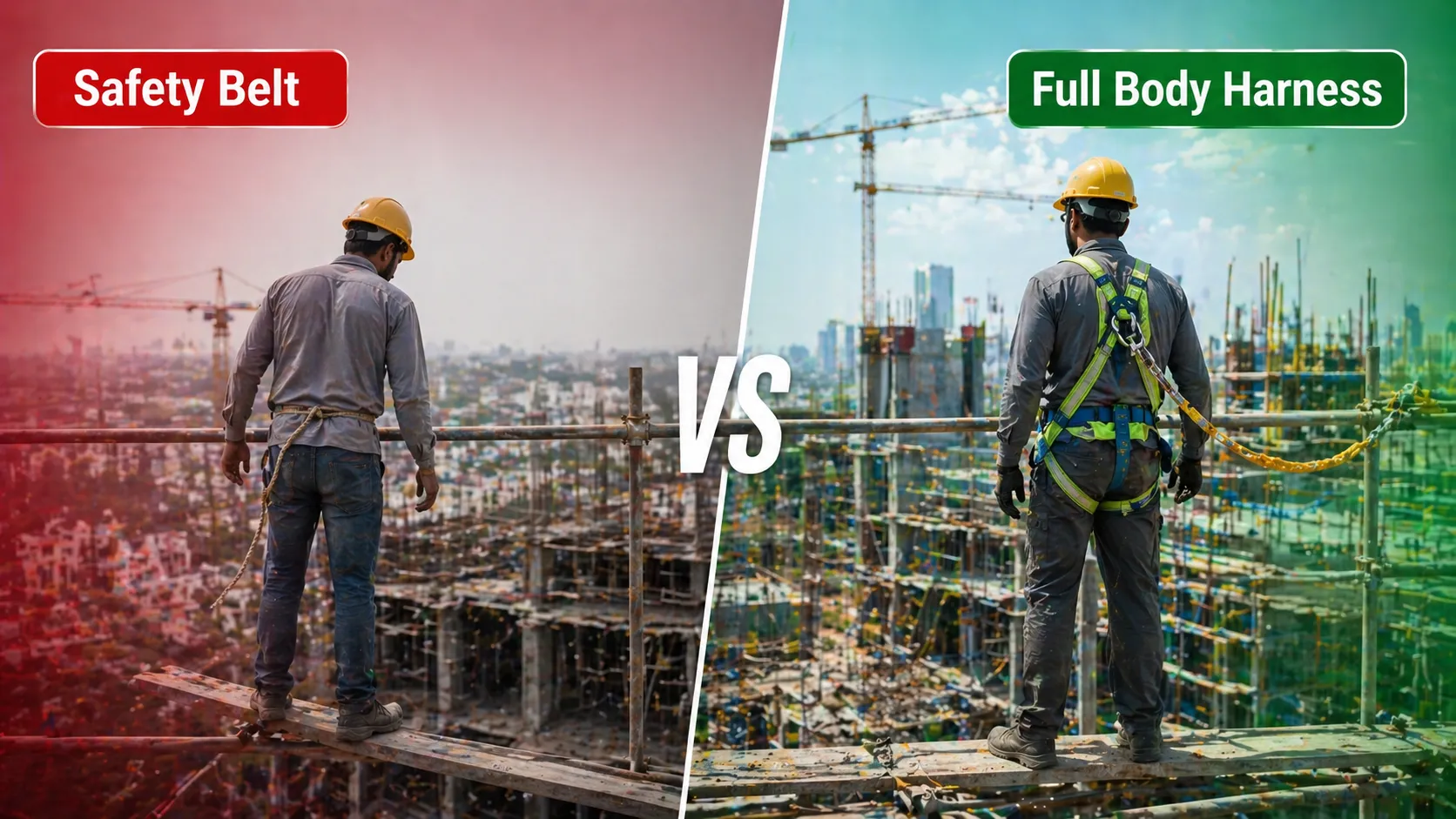
Full body harness and safety belt differ in function, safety level, and compliance with legal standards.
| Parameter | Full Body Harness | Safety Belt |
| Purpose | Fall arrest | Work positioning |
| Force distribution | Across body | Waist only |
| Compliance | EN 361, IS 3521 | Not allowed for fall arrest |
| Injury risk | Low when used correctly | High during fall |
| Use cases | Construction, telecom, oil and gas | Limited positioning tasks |
This comparison highlights why harnesses are the standard choice across industries.
Legal Requirements in India for Fall Protection Equipment
Indian law mandates certified fall protection systems for work at height under the Factories Act 1948 and relevant IS standards.
Employers must ensure that workers are equipped with proper PPE. This includes full body harnesses for any fall risk above defined height thresholds.
Key legal requirements include:
- Use of certified PPE compliant with IS or EN standards
- Proper anchorage systems for fall arrest
- Worker training and inspection of equipment
- Documentation for safety audits
Non-compliance can result in penalties, project shutdowns, and legal liability.
Which Standard Applies to Harnesses in India
EN 361 and IS 3521 standards apply to full body harnesses used in fall protection systems in India.
These standards define:
- Load-bearing capacity
- Design requirements
- Testing procedures
- Marking and certification
Procurement teams must verify certifications before purchasing equipment. Using uncertified gear can lead to compliance failure.
When Should You Choose a Full Body Harness
A full body harness should be used whenever there is a risk of falling from height, regardless of industry.
Industries requiring harnesses include:
- Construction and infrastructure
- Telecom tower installation
- Oil and gas maintenance
- Industrial plant operations
Can a Safety Belt Ever Replace a Harness
A safety belt cannot replace a harness in any fall arrest scenario because it does not provide adequate protection. Belts may only be used for positioning tasks where fall risk is eliminated. Even in such cases, secondary fall protection is recommended.
Safety officers must evaluate risk before approving any equipment.
Specification Insight: Full Body Harness
Below is a typical specification reference for an industrial full body harness:
| Specification | Value |
| Material | Polyester webbing |
| Breaking strength | 15 kN or higher |
| D-ring type | Forged alloy steel |
| Certification | EN 361, ANSI |
| Weight capacity | Up to 140 kg |
Indian Inovatix manufactures harnesses in a 33,000 sq ft facility in Ahmedabad, ensuring consistent quality and testing.
Key Takeaways
- Full body harness vs safety belt is a safety-critical comparison
- Harnesses are mandatory for fall arrest under IS and EN standards
- Safety belts are restricted to positioning tasks only
- Legal compliance under the Factories Act 1948 requires certified equipment
- Indian Inovatix Ltd. provides tested systems protecting over 500,000 workers
Conclusion
Choosing between a harness and a belt is not optional. It directly impacts worker safety and regulatory compliance. A full body harness ensures safe force distribution and meets legal requirements across industries.
Indian Inovatix Ltd., Ahmedabad, Gujarat, India, stands as a manufacturer, supplier, and specialist in fall protection systems. With certified products and nationwide installations, it supports safe and compliant operations.
Equip Your Workforce with Certified Protection
Unsafe height work leads to irreversible consequences.
Request a site assessment from Indian Inovatix Ltd. and ensure your systems meet legal standards.
FAQ
What is the main difference between a harness and a safety belt?
A harness distributes fall forces across the body, while a safety belt applies force to the waist. Harnesses are used for fall arrest. Belts are only for positioning tasks.
Is a safety belt allowed for fall protection in India?
No. Safety belts are not allowed for fall arrest under IS and EN standards. A full body harness is required for compliance.
Why is a full body harness safer?
It spreads impact forces across stronger body parts. This reduces injury risk and keeps the worker upright after a fall.
What standard applies to harnesses in India?
EN 361 and IS 3521 standards apply. These define testing, load capacity, and design requirements.
Can safety belts be used in construction sites?
No. Construction work involves fall risk, so only full body harness systems are allowed.
How often should harnesses be inspected?
Harnesses should be inspected before every use and periodically by a competent person as per safety guidelines.
What industries require full body harness systems?
Construction, telecom, oil and gas, and industrial maintenance require harness systems for safety compliance.
Is full body harness vs safety belt important for audits?
Yes. Using the wrong equipment can lead to audit failure and penalties under the Factories Act 1948.
Are harness systems required in Ahmedabad industrial zones?
Yes. Industrial operations in Ahmedabad must comply with national safety laws and standards.


Talk to Our Safety & Protection Specialists
Have questions or need guidance? Our experts can help you choose the most reliable and high-performance safety solutions tailored to your industry and site requirements.
-

- Call Us +91-8849452638
Need Help Determining the Right Fall Protection for You?
With our vast experience, our experts will assist you in selecting the most relevant system for your needs.